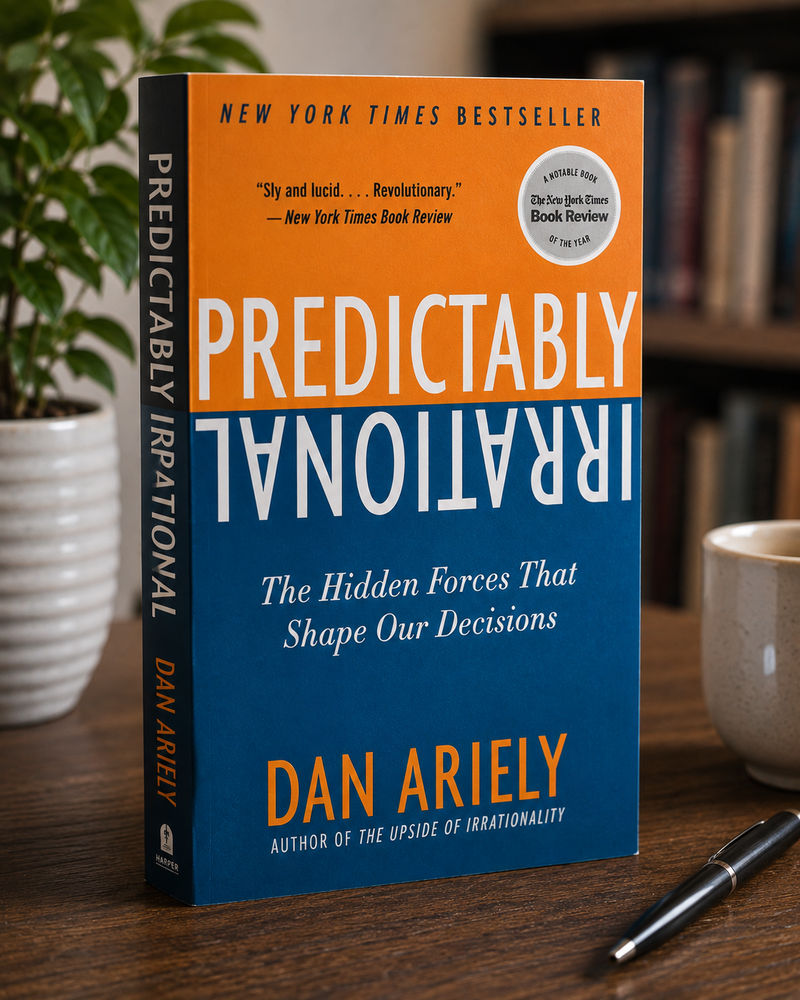
Predictably Irrational by Dan Ariely: The Complete, Easy-to-Understand Summary
A behavioral economics classic built on one reassuring twist: we're not irrational at random — we're irrational in the exact same ways, over and over, which means those patterns can actually be studied.
Quick thought experiment: a magazine offers you three subscription options — web-only for one price, print-only for a much higher price, or print-plus-web for that exact same higher price. Nobody in their right mind would pick print-only when the combo costs the same. So why include it at all? Dan Ariely noticed this real pricing page and ran the experiment on his own students: with all three options on the table, most people picked the combo. Remove the "useless" print-only option, and preferences flipped entirely toward the cheaper web-only plan. Nothing about the actual value of either option had changed — only the decoy sitting next to it. That single, small manipulation is the whole thesis of Predictably Irrational in miniature: our choices are shaped by comparison, context, and emotion far more than by the sober arithmetic we assume we're doing.
- Core concept: our irrationality isn't random — it follows consistent, predictable patterns, which is exactly what makes it possible to study and design around.
- Relativity: we rarely judge value on its own; we compare options against each other, so a strategically placed "decoy" can flip which option looks best.
- Anchoring: an arbitrary first number we encounter quietly sets the scale for everything we're later willing to pay, even when we know it was arbitrary.
- The cost of zero: "free" isn't just a low price — it's its own emotional category, capable of making us pick a worse option simply because it costs nothing.
- Social vs. market norms: mixing "as a favor" with "for money" changes the entire nature of an exchange, and rarely for the better.
The Core Idea
Dan Ariely's Predictably Irrational opens by challenging a basic assumption of classical economics: that people, given the information, make rational decisions in their own best interest. Ariely's experiments — run on students, shoppers, and everyday volunteers — show the opposite again and again. People overpay, underestimate, procrastinate, and contradict their own stated preferences, but they do it in the same predictable ways across different contexts. That predictability is the book's real discovery: if irrationality followed no pattern, there'd be nothing to write about. Because it does, it can be measured, anticipated, and in some cases, designed for our benefit instead of against it.
The book's real subject is the gap between the decision-maker we think we are and the one the data describes. Ariely isn't arguing people are foolish — he's arguing that the mental shortcuts behind bad decisions are the same shortcuts nearly everyone relies on, which is what makes them worth understanding rather than simply scolding.
The Rational Model vs. What Ariely Found
| Feature | The Rational Model | What Predictably Irrational Shows |
|---|---|---|
| How we judge value | In absolute terms, based on the item itself. | Relative to whatever else is offered alongside it. |
| Response to a price of zero | Treated as just another low price point. | Triggers a distinct, outsized pull of its own. |
| Ownership | An item's value stays the same regardless of who holds it. | Value inflates the moment we own the item ourselves. |
| Deadlines | Self-discipline alone should be enough to finish on time. | External, binding deadlines reliably outperform good intentions. |
| Paying someone for a favor | Money should only add to their goodwill. | Money often replaces goodwill with resentment instead. |
Predictably Irrational in Action: Real-World Domains
1. Predictably Irrational in Shopping & Pricing
Ariely's clearest examples come from ordinary retail. The Economist's three-tier subscription page shows the decoy effect in action: an option nobody would rationally choose still succeeds at making a different option look better by comparison. Anchoring works alongside it — once a customer has mentally registered a high "original" price, every discount afterward feels generous, even if the discounted price is still more than the item is objectively worth.
2. Predictably Irrational at Work and in Relationships
Ariely extends the same logic to favors and workplace exchanges. In one experiment, people asked to complete a tedious task worked hardest when they weren't paid at all, harder than when paid a small amount, because unpaid effort ran on social norms while a small payment reframed the same task as underpaid labor. He points to a real case where the AARP asked lawyers to offer discounted legal services to needy retirees for a modest hourly rate — and were turned down — but when the same lawyers were asked to do it entirely for free, they overwhelmingly agreed.
- Market-norms approach: introduces money into a favor, and the exchange gets judged against market wages — often unfavorably.
- Social-norms approach: keeps a favor a favor, and goodwill remains intact without a price tag attached.
3. Predictably Irrational in Honesty and Self-Control
Ariely ran a classroom experiment across three sections of the same course: one class got no deadlines at all before the final due date, one got three deadlines they set for themselves, and one got three deadlines imposed by the professor. The imposed deadlines produced the best performance, self-set deadlines came second, and no deadlines at all performed worst — evidence that most people know they'll procrastinate and still can't reliably out-plan their future selves without outside structure.
Social Norms vs. Market Norms
The engine behind several of the book's most memorable examples is a single distinction: we operate under two separate rulebooks, and mixing them rarely goes well.
Two Sets of Rules
Social norms govern relationships, favors, and community — warm, flexible, and not measured in dollars. Market norms govern wages, prices, and paid labor — clear-eyed, transactional, and comparison-driven. Ariely's experiments show these two systems don't blend gently; introducing market norms into a social exchange tends to switch off the social norms entirely, rather than simply adding a small transactional layer on top. Once money enters the conversation, people stop being generous neighbors and start being underpaid workers — even over a request as small as helping carry a couch.
Why It Matters
- A modest payment for a favor can produce less effort and less goodwill than no payment at all.
- Businesses can borrow the warmth of social norms in branding ("like a good neighbor") while still operating on market norms underneath.
- Once social norms are replaced by market norms in a relationship, Ariely notes it's very difficult to restore them.
How to Use These Insights
- Look for the decoy before you choose. If a clearly inferior option is sitting next to your two real choices, ask what it's making the more expensive option look like by comparison.
- Notice your own anchors. Before accepting a "discount," ask what you'd be willing to pay if you'd never seen the original price at all.
- Treat "free" with extra scrutiny. Ask what a free item is costing you in time, attention, or a better paid alternative you're passing up.
- Use external deadlines, not willpower. Commit to binding checkpoints — a coach, a shared calendar, a public commitment — rather than trusting your future self to self-regulate.
- Keep favors and payments separate. Decide up front whether a relationship runs on social norms or market norms, and avoid mixing the two mid-exchange.
Where the Book Falls Short
A useful summary tells you the limits too, not just the highlights. Four fair criticisms worth knowing:
- Heavy reliance on small student samples. Many of the book's experiments were run on university students at MIT, Duke, and Berkeley, which raises the usual generalizability questions common across behavioral science.
- Correlational leaps into prescription. Ariely sometimes moves quickly from "here's a lab finding" to "here's what companies or policymakers should do," without always addressing whether the effect holds up at real-world scale.
- Broader credibility concerns about the author. Separately from this book, a later study Ariely co-authored on honesty pledges was found by independent researchers to contain fabricated data and was retracted, which has led some readers to weigh his other work with added scrutiny — even though it's a distinct case from the experiments described here.
- Anecdote-forward style. Like much of the genre, engaging stories sometimes carry more narrative weight than the underlying statistical effect size would justify on its own.
Your 30-Day Practice Plan
- Week 1: Spot one decoy or anchor price a day — a menu, a subscription tier, a "was/now" discount — and identify what you'd choose if the decoy or the original price weren't shown at all.
- Week 2: Before accepting anything labeled "free," name what it's actually costing you in time, data, or a better option you're skipping.
- Week 3: Set one binding external deadline for a task you've been putting off — a scheduled call, a shared document, a public commitment — instead of relying on willpower alone.
- Week 4: Notice one relationship where money and favors are getting blurred, and consciously decide whether to keep it on social norms or market norms.
Core Takeaways
Irrationality is systematic
The same mistakes recur across contexts, which is what makes them predictable and worth studying.
Value is relative
We judge options by comparison, not in isolation — which is exactly what decoys and anchors exploit.
Free is its own category
Zero cost triggers a pull disproportionate to the actual value on offer.
Money changes relationships
Mixing favors with payment tends to replace goodwill rather than simply reward it.
Frequently Asked Questions
What is the main idea of Predictably Irrational?
That human irrationality isn't random — it follows consistent, predictable patterns shaped by relativity, emotion, social context, and expectation, which means it can be studied, anticipated, and designed around.
What is the decoy effect?
It's the finding that adding a deliberately unattractive third option can change which of the original two options people prefer, since we judge value by comparison rather than in absolute terms — illustrated by Ariely's Economist subscription example.
What is anchoring in the book?
Anchoring is the tendency for an arbitrary first number we encounter to quietly set the scale for what we're willing to pay for that item and related items afterward, even when we know the number was arbitrary.
Why is "free" so powerful?
Because zero cost isn't treated like just another low price — it functions as its own emotional category, capable of making people choose a worse option simply because it costs nothing at all.
What's the difference between social norms and market norms?
Social norms govern favors and relationships, while market norms govern paid exchanges. Introducing money into a social exchange tends to replace goodwill with resentment rather than simply adding to it.
Has the book, or Ariely's research, faced criticism?
Yes. Beyond general concerns about generalizing from small student-sample experiments, a separate, unrelated study Ariely later co-authored on honesty pledges was found by independent researchers to contain fabricated data and was retracted, prompting broader scrutiny of his research.
Conclusion
Strip away the decoys, the free samples, and the dragged circles on a computer screen, and Predictably Irrational makes one grounded claim: you make the same kinds of mistakes as everyone else, in the same predictable order, which means you can start catching them before they cost you. By noticing when a comparison is being engineered, treating "free" with healthy suspicion, building in external structure instead of trusting willpower alone, and keeping favors separate from payment, anyone can close some of the gap between the rational decision-maker they imagine themselves to be and the very human one the data describes. You don't need to distrust every choice you make. Just notice, once today, whether you're comparing an option to what it's actually worth — or to whatever's sitting next to it.