The 7 Habits of Highly Effective People: The Complete, Easy-to-Understand Summary
Why this 1989 book still outsells most releases today — and how to actually apply it, one habit at a time.
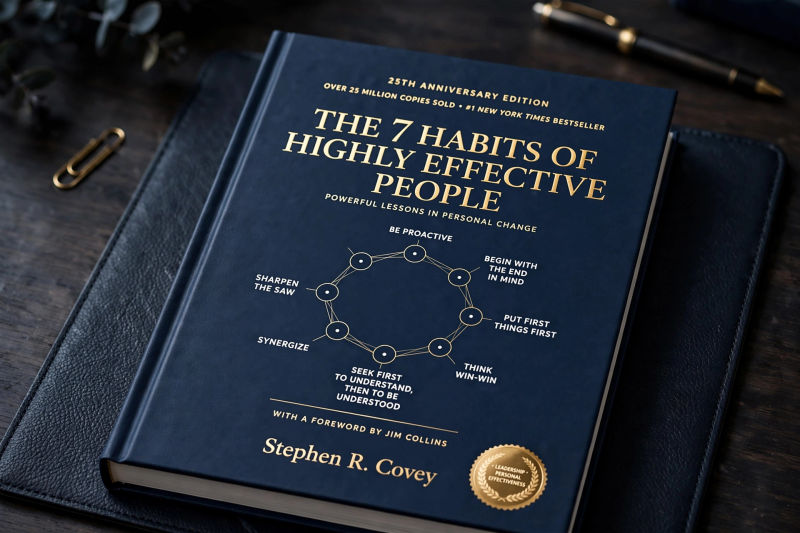
Quick question before we start: have you ever felt busy all day but somehow less in control of your life by the end of it? That paradox — motion without progress — is exactly the problem Stephen Covey set out to solve. After studying two centuries of "success literature," he noticed something almost everyone had missed: the advice that actually works has barely changed in 200 years. Everything else is just repackaging.
- Core idea: Lasting effectiveness comes from character (integrity, honesty, humility) — not from personality tricks or image management.
- The journey: Dependence ("you take care of me") → Independence ("I am responsible") → Interdependence ("we build something bigger together").
- Habits 1–3 (Private Victory): Master yourself first — your choices, your goals, your time.
- Habits 4–6 (Public Victory): Master relationships — mutual benefit, real listening, creative teamwork.
- Habit 7 (Renewal): Keep recharging your body, mind, spirit, and relationships, or the first six habits quietly decay.
The Big Idea Behind the Book
Published in 1989 and reprinted for decades since, The 7 Habits of Highly Effective People makes one uncomfortable claim: most self-help advice treats symptoms, not causes. Covey calls this the Personality Ethic — the "smile more, network harder, fake confidence" approach that became popular after World War I. It can produce short-term wins, but it's brittle, because it's built on technique rather than trust.
The alternative, which Covey calls the Character Ethic, is older and slower — principles like integrity, patience, courage, and justice. It doesn't promise overnight charisma. It promises something more durable: people who actually trust you, because you're consistent when no one's watching.
The Production vs. Production Capability Balance
One of the book's simplest but most useful ideas is the P/PC balance. "P" stands for Production — the result you want right now (a finished report, a sale, a good grade). "PC" stands for Production Capability — the asset that creates that result (your health, a relationship, a skill, a machine).
Push P too hard without maintaining PC, and the asset eventually breaks. Skip sleep to hit a deadline for a week and you'll finish the project — but your focus, mood, and health will pay the bill later. Effectiveness means protecting the asset while still getting results.
The Maturity Continuum
Covey maps personal growth onto three stages. Think of them less as labels and more as a mirror — most people can spot themselves somewhere on this line right now, in at least one part of their life:
- Dependence — the mindset of "you": you caused this, you fix it, you owe me. Dependent people outsource their outcomes to circumstances or other people.
- Independence — the mindset of "I": I'm responsible, I decide, I produce. Built through Habits 1–3.
- Interdependence — the mindset of "we": I choose to combine my strengths with yours because together we get more done than either of us could alone. Built through Habits 4–6.
Here's the part people miss: interdependence is not a return to dependence. You can only build genuinely healthy partnerships once you no longer need someone else to feel whole.
Part 1 — Private Victory: From Dependence to Independence
1Be Proactive
Between something happening to you and how you react, there's a gap — small, but real. Covey argues that in that gap lives your freedom to choose, based on your values rather than your mood. Reactive people skip over that gap entirely; proactive people use it.
Circle of Concern vs. Circle of Influence
Everyone has a Circle of Concern — things you care about but can't control (traffic, the weather, your boss's mood, the news). Inside it sits a smaller Circle of Influence — things you actually can act on (your effort, your attitude, your next message).
- Reactive people spend their energy in the Circle of Concern, blaming things outside their control — and that circle slowly shrinks.
- Proactive people spend their energy inside the Circle of Influence — and that circle slowly grows.
2Begin With the End in Mind
Covey's claim: everything is created twice. First mentally — someone imagines it — then physically, when it's actually built. Skip the first creation and you're just reacting your way through life without a destination.
His signature exercise is imagining your own funeral and what you'd want said about you by family, friends, and colleagues. It sounds morbid, but it's really a fast way to separate what you genuinely value from what you've just absorbed from other people's expectations.
Writing a Personal Mission Statement
A mission statement is a short written answer to: who do I want to be, and what do I want to contribute? Covey warns against centering your life on things that shift constantly — money, work, possessions, or other people's approval — because anything that moves under you makes a shaky foundation. Principles like honesty and contribution don't move.
3Put First Things First
If Habit 2 is the map, Habit 3 is actually driving the car. It's daily execution — organizing your time around what matters, not just what's loud.
| Category | Urgent | Not Urgent |
|---|---|---|
| Important | Quadrant I — Crises Deadlines, emergencies, pressing problems. |
Quadrant II — Growth Planning, relationships, prevention, real rest. |
| Not Important | Quadrant III — Distraction Other people's urgent requests, notifications. |
Quadrant IV — Waste Mindless scrolling, busywork, time-killers. |
The core insight
Most people's weeks are eaten by Quadrant I and III. Effective people deliberately protect time for Quadrant II — the stuff that's never urgent, which is exactly why it gets skipped, and exactly why skipping it eventually creates more Quadrant I crises.
The Emotional Bank Account
Before jumping into relationships, Covey introduces a metaphor worth remembering long after you finish the book: every relationship works like a bank account of trust. You make deposits and withdrawals with every interaction, and the balance decides how much goodwill you have to draw on when things get hard.
| Deposits (build trust) | Withdrawals (drain trust) |
|---|---|
| Keeping small promises | Breaking small promises |
| Listening without interrupting | Half-listening while planning your reply |
| Apologizing sincerely and specifically | Apologizing to end the conversation faster |
| Clarifying expectations upfront | Assuming the other person "should just know" |
Part 2 — Public Victory: From Independence to Interdependence
4Think Win-Win
Covey lists six ways people approach a disagreement: Win-Win, Win-Lose ("I win, you lose"), Lose-Win ("go ahead, step on me"), Lose-Lose (two stubborn people wreck it for both), Win (only caring about your own outcome), and Win-Win or No Deal — where, if a genuinely mutual outcome isn't possible, both sides agree to walk away rather than force a bad compromise.
The mindset underneath all of this is what Covey calls an abundance mentality — a belief that there's enough success, credit, and opportunity to go around, versus a scarcity mentality, where someone else's win automatically feels like your loss.
5Seek First to Understand, Then to Be Understood
Most conversations are two people waiting for their turn to talk. Covey's fix is empathetic listening — listening with your ears, eyes, and attention fully on the other person's meaning, not your next response.
He names four habits that quietly sabotage real listening — evaluating what's said before it's finished, probing with questions from your own agenda, jumping straight to advice, and interpreting someone's motives through your own experience instead of theirs. His one-line fix: diagnose before you prescribe.
6Synergize
Synergy is Covey's shorthand for "1 + 1 = 3 or more" — the idea that combining genuinely different perspectives can create a solution better than either person's original idea. It only works if differences are treated as raw material rather than an obstacle to smooth over. A room full of people who all think identically rarely produces anything new; a little friction, handled respectfully, usually does.
Part 3 — Renewal
7Sharpen the Saw
The name comes from an old parable about a woodcutter who refuses to stop and sharpen his saw because he's "too busy sawing" — and gets slower every day as a result. Habit 7 is maintenance for the only tool you can never replace: yourself.
Physical
Sleep, nutrition, and regular movement — the baseline everything else depends on.
Mental
Reading, writing, and learning — anything that stretches your thinking instead of just consuming.
Spiritual
Reflection, nature, or whatever reconnects you to your values and sense of purpose.
Social / Emotional
Investing in relationships and practicing everything from Habits 4–6 in real life.
Neglect any one dimension long enough, and the other six habits quietly lose their power — not because the ideas stopped working, but because the person applying them ran out of fuel.
Where the Book Falls Short
A good summary should tell you the whole picture, not just sell you the book. Three fair criticisms worth knowing before you dive in:
- It assumes stability. Much of the advice presumes a fairly stable job, family, and life structure — which doesn't map cleanly onto every economic or cultural reality.
- It can feel individual-heavy. Some critics argue the book underweights systemic and structural barriers to effectiveness, focusing almost entirely on personal choice.
- Some language has aged. Written in 1989, a few examples and gender assumptions feel dated by today's standards, even though the underlying principles hold up.
None of this erases the value of the core framework — it just means you should apply it as a flexible toolkit, not a rigid script.
Your 30-Day Starter Plan
Reading about habits and building them are two different skills. Here's a low-pressure way to actually test-drive the book instead of just admiring it:
- Week 1 — Habit 1: Every time you catch yourself blaming something outside your control, name one thing inside your control instead.
- Week 2 — Habit 2 & 3: Write a five-sentence personal mission statement. Block one recurring "Quadrant II" hour on your calendar and protect it like a real meeting.
- Week 3 — Habit 4 & 5: In every disagreement, summarize the other person's point before making yours.
- Week 4 — Habit 6 & 7: Deliberately ask someone who thinks differently from you for their take on a problem you're stuck on. Pick one renewal habit (sleep, reading, a walk) and keep it for the whole week.
Core Takeaways
Character beats charisma
Long-term trust is built on consistency, not impressions.
Protect Quadrant II
What's important rarely screams for your attention — you have to schedule it.
Understand before you respond
Most conflict shrinks the moment someone feels genuinely heard.
Renewal is not optional
Skipping self-maintenance eventually breaks everything built on top of it.
Frequently Asked Questions
What is the main message of The 7 Habits of Highly Effective People?
That lasting effectiveness comes from character and principles, built in a sequence — self-mastery first, then healthy relationships, then ongoing renewal — rather than from personality techniques or quick fixes.
What order should the 7 habits be practiced in?
Covey designed them sequentially: Habits 1–3 build self-mastery (Private Victory), Habits 4–6 build relationships (Public Victory), and Habit 7 sustains all six through ongoing renewal.
What is the Circle of Influence?
It's the set of things you can actually control or affect — your effort, attitude, and choices — as opposed to the Circle of Concern, which includes things you worry about but can't control.
Is The 7 Habits of Highly Effective People still relevant today?
Yes, though a few examples feel dated. The core ideas — proactivity, prioritization, empathetic listening, and renewal — remain widely taught in leadership and personal-development programs.
What is Quadrant II in the time management matrix?
It's the category of tasks that are important but not urgent — like planning, relationship-building, and prevention — which Covey argues deserves the most deliberate attention, since it rarely creates its own urgency.
Conclusion
Strip away the decades of business-seminar reputation, and The 7 Habits of Highly Effective People is really a book about sequencing: master yourself before you try to master relationships, and keep renewing both, or the whole structure quietly erodes. You don't need to adopt all seven habits overnight. Pick one, apply it for a week, and notice what changes — that's a far more effective way to build effectiveness than reading about it ever will be.