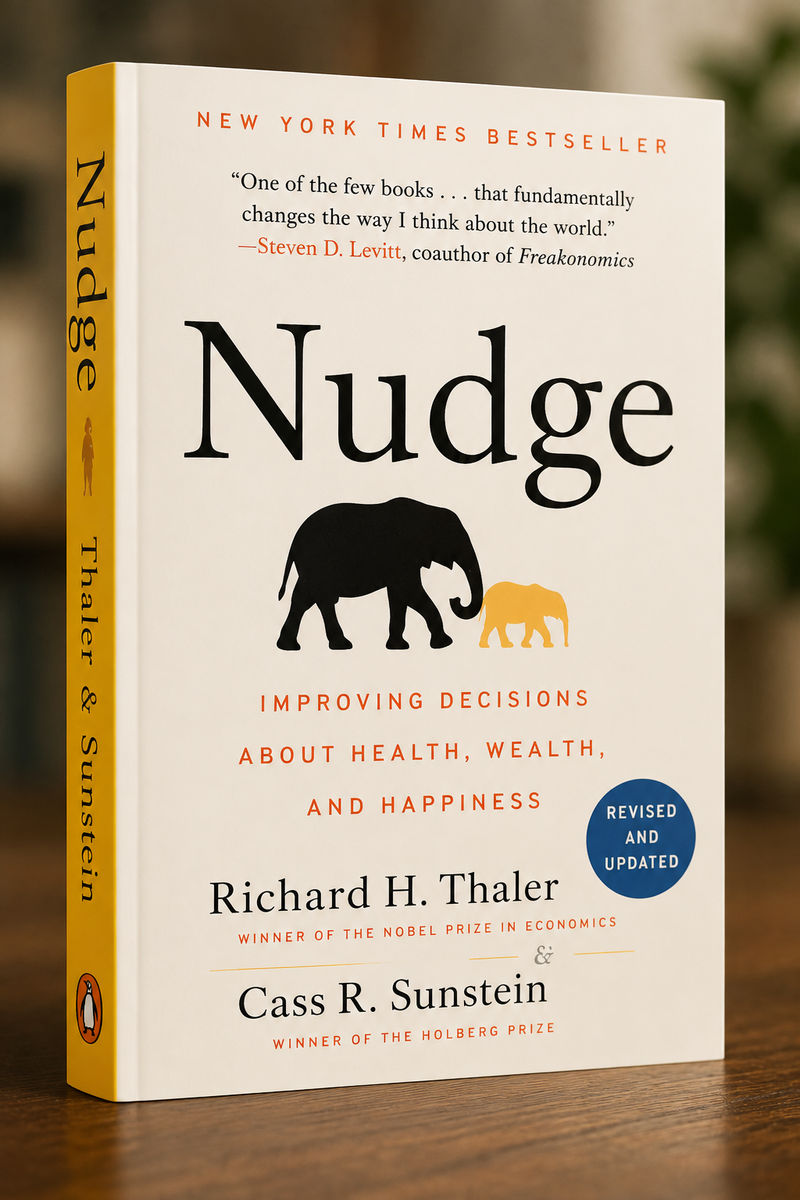
Nudge by Richard Thaler & Cass Sunstein: The Complete, Easy-to-Understand Summary
Why the single most powerful way to change someone's behavior often isn't to restrict their choices at all — it's to quietly redesign the way those choices are presented.
A school cafeteria director named Carolyn once realized something odd: simply by changing the order food was arranged in the lunch line — putting fruit at eye level, desserts further away — she could shift what thousands of kids chose to eat every day, without banning a single item or changing a single price. No rule was broken. No choice was removed. And yet behavior changed dramatically. Richard Thaler and Cass Sunstein open Nudge with Carolyn's cafeteria because it captures their entire argument in miniature: the way choices are arranged is never neutral, and once you accept that, the real question isn't whether to influence decisions — it's whether you'll do it thoughtfully, or by accident.
- Core concept: Small changes in how choices are presented — called choice architecture — predictably steer decisions, even when every option stays available.
- The trap: Every choice environment already nudges people one way or another, whether or not anyone designed it intentionally — there's no such thing as a neutral presentation.
- Libertarian paternalism: Thaler and Sunstein argue it's possible to steer people toward better outcomes for themselves while fully preserving their freedom to choose otherwise.
- Defaults are destiny: whatever option is pre-selected tends to stick, because most people go with the default rather than actively opting out or in.
- Humans aren't Econs: real people rely on mental shortcuts and are swayed by framing, which is exactly why thoughtful choice architecture matters.
The Core Idea
Richard Thaler and Cass Sunstein's Nudge argues that the environment in which a decision is presented — its choice architecture — has a powerful, often invisible effect on what people ultimately choose. This isn't a claim about restricting options or manipulating people against their interests. It's the more subtle observation that presentation is unavoidable: a form has to list options in some order, a cafeteria has to place food somewhere, a retirement plan has to have some default setting. Since a neutral, influence-free presentation doesn't exist, the authors argue we should design these defaults deliberately, in ways that help people while leaving every option fully intact.
This is the idea behind their term "libertarian paternalism" — paternalistic in that it tries to steer people toward choices that make them better off, and libertarian in that it never forecloses any option. A nudge, in their definition, changes behavior in predictable ways without forbidding anything or significantly changing economic incentives. Removing a choice, or taxing it heavily, isn't a nudge. Changing the default, isn't a nudge. Changing the default, the framing, or the visibility of an option is.
The Econ vs. The Human
| Feature | The Econ (Traditional Model) | The Human (Real Behavior) |
|---|---|---|
| Decision-making | Computes the optimal choice using all available information. | Relies on mental shortcuts, habits, and defaults. |
| Sensitivity to defaults | Unaffected by which option is pre-selected. | Strongly inclined to stick with whatever is the default. |
| Handling complexity | Processes complex tradeoffs effortlessly and consistently. | Gets overwhelmed by complexity and prone to error. |
| Time preference | Values future rewards consistently with present ones. | Over-values immediate rewards over long-term ones. |
| Effect of framing | Reaches the same decision no matter how options are worded. | Can reach different decisions depending purely on framing. |
The NUDGES Framework
The authors offer a practical checklist for designing good choice architecture, built around the acronym NUDGES.
1. iNcentives
Identify who bears the costs and gets the benefits of a choice, and make those incentives visible — people often can't respond sensibly to costs and benefits they can't actually see.
2. Understand Mappings
Make sure people can accurately connect a choice to its real-world consequence — many decisions go wrong simply because the link between the option and its outcome isn't clear.
3. Defaults
Set the default to whatever outcome would serve most people best, since most people will stick with it — this is the single most powerful lever in the whole framework.
4. Give Feedback
Let people know, quickly and clearly, how their choices are working out, so they can course-correct rather than repeat a mistake indefinitely.
5. Expect Error
Design systems assuming people will make mistakes, and build in ways to catch or reverse those errors, rather than assuming flawless behavior.
6. Structure Complex Choices
When a decision has many options or variables, organize and simplify the structure so people can actually compare them meaningfully, instead of being paralyzed or defaulting at random.
Nudge in Action: Real-World Domains
1. Nudge in Money and Retirement Savings
Thaler and Sunstein describe how automatic enrollment in retirement plans — making saving the default rather than something employees must actively sign up for — dramatically raises participation, simply by working with people's tendency to stick with whatever is already selected. They also describe a program that lets people commit today to save more out of future raises, so the saving increase never has to feel like a loss in the present.
2. Nudge in Health and Public Policy
The book examines organ donation policy as a striking example of default power: countries where the default is enrollment as a donor, with the choice to opt out, have far higher donor participation than countries where the default is the reverse, even though every citizen technically has the same free choice either way. Similar reasoning is applied to food placement, smoking, and other public health decisions where the default option quietly carries enormous weight.
3. Nudge in Everyday Choice Architecture
Away from major policy, the authors show the same principles at work in ordinary product design and forms — the order options are listed, whether a checkbox is pre-ticked, how a subscription renewal is framed — arguing that anyone who designs a form, a menu, or a workplace policy is already shaping outcomes, whether or not they realize it.
Carolyn's Cafeteria
Thaler and Sunstein's clearest illustration of unavoidable choice architecture is the story that opens the book.
Same Options, Different Order, Different Outcomes
Carolyn manages school cafeterias serving hundreds of thousands of students, and she runs an experiment: in some schools she arranges the food so healthier items are at eye level and easy to reach; in others, she leaves the layout unchanged. Nothing is banned, nothing is priced differently — yet the arrangement alone measurably shifts what kids choose to eat. The lesson Thaler and Sunstein draw is not that Carolyn should feel free to manipulate children — it's that she has no way to avoid influencing them. Some layout has to exist, and that layout will always nudge in some direction.
Why This Matters
- It shows that "neutral" choice presentation is a myth — every layout, order, or default already nudges behavior one way or another.
- It reframes choice architecture as a responsibility rather than an optional design flourish.
- It sets up the book's central defense of libertarian paternalism: if influence is unavoidable, it should at least be used thoughtfully.
Where the Book Falls Short
A useful summary tells you the limits too, not just the highlights. Three fair criticisms worth knowing:
- Where does nudging end and manipulation begin? Critics argue the line between a helpful default and a manipulative one isn't always clear, especially when the "chooser" for a whole population is a government or a corporation rather than the individual.
- Effect sizes vary in the real world. Some later research has found that certain nudges produce smaller or less consistent effects outside controlled studies than the book's most famous examples suggest.
- Risk of substituting for deeper reform. Critics warn that policymakers can lean on cheap, popular nudges instead of tackling harder structural problems — like inadequate wages or systemic access issues — that a change in choice architecture alone can't fix.
Your 30-Day Starter Plan
- Week 1: Audit your own environment for hidden choice architecture already nudging you — subscription defaults, app settings, the layout of your kitchen or workspace.
- Week 2: Build one default in your own life that removes friction from a good choice, like an automatic transfer into savings on payday.
- Week 3: Pick one common bias — status quo bias, anchoring, or present bias — and watch for it specifically in a decision you make often.
- Week 4: Design a small, honest nudge for a decision that affects someone else — a teammate, a family member — using a default or framing change rather than a restriction.
Core Takeaways
There's no neutral choice
Every way of presenting options already nudges behavior — intentionally or not.
Defaults are destiny
Whatever is pre-selected tends to stick, making defaults the most powerful lever available.
Freedom stays intact
A true nudge never removes an option — it only shapes which one people tend to choose.
Design deliberately
Since influence is unavoidable, the real choice is whether it's designed thoughtfully.
Frequently Asked Questions
What is a nudge, according to Thaler and Sunstein?
Any small feature of how a choice is presented that predictably changes behavior without forbidding any option or significantly changing its economic incentives — like changing a default setting rather than banning a choice.
What is libertarian paternalism?
The book's central idea that it's possible to steer people toward better decisions for themselves while fully preserving their freedom to choose differently — paternalistic in goal, libertarian in method.
What is choice architecture?
The design of the environment in which people make decisions — the order of options, the default setting, how information is framed — all of which shape choices whether or not it was designed intentionally.
What is the difference between Econs and Humans in Nudge?
Econs are the perfectly rational decision-makers assumed by traditional economic theory. Humans are how people actually behave — influenced by defaults, biases, and how choices are framed.
What is the cafeteria story in Nudge?
It's the book's opening story about a school food-service director who discovers that simply changing the order food is placed in the lunch line changes what kids choose to eat, without restricting any options — illustrating that choice architecture always has an effect, intended or not.
Has Nudge faced any criticism?
Yes. Critics have questioned where nudging ends and manipulation begins, pointed to smaller or inconsistent effect sizes in some real-world settings compared to lab studies, and warned that nudges can be used by policymakers as a substitute for more substantive structural reform.
Conclusion
Strip away the case studies, and Nudge makes one grounded claim: there is no such thing as a neutral way to present a choice, so the environments we build — forms, menus, policies, defaults — are always shaping behavior, whether we design them on purpose or not. Thaler and Sunstein's invitation isn't to manipulate people, but to take that responsibility seriously: to build choice architecture that helps people get what they'd choose for themselves anyway, while leaving every door fully open. You don't need to redesign your whole life today. Just find one default already working against you, and change it.