Being and Time by Martin Heidegger: The Complete, Easy-to-Understand Summary
A philosopher spends over four hundred dense pages insisting that Western thought forgot to ask its most basic question: what does it actually mean for something to be? Heidegger's answer runs through hammers, anxiety, gossip, death, and the strange fact that we're never just watching the world, we're already caught up in it. Here's the whole argument, explained without the jargon, plus a way to practice it.
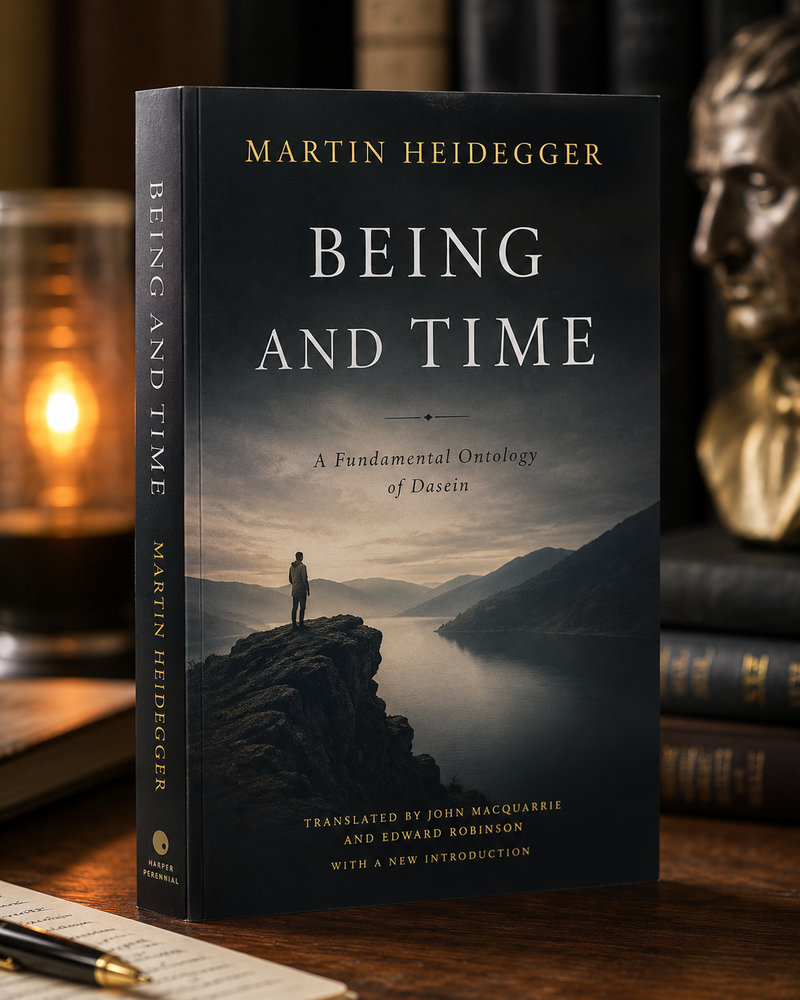
Our take in one line: this isn't a self-help manual about "living in the moment," it's a technical, occasionally brutal argument that twenty-five centuries of philosophy asked the wrong question about existence, and that fixing it starts with taking your own death seriously.
Try this before you read another word. Ask yourself what it means to say something "is." Not what a chair is, or what a number is, but what "is" itself means, the thing every sentence with the verb "to be" quietly assumes you already understand. Martin Heidegger's 1927 book argues that philosophy has been answering questions about particular things for over two thousand years while never pausing to ask this one directly, and that the entity best positioned to ask it is the strange kind of being that can ask questions about its own existence in the first place: us.
- Core concept: Published in 1927, the book asks what it means for anything to "be" at all, and argues philosophy has covered over this question by focusing only on particular things that exist.
- The framework: Five ideas run through it — the forgotten question of Being, Dasein (the being for whom its own existence is an issue), being-in-the-world, the pull of anonymous conformity and anxiety before death, and care as the structure that ties it all together in time.
- The mechanism: Heidegger starts from lived, practical engagement rather than detached observation, arguing we encounter the world as a web of usable things and meaningful involvements long before we ever step back to analyze it as objects.
- The misconception: This isn't a guide to "living authentically" in the self-help sense, and the book was never finished, only about a third of Heidegger's planned project was ever published.
- The reframe: Confronting your own finite, ending existence honestly, rather than fleeing into the comfortable anonymity of "what one does," is what allows a life to become genuinely your own.
What The Book Actually Argues
Martin Heidegger's Sein und Zeit was published in 1927, dedicated to his teacher and mentor Edmund Husserl, the founder of phenomenology, "in friendship and admiration." Heidegger wrote it partly under career pressure: he needed a substantial publication to secure a professorship, and the book that resulted became, almost immediately, one of the most influential and most difficult works of twentieth-century philosophy.
Its opening move is to revive what Heidegger calls "the question of Being," a question he claims Western philosophy has forgotten precisely because it seems too obvious to ask. We use the word "is" constantly, and assume we already know what it means. Heidegger insists this assumption is exactly the problem: philosophers since Plato and Aristotle have asked endless questions about particular beings, what a soul is, what substance is, what causes what, without ever properly asking what it means for something to be in the first place.
To ask that question rigorously, Heidegger argues, you need to start with the one entity for whom its own being is already an issue, a being that doesn't just exist but has some understanding, however vague, of what existing means. His name for this entity is Dasein, a German word literally meaning "being-there," chosen deliberately to sidestep loaded terms like "consciousness," "subject," or "soul," each of which drags centuries of philosophical baggage into the discussion before the analysis has even started.
The Five Pillars of the Book
Beneath the technical vocabulary, five recurring ideas carry the philosophical weight of the book.
- The Question of Being. The claim that philosophy has confused "Being" itself with the sum of "beings" that exist, and forgotten to ask the more basic question.
- Dasein. The name for our distinctive way of existing, always already engaged with a world rather than a detached mind observing objects.
- Being-in-the-World. The claim that we encounter things first as usable, meaningful, and involved in our projects, not as neutral objects with properties.
- The They and Anxiety. The pull toward anonymous conformity in everyday life, and the disorienting mood that can break that pull and reveal our own finite existence.
- Care and Temporality. The claim that our being is structured by time itself, stretched between a past we're thrown into, a future we're projecting toward, and a present we're absorbed in.
The Question Philosophy Forgot to Ask
Heidegger draws a sharp line between "beings" (Seiende), any particular thing that exists, a chair, a number, a person, a mood, and "Being" (Sein), the fact that these things are at all, the underlying intelligibility that lets anything show up as something in the first place. He calls this distinction the "ontological difference." His complaint against most of Western philosophy is that it has only ever investigated beings, cataloguing what exists and how different kinds of things relate to each other, while treating Being itself as though it were either self-evident or simply another very general kind of being, the emptiest and most abstract category there is.
Heidegger's alternative is to treat Being as the genuinely fundamental question, the one that makes every other question about what exists possible in the first place. And because Being can only ever show up for an entity capable of having some understanding of it, the investigation has to begin with an analysis of that entity's own way of existing, which is where Dasein enters the picture.
Dasein: The Being Whose Own Being Is a Question
Dasein is Heidegger's term for the distinctively human way of existing, defined by the fact that its own being is always at issue for it. Unlike a rock or a hammer, which simply are what they are, Dasein is always in some way concerned about, oriented toward, or taking a stand on its own existence, even when it isn't consciously reflecting on that fact.
Crucially, Heidegger insists Dasein is never a detached mind that first exists in isolation and then looks out at a world of objects. That picture, inherited from Descartes, is exactly the kind of assumption Heidegger wants to dismantle. Dasein is always already "thrown" into a particular situation, a body, a language, a historical moment, a set of relationships, none of which it chose, and it finds itself engaged with that situation before it ever has the chance to step back and observe it from a neutral distance.
Being-in-the-World: Why a Hammer Disappears When It Works
Heidegger's most famous illustration involves something as ordinary as a hammer. When you're using a hammer well, absorbed in the task of hammering, you're not consciously perceiving it as an object with a certain weight, shape, and material. It effectively disappears from your awareness, becoming what Heidegger calls "ready-to-hand" (zuhanden), equipment that recedes into smooth, practical use as part of a larger task, building a shelf, fixing a fence.
It's only when something goes wrong, the head comes loose, the hammer isn't where you expect it, or it's simply missing, that the hammer suddenly becomes conspicuous. At that point it shifts into what Heidegger calls "present-at-hand" (vorhanden), an object you now stare at, examine, and think about in terms of its properties. Traditional philosophy, Heidegger argues, made the mistake of starting its analysis from this second, disrupted mode, treating detached observation of objects as the basic relationship we have to the world, when it's actually a derivative case that only shows up when smooth, practical involvement breaks down.
This practical involvement extends outward into what Heidegger calls "world," not a container that holds objects, but a total structure of meaningful relationships, this tool points to that task, which points to that purpose, which points to who I am, that Dasein is always already caught up in, well before any detached reflection begins.
The They and the Comfort of Not Being Yourself
Most of the time, Heidegger argues, Dasein doesn't act as a distinct individual making its own choices. It acts as "one" does, following average interpretations of what's proper, what's said, what's done, a diffuse, anonymous social authority Heidegger calls "the They" (das Man). We dress a certain way because that's what one wears, hold opinions because that's what one thinks, and move through daily routines largely on autopilot, guided by unspoken social norms rather than any deliberate choice of our own.
Heidegger calls the broader tendency to lose oneself in this public, distracted mode of existing "falling" (Verfallenheit), and describes it through three intertwined features of everyday life: idle talk, chatter and opinion repeated and passed along without any real grounding in genuine understanding; curiosity, a restless jumping from one novelty to the next without ever settling into anything; and ambiguity, a fog in which it becomes hard to tell genuine understanding from mere gossip. None of this is presented as a moral failing exactly, it's a structural feature of everyday existence that Dasein is always, to some degree, caught up in.
Anxiety, Death, and Becoming Authentic
What breaks the grip of the They, according to Heidegger, is a distinctive mood he calls anxiety (Angst), which he carefully distinguishes from ordinary fear. Fear always has a definite object, you're afraid of the dog, the exam, the deadline. Anxiety has no definite object at all, and that's exactly what makes it unsettling: it isn't about any particular thing in the world, it's a mood in which the whole familiar web of meaning that usually structures your life suddenly feels groundless, and you're confronted with your own bare existence, stripped of the comfortable roles the They usually hands you.
This confrontation is intensified by what Heidegger calls "being-toward-death." Death, in his account, isn't simply an event that happens at the end of a life. It's a possibility Dasein carries with it at every moment, the one possibility that is entirely its own, that no one else can undergo in its place, and that can arrive at any time. The They's usual strategy is to talk about death only in the abstract, "everyone dies eventually," while quietly treating it as something that always happens to someone else, not yet, not really me. Authentic being-toward-death means dropping that evasion and facing one's own finitude directly, which Heidegger argues has the paradoxical effect of individualizing Dasein, calling it back from the anonymous crowd to its own singular, finite existence.
This is where Heidegger's account of authenticity (Eigentlichkeit) versus inauthenticity (Uneigentlichkeit) takes shape, and it's worth being precise about what he does and doesn't mean by it. It isn't a claim about a hidden "true self" versus a "fake self" in the pop-psychology sense. It's about whether Dasein takes up its own possibilities as genuinely its own, having reckoned honestly with its finitude, or simply drifts along inside the interpretations handed to it by the They. Heidegger describes a kind of inner call, "conscience" (Gewissen), that summons Dasein back to itself, and a corresponding notion of "guilt" (Schuld) that isn't about moral wrongdoing but about the basic, structural fact that Dasein never fully grounds itself, it's always thrown into a situation it didn't choose. Owning up to that condition clearly and resolutely is what Heidegger calls "resoluteness" (Entschlossenheit).
The Practical Reframe
If your days feel like they belong to no one in particular, borrowed opinions, borrowed routines, borrowed ambitions, Heidegger's suggestion isn't to seek out some hidden essential self. It's to stop evading the fact of your own death long enough to notice which of your current possibilities you'd still choose in light of it.
Care and Temporality: What Holds It All Together
In the book's second major movement, Heidegger argues that everything discussed so far, thrownness, practical engagement, falling into the They, anxiety, being-toward-death, is unified by a single underlying structure he calls "care" (Sorge). Dasein, on this account, is always simultaneously ahead of itself, projecting into future possibilities; already thrown into a past situation and set of facts it didn't choose; and alongside things and other people in the present, absorbed in its everyday dealings. Care is the name for this threefold structure holding all at once.
Heidegger then argues that this structure of care is really a structure of time. The future dimension of care corresponds to what he calls "ecstatic" temporality reaching forward; the past dimension corresponds to "thrownness" or "having-been"; the present corresponds to absorbed dealing with things at hand. Authentic temporality, tied to anticipatory resoluteness in the face of death, draws these three together into a life that owns its own finite stretch of time. Inauthentic temporality, by contrast, is scattered and forgetful, absorbed in a string of disconnected "nows" handed down by the They, with little sense of a life gathered into a coherent whole.
Authentic vs. Inauthentic Existence, at a Glance
| Dimension | Inauthentic (They-self) | Authentic (Owned self) |
|---|---|---|
| Relation to death | Evaded, treated as something that happens to others, not yet. | Faced directly through anticipatory resoluteness. |
| Relation to possibilities | Drifting along with whatever the They finds proper. | Chosen and owned in light of one's finitude. |
| Temporal focus | Scattered, absorbed in a string of disconnected present moments. | Gathered, oriented by a future shaped by mortality. |
| Guiding voice | The They (das Man) and its average interpretations. | The call of conscience. |
| Heidegger's synthesis | The same everyday activities, taken up as genuinely one's own rather than borrowed. | |
The Story Behind the Philosophy
Being and Time grew directly out of Heidegger's relationship with Edmund Husserl, whose method of phenomenology, a careful description of how things show up in experience, gave Heidegger his basic approach even as he pushed it in a very different direction. Heidegger succeeded Husserl in the chair of philosophy at Freiburg, and the book that made that possible remains, in its published form, only a fragment of what he originally intended: a two-part, six-division project meant to work back from an analysis of Dasein toward a direct account of Being and time itself. That final destination was never reached. Scholars refer to the shift in Heidegger's later thinking, away from the existential analysis of Dasein and toward language, art, technology, and what he called "the history of Being," as "the turn" (die Kehre).
Where the Book Strains
A useful summary tells you the limits too, not just the highlights. Three fair criticisms worth knowing before you dive in:
- The prose is notoriously difficult. Heidegger coins dozens of new terms and repurposes ordinary German words in technical ways; even trained philosophers find the original resists easy paraphrase, and English translations wrestle constantly with words like Dasein, Sorge, and Geworfenheit that have no clean equivalent.
- The project is unfinished. Only roughly a third of the planned work was ever published, and the book's central promise, a direct account of Being and time, is never delivered within its own pages.
- Heidegger's politics cast a long shadow. His Nazi party membership, his rectoral address, and his post-war silence on both remain a serious and unresolved problem for readers and scholars, and continue to shape ongoing debate about whether or how the book's account of authentic community connects to what came after it.
Your 30-Day Practice Plan
- Week 1 — Notice the ready-to-hand. Pick one tool or object you use automatically each day, a keyboard, a doorknob, a phone, and notice the moment it goes from invisible to "present," when it breaks, feels off, or gets in the way.
- Week 2 — Listen for the They. Each day, catch one moment when you're doing something "because that's what one does," and ask honestly whether you'd still choose it if you stopped to think it through.
- Week 3 — Sit with anxiety without naming an object. When a diffuse unease shows up that isn't clearly about anything specific, resist immediately pinning it to a cause, and notice what it reveals about your situation instead.
- Week 4 — Practice anticipatory resoluteness. Spend a few minutes genuinely reflecting on your own mortality, not to be morbid, but to ask what that makes actually matter to you, and let one decision this week be shaped by the answer.
Core Takeaways
Being is not the same as beings
Philosophy forgot to ask what it means for anything to exist at all.
You're never a detached observer
Dasein is always already thrown into and engaged with a world.
Objects only become "present" to us when something breaks.
Facing death makes a life your own
Owning your finitude, not fleeing it, is the root of authenticity.
Frequently Asked Questions
What is the main message of Being and Time?
That Western philosophy forgot to ask what it means for anything to "be" at all, and that answering this question requires starting from Dasein, the kind of being for whom its own existence is always an issue, and its lived, practical, finite engagement with the world.
What does "Dasein" mean?
Dasein, literally "being-there," is Heidegger's term for the distinctively human way of existing: a being that is always already engaged with a world and for whom its own being is always, in some way, at issue.
What's the difference between ready-to-hand and present-at-hand?
Ready-to-hand describes equipment used smoothly and unreflectively as part of a task, like a hammer in the middle of hammering. Present-at-hand describes that same object once it becomes conspicuous, broken, missing, or in the way, and is instead stared at and examined as an object with properties.
Why is the book unfinished?
Heidegger planned a two-part, six-division work, but only published the first two divisions of Part One. He later concluded that the way he had originally framed the question of Being needed to change, and the promised remainder was never completed.
Does Heidegger's Nazi party membership affect how the book should be read?
It's a genuine and unresolved point of debate. Heidegger joined the Nazi party in 1933 and never publicly renounced it after the war. Scholars are divided over how directly this connects to the book's ideas, published six years earlier, versus how separable the philosophical apparatus is from the politics that followed it.
Final Verdict
Whether Being and Time lands for a given reader often depends on their tolerance for prose that invents its own vocabulary as it goes, and for an argument that never quite reaches the destination it promises in its own title. Heidegger never delivers a direct account of Being and time within these pages, and by the book's own unfinished trajectory, perhaps he couldn't have. What it offers instead is one of philosophy's most sustained attempts to describe existence from the inside, not as a detached mind surveying objects, but as a finite being, thrown into a world it didn't choose, borrowing most of its days from an anonymous crowd, and occasionally, briefly, anxiously, called back to the fact that this particular, ending life is its own. Nearly a century after its publication, that description is still the book's most demanding argument, and its most enduring one.