The Power of Now by Eckhart Tolle: The Complete, Easy-to-Understand Summary
One question quietly runs through this entire book: what would your life feel like if you stopped living in your head? Here's every core idea, explained in plain English, with a practice plan you can start today.
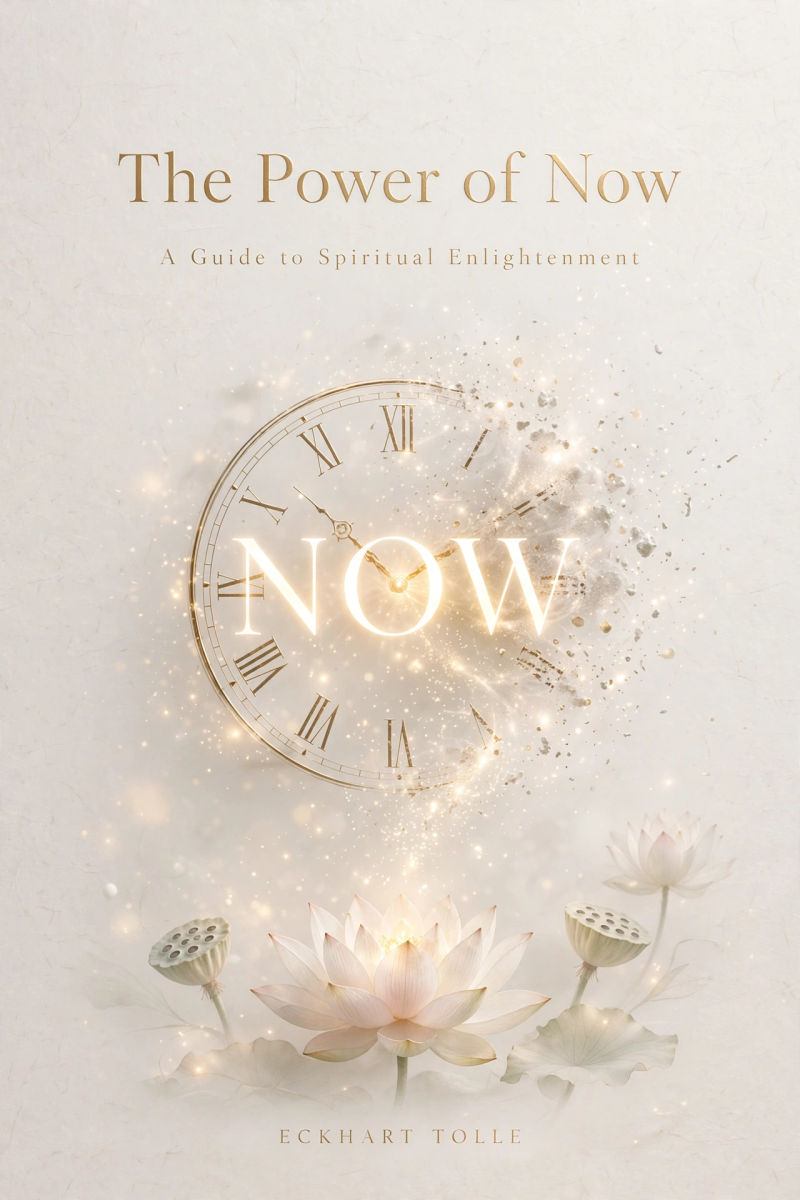
Our take in one line: this isn't really a book you finish — it's a mirror you sit in front of, and the version of you reading it in a calm moment gets something very different out of it than the version reading it at 2 a.m.
Try this before you read another word. Stop, and notice the voice in your head that's currently narrating this sentence, judging it, or thinking about something else entirely. Found it? That's the exact starting point of the entire book — and Eckhart Tolle's central claim is that the moment you can notice that voice, you've already discovered you are not it.
- Core concept: Suffering is manufactured by the thinking mind's obsession with past and future — not by the present moment itself.
- The enemy: The "ego" — a false sense of self built from memory, roles, and mental commentary.
- The hidden wound: The "pain-body," a reservoir of old emotion that periodically resurfaces and feeds on drama.
- The tool: Presence — becoming the observer of thought instead of being fused with it.
- The goal: Not silencing the mind forever, but no longer being unconsciously controlled by it.
What The Book Actually Argues
Published in 1997, The Power of Now doesn't read like a conventional self-help book with numbered steps and neat formulas. It's structured almost like a transcribed spiritual dialogue: Tolle answers a stream of imagined reader questions, circling the same handful of ideas from different angles until, somewhere around the third or fourth pass, they finally click. That repetitive structure is either the book's greatest strength or its biggest weakness, depending entirely on your patience.
Strip away the dialogue format, and the central claim is almost embarrassingly simple: nearly all human suffering is generated by a mind that lives in the past or the future rather than in direct contact with the present. Tolle argues the "Now" is the only place life has ever actually happened — everything else your mind does is memory, projection, or rehearsal.
The Voice in Your Head
Tolle opens by asking readers to simply notice the near-constant internal monologue running underneath everyday life — commentary, judgment, worry, replay, rehearsal. Most people are so fused with this voice that they mistake it for themselves, when it's really just mental noise they have the built-in capacity to observe.
The book's foundational exercise follows directly from this: become the observer of your own thinking. The instant you notice a thought arising, you create a small gap of awareness that is not itself a thought — and Tolle calls that gap your very first taste of presence.
The Ego, Explained Simply
What Tolle calls the "ego" isn't vanity in the everyday sense of the word. It's the mental construct assembled from memories, roles, opinions, and imagined futures that a person mistakes for their true identity. Because the ego is literally made of past and future material, it can only stay alive by keeping your attention away from the present moment.
This, Tolle argues, is exactly why people compulsively replay old grievances or rehearse anxious future scenarios: the ego needs psychological time to sustain its sense of self — even at the direct cost of the person's own peace of mind.
The Pain-Body
One of the book's most distinctive — and most useful — contributions is the concept of the pain-body: an accumulated field of old, unprocessed emotional pain that lives semi-dormant inside a person and periodically "wakes up," hijacking mood and behavior with almost no warning. Tolle suggests the pain-body actually feeds on negative thought and drama, pulling people into arguments or spirals of self-pity in order to replenish itself.
The Practical Reframe
When you notice a sudden, disproportionate emotional reaction — rage over something small, a wave of despair that seems bigger than the trigger — Tolle's suggestion isn't to suppress it or act it out. It's to consciously observe it as "the pain-body being triggered," which he claims quietly drains its power over you.
Surrender Is Not Passivity
A common misreading of the book is that it preaches passivity — that "acceptance" means giving up. Tolle is explicit that surrender doesn't mean giving up on action; it means dropping inner resistance to what's already happening in this moment, so that whatever action you take next comes from clarity instead of reactive frustration.
Clock Time vs. Psychological Time
Tolle draws a sharp line between clock time — the practical use of time to plan a meeting or catch a flight — and psychological time, the mind's habitual dwelling in regret or anticipation. He argues clock time is useful and necessary for functioning in the world; psychological time is almost always a source of unnecessary suffering layered on top of ordinary life.
- Clock time in action: "The flight leaves at 6, so I need to leave the house by 4."
- Psychological time in action: Replaying a flight you missed three years ago every time you pack a bag.
Core Practices the Book Teaches
1. Anchoring in the Body
Tolle repeatedly returns to one practical anchor: feeling the "inner body" — the subtle field of aliveness or energy inside the physical body — as a way of pulling attention out of compulsive thinking and back into direct sensation.
2. Acceptance of "What Is"
A recurring instruction throughout the book is to fully accept the present moment exactly as it is — even when it's unpleasant — rather than mentally labeling it as a problem. Tolle's argument is that resistance to the moment, not the moment itself, is usually what creates the felt sense of suffering.
- Stuck in traffic? The delay is a fact; the frustration is a resisted thought layered on top of it.
- Facing a difficult conversation? The discomfort is real; the dread is the mind rehearsing a future that hasn't happened yet.
Ego-Driven Mind vs. Presence, at a Glance
| Dimension | Ego / Unconscious Mind | Presence / Awareness |
|---|---|---|
| Time orientation | Lives in past regret or future anxiety. | Anchored in the Now. |
| Relationship to thought | Fused with thought, identified as "self." | Observes thought without being it. |
| Response to pain | Resists, reacts, replays the story. | Accepts, feels, and lets it move through. |
| Sense of self | Built from roles, opinions, and story. | Rooted in direct, felt experience. |
| Under stress | Feeds the pain-body with drama. | Names the reaction and lets it deflate. |
Presence in Relationships
Tolle applies the same framework directly to relationships. He argues that most relationship conflict is really two egos — two accumulated stories about who's right, who owes what, who's been wronged — colliding, and often reactivating each partner's pain-body in the process. A disagreement that seems to be about dishes or plans is frequently, underneath, two old wounds triggering each other.
Where the Book Strains
A useful summary tells you the limits too, not just the highlights. Three fair criticisms worth knowing before you dive in:
- Light on structure and evidence. The book operates as a spiritual teaching text rather than a research-based psychology manual — readers hoping for citations, studies, or step-by-step frameworks will find little of that here.
- Repetitive by design. The dialogue format circles the same handful of ideas repeatedly; by the midpoint, some readers feel the book could have said the same thing in half the pages.
- Easy to misread as passivity. "Accept what is" can be flattened into an excuse to avoid difficult decisions or necessary action, even though Tolle explicitly argues against that reading.
Your 30-Day Presence Plan
- Week 1 — Notice the voice. Three times a day, pause and ask "what is my mind saying right now?" Just observe it; don't argue with it.
- Week 2 — Anchor in the body. Each morning, spend 60 seconds feeling the aliveness in your hands before you touch your phone.
- Week 3 — Catch psychological time. When you notice you're replaying the past or rehearsing the future, silently label it: "this is psychological time," and return to whatever you're doing physically right now.
- Week 4 — Name the pain-body. The next time you feel a reaction that seems bigger than the trigger, name it internally instead of acting on it immediately, and notice whether the intensity shifts.
Core Takeaways
You are the observer, not the thought
Creating a gap of awareness around your own thinking is the starting point for everything else the book teaches.
Use clock time, drop psychological time
Plan and act using practical time, but resist the mind's habit of dwelling in regret or anticipation.
Notice the pain-body, don't feed it
Old emotional pain resurfaces through drama and reactivity; conscious observation drains its grip.
Accept what is, then act
Acceptance isn't passivity — it's dropping inner resistance so action comes from clarity, not reactivity.
Frequently Asked Questions
What is the main message of The Power of Now?
That almost all suffering comes from the mind's habit of living in the past or future through thought, and that freedom is found by anchoring attention in present-moment awareness instead of being fused with the thinking mind.
What does Eckhart Tolle mean by the ego?
Tolle uses "ego" to mean the mental construct built from memories, roles, opinions, and imagined futures that a person mistakes for their true identity — a construct that survives by keeping attention on the past or future rather than the present.
What is the pain-body in The Power of Now?
The pain-body is Tolle's term for an accumulated reservoir of old, unprocessed emotional pain stored in a person that periodically reactivates, hijacking mood and pulling the person toward drama or conflict to sustain itself.
What is the difference between clock time and psychological time?
Clock time is the practical use of time to plan and act, like catching a flight. Psychological time is the mind's habitual dwelling in regret about the past or anxiety about the future — which Tolle identifies as a major source of unnecessary suffering.
Is The Power of Now backed by science?
The book is written as a spiritual teaching text rather than a research-based psychology manual, so it offers little in the way of citations or studies. That said, its emphasis on present-moment attention overlaps with well-studied mindfulness practices.
Final Verdict
Whether The Power of Now lands for a given reader often depends less on the ideas themselves — many of which echo older contemplative traditions — and more on whether Tolle's meditative, repetitive style resonates or grates. For readers open to sitting with a single idea from multiple angles, it can function almost like a slow-release medication for a restless mind. For readers who want frameworks, exercises, and citations, it may feel thin on structure. Either way, its influence on the modern mindfulness and self-help landscape is hard to overstate — and its central invitation, simply notice what's happening right now, remains exactly as accessible on page one as it is on the last page.