The Paradox of Choice by Barry Schwartz: The Complete, Easy-to-Understand Summary
One question quietly runs through this entire book: what if the aisle of 30 shampoo options isn't freedom, it's a quiet source of stress you've just learned to stop noticing? Here's every core idea, explained in plain English, with a practice plan you can start today.
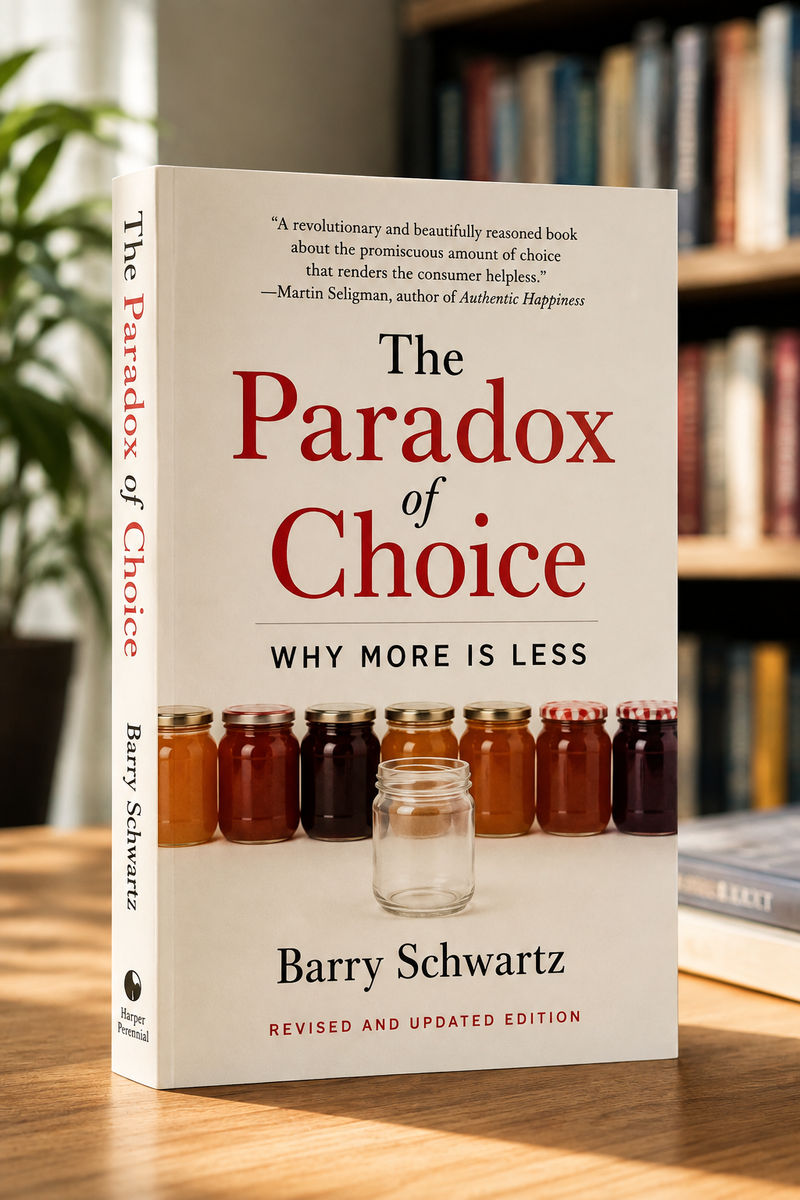
Our take in one line: this book turns a very modern, very specific kind of exhaustion, standing frozen in front of 40 nearly identical options, into a clearly explained psychological pattern with an actual off-ramp.
Try this before you read another word. Think of the last time you spent twenty minutes comparing near-identical products online, then felt oddly unsatisfied with whatever you finally bought. Barry Schwartz's entire book is built on that exact feeling, and his central claim is genuinely counterintuitive: past a certain point, more options don't make you freer. They make you more anxious, more regretful, and less happy with whatever you end up choosing.
- Core concept: Some choice is essential for wellbeing, but beyond a certain point, more options reduce happiness rather than increase it.
- The split: Maximizers try to find the single best option; satisficers stop once something is "good enough."
- The hidden tax: Every choice carries opportunity costs, the value of every option not picked, which grow heavier as options multiply.
- The trap: More options raise expectations, and higher expectations make any single outcome more likely to disappoint.
- The fix: Deliberately limiting options, satisficing more, and controlling comparison restores much of the lost satisfaction.
What The Book Actually Argues
Published in 2004, The Paradox of Choice challenges a belief so deeply embedded in modern life that it rarely gets questioned: that more options are always better. Barry Schwartz, a psychologist, argues that while a baseline amount of choice is genuinely important for autonomy and wellbeing, modern life has pushed far past that baseline, into a zone where additional options actively make people less satisfied and less happy.
The book walks through supermarket aisles stocked with dozens of nearly identical products, health insurance plans with endless variations, and even choices about careers and relationships, arguing that the same psychological mechanisms, rising expectations, opportunity costs, and regret, apply across all of them.
Maximizers vs. Satisficers
One of the book's central distinctions is between two decision-making styles. A maximizer tries to examine every available option in search of the single best possible choice. A satisficer sets a standard for "good enough" and stops searching once an option meets it, even if something marginally better might exist somewhere else.
Schwartz's research found a striking pattern: maximizers often do end up making objectively better choices, yet report feeling worse about them, more regret, more second-guessing, less satisfaction, than satisficers, who tend to feel more at peace with decisions that are simply good enough.
Opportunity Costs and Regret
Every choice comes with opportunity costs, the value of everything not chosen. Schwartz argues that as the number of alternatives grows, the mental weight of everything given up grows with it, quietly eroding satisfaction with whatever option was actually selected, regardless of how good that option objectively is.
This feeds directly into regret, both the anticipated regret that makes decisions harder to make in the first place, and the after-the-fact regret that creeps in once a choice is compared against paths not taken.
Adaptation and Escalating Expectations
Schwartz connects choice overload to hedonic adaptation, the well-documented tendency for people to get used to almost anything over time, which means the boost from finally landing on "the best" option fades faster than expected. Compounding this, more options tend to raise expectations before a decision is even made, and higher expectations make any actual outcome more likely to fall short.
The Practical Reframe
When a decision starts to feel unusually stressful for its actual stakes, buying a blender, choosing a streaming show, Schwartz's suggestion isn't to research harder. It's to recognize that expectations may have quietly inflated along with the number of options, and to deliberately lower the bar back to "good enough."
Choice Overload Isn't About Having No Options
A common misreading of the book is that Schwartz wants people to have fewer choices altogether, or that any choice is inherently bad. He's careful to distinguish the genuine value of meaningful choice from the diminishing, even negative, returns of choice well past the point of usefulness.
Social Comparison and the Comparison Trap
Schwartz argues that satisfaction with a choice depends heavily on comparison, not just to the alternatives that were available, but to what other people chose or received. More options make these comparisons easier and more frequent, which tends to erode contentment even when the outcome itself hasn't changed at all.
- Comparing to alternatives: "Would the other laptop have been better?"
- Comparing to others: "My coworker's laptop looks nicer than mine."
Core Practices the Book Teaches
1. Choose When to Choose
Schwartz recommends deliberately deciding which decisions actually deserve extensive research and which don't, rather than applying the same maximizing energy to every choice, from a mortgage to a brand of toothpaste.
2. Make Decisions Non-Reversible
Counterintuitively, Schwartz cites research suggesting that decisions framed as final tend to produce more satisfaction than decisions left open to change, because an open door keeps opportunity costs and comparison active long after the choice is made.
- Reversible framing: Constantly wondering whether to switch back or try something else.
- Non-reversible framing: Committing fully and redirecting mental energy toward making the choice work.
Maximizer vs. Satisficer, at a Glance
| Dimension | Maximizer | Satisficer |
|---|---|---|
| Decision goal | Find the single best possible option. | Find an option that's good enough. |
| Time spent deciding | Extensive research and comparison. | Stops once a standard is met. |
| Post-decision feeling | More regret and second-guessing. | More contentment and closure. |
| Sensitivity to alternatives | High, opportunity costs weigh heavily. | Lower, alternatives matter less once satisfied. |
| Outcome quality | Often objectively better on paper. | Often subjectively more satisfying. |
Choice Overload in Everyday Life
Schwartz extends the framework well beyond shopping, applying it to career paths, relationships, and even identity itself, arguing that a world offering seemingly limitless options for who to become or who to partner with can produce the same paralysis and dissatisfaction as a shelf of 30 salad dressings. The famous example he references is a supermarket jam-tasting study, in which a table offering 24 jams attracted more browsers but led to far fewer purchases than a table offering only 6.
Where the Book Strains
A useful summary tells you the limits too, not just the highlights. Three fair criticisms worth knowing before you dive in:
- Mixed replication on key studies. The famous jam study has produced inconsistent results in later replication attempts, with some follow-up research finding weaker or no choice-overload effects under different conditions.
- Context matters more than the book sometimes suggests. Later research indicates choice overload depends heavily on factors like how similar the options are and how much expertise the chooser has, nuances the book's central thesis doesn't always fully capture.
- Can read as prescriptive. Some readers find the book's tone leans toward telling people to want less, which can feel dismissive of situations where more genuine options really do matter, particularly for people who have historically had too few choices.
Your 30-Day Decision Plan
- Week 1 — Identify your maximizing habits. Notice one decision each day where you're spending more time comparing options than the decision's importance warrants.
- Week 2 — Set "good enough" standards. Before starting a search or purchase, define in advance what would count as good enough, and stop once you hit it.
- Week 3 — Reduce comparison. Notice one moment a day where you're comparing your choice to someone else's, and consciously redirect attention back to your own criteria.
- Week 4 — Practice non-reversible commitment. Pick one recent decision and consciously stop revisiting it, redirecting the energy toward making the choice work instead of second-guessing it.
Core Takeaways
More choice has diminishing returns
Past a certain point, additional options reduce satisfaction rather than increasing it.
Satisficing beats maximizing
"Good enough" decisions tend to produce more lasting contentment than exhaustive searches.
Opportunity costs are a hidden tax
Every option not chosen quietly subtracts from satisfaction with the one that was.
Comparison undercuts contentment
Limiting both internal and social comparison protects satisfaction with a decision already made.
Frequently Asked Questions
What is the main message of The Paradox of Choice?
That while some choice is essential for wellbeing, beyond a certain point more options make people less happy, not more, because of rising opportunity costs, escalating expectations, and increased regret, a phenomenon Schwartz calls the paradox of choice.
What is the difference between a maximizer and a satisficer?
A maximizer is someone who tries to examine every option to find the single best possible choice, while a satisficer sets a standard for "good enough" and stops once an option meets it. Schwartz's research found maximizers tend to make objectively better choices but feel worse about them, while satisficers report higher overall satisfaction.
What is the jam study in The Paradox of Choice?
The jam study refers to a well-known experiment by researchers Sheena Iyengar and Mark Lepper in which a tasting booth offering 24 jams attracted more browsers but sold far less than a booth offering only 6, illustrating how too many options can suppress both decision-making and satisfaction.
What are opportunity costs in decision-making?
Opportunity costs are the value of the options you gave up in order to choose the one you picked. Schwartz argues that as the number of alternatives grows, so does the mental weight of everything forgone, which quietly reduces satisfaction with whatever choice was ultimately made.
Is The Paradox of Choice backed by science?
Yes. Barry Schwartz is a psychologist, and the book draws on behavioral economics and decision-making research, including studies by Daniel Kahneman, Amos Tversky, and the well-known jam experiment by Iyengar and Lepper, though some specific findings, like the original jam study, have had mixed replication results in later research.
Final Verdict
Whether The Paradox of Choice lands for a given reader often depends on how much of their own decision-making they recognize in the maximizer description. Schwartz writes with an accessible, example-driven style that makes the ideas easy to apply immediately, even if some of the underlying research, particularly the famous jam study, has aged less cleanly under later scrutiny. For readers exhausted by endless comparison shopping and decision fatigue, it offers real, usable relief. For readers wanting airtight, uniformly replicated science, a few of its flagship examples warrant a more skeptical read today. Either way, its central invitation, choose when to choose, and let "good enough" be enough more often, remains a genuinely useful corrective to a world that keeps insisting more options are always better.