The Nicomachean Ethics by Aristotle: The Complete, Easy-to-Understand Summary
Twenty-three centuries before self-help had a name, Aristotle sat down and asked the most basic question in ethics: not "what should I do," but "what kind of person should I become, and how do I actually become that." Here's every core idea, explained in plain English, with a practice plan you can start today.
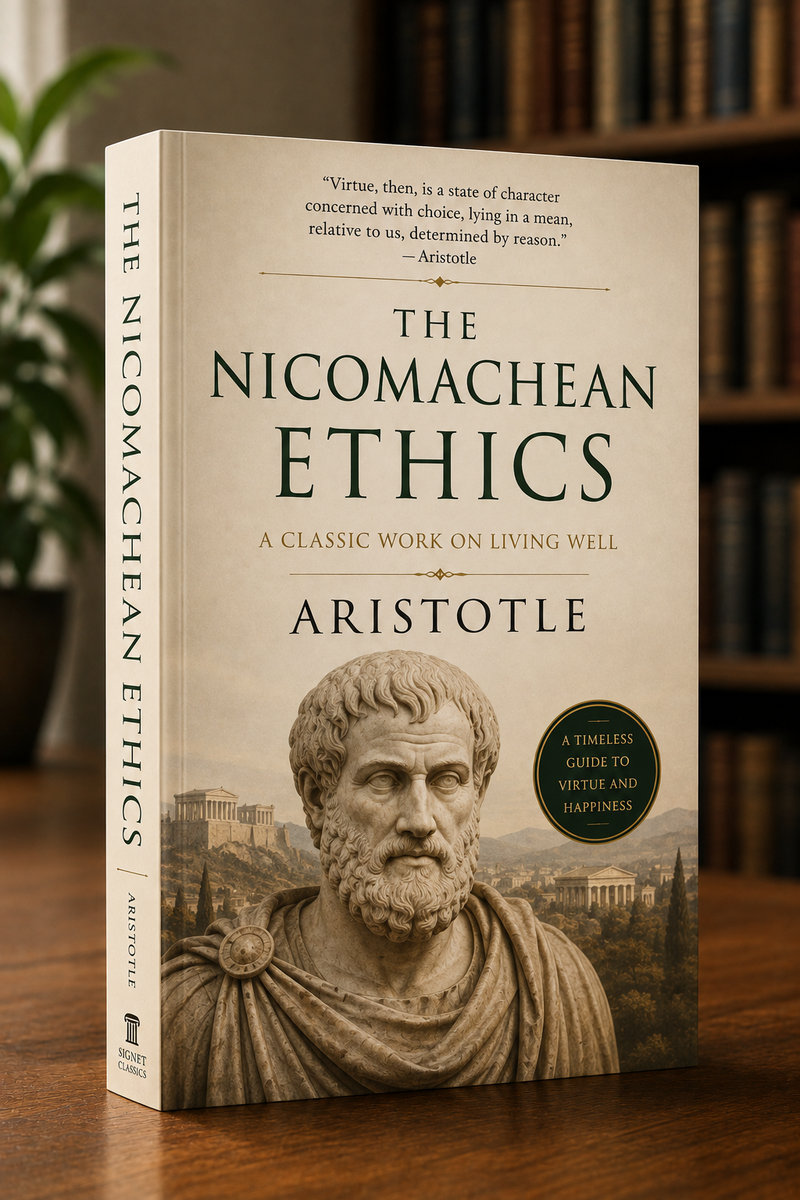
Our take in one line: this isn't a rulebook for telling right from wrong, it's a 2,300-year-old argument that ethics is less about following rules in the moment and more about slowly becoming, through practice, the kind of person who doesn't need them.
Try this before you read another word. Think of someone you'd genuinely call a good person, not someone who follows rules out of fear of getting caught, but someone whose decency seems to come naturally, almost without effort. Aristotle's entire book is an attempt to explain how a person gets to be like that: not by memorizing moral laws, and not by luck, but through a specific, learnable process of practice, reflection, and habit that he lays out across ten books of lecture notes.
- Core concept: Written around 350 BC, the Nicomachean Ethics argues that the goal of human life is eudaimonia, flourishing, achieved through virtuous activity guided by reason over a complete life.
- The framework: Virtue as a mean between two vices, one of excess and one of deficiency, with the exact midpoint determined relative to the individual and situation, not by a fixed formula.
- The mechanism: Habituation — virtue is built by repeatedly doing virtuous acts, the same way a skill is built by practicing it, not by simply understanding the theory behind it.
- The misconception: Eudaimonia is not the same as feeling happy or pleasure in the moment. It means living and acting well across an entire life, which sometimes requires real difficulty.
- The reframe: Ethics, for Aristotle, isn't primarily about rules or duties. It's about becoming the kind of person who reliably does the right thing, in the right way, for the right reasons, almost as second nature.
What The Book Actually Argues
Written around 350 BC, the Nicomachean Ethics began as lecture notes for Aristotle's school in Athens, the Lyceum, and takes its name, most scholars believe, from Aristotle's son Nicomachus, who is thought to have edited or preserved the material after his father's death. It stands as the most complete and influential ethical treatise to survive from ancient Greece, and it still anchors an entire branch of modern moral philosophy known as virtue ethics.
Aristotle opens by asking a deceptively simple question: what is the highest good at which all human activity ultimately aims? Other goods, wealth, honor, pleasure, health, are valuable, he argues, but always for the sake of something further. Only one end seems to be sought purely for its own sake, never as a means to something else: eudaimonia, usually translated as "happiness" but closer in meaning to "flourishing" or "living well."
From there, Aristotle builds what's known as the function argument. Everything with a characteristic activity, a knife, an eye, a flute player, is good insofar as it performs that activity well. Human beings, he argues, have a distinctive function too: activity guided by reason. It follows that the human good is activity of the soul in accordance with reason, performed excellently, which is to say, virtuously, and sustained across a complete life rather than a single lucky afternoon.
The Four Pillars of the Nicomachean Ethics
Across its ten books, the Nicomachean Ethics keeps returning to four interlocking ideas. Understanding them turns a dense ancient treatise into a genuinely usable framework.
- Eudaimonia. The highest human good, flourishing achieved through virtuous activity across a whole life, not a fleeting emotional state.
- The Doctrine of the Mean. Moral virtue as a balance point between two vices, excess on one side and deficiency on the other.
- Virtue as Habit. Character isn't given by nature or grasped purely through theory; it's built by repeatedly performing virtuous actions until they become second nature.
- Practical Wisdom (Phronesis). The intellectual skill of correctly judging what the virtuous mean actually looks like in a specific, real situation.
Eudaimonia: What "Happiness" Actually Means
Modern readers often import a modern idea of happiness, a positive feeling, a good mood, into this book, and it derails the whole argument. Aristotle's eudaimonia is closer to "flourishing" or "a life well lived" than to a passing emotion. Crucially, he argues it can only be judged across an entire life, not a single moment: a life can look successful for years and still not qualify as eudaimon if it ends in ruin or dishonor, and a life can involve real hardship while still counting as flourishing, if that hardship is met virtuously.
He also argues that eudaimonia isn't purely internal or independent of circumstance. External goods, health, some measure of wealth, good friends, a measure of good fortune, matter too, since virtuous activity needs resources and opportunity to actually express itself in the world. This is one of the book's more debated claims, since it means eudaimonia isn't entirely within our control, however virtuous we manage to become.
The Doctrine of the Mean
Aristotle's most famous and most practically useful idea is that moral virtue sits at a mean, a balance point, between two vices: one of excess and one of deficiency. Courage, for instance, is the mean between cowardice, too little confidence in the face of danger, and recklessness, too much. Generosity is the mean between stinginess and wastefulness.
Two details matter here, and both are frequently missed. First, this mean is not a fixed mathematical midpoint, it's relative to us, meaning it depends on the person, the situation, and the stakes involved; the right amount of anger in one circumstance is not the right amount in another. Second, finding that mean isn't a matter of simple calculation. It requires the fourth pillar, practical wisdom, applied fresh to each real situation.
Why Virtue Is a Habit, Not a Feeling
Aristotle draws a sharp line between the two broad kinds of virtue he identifies: intellectual virtues, like wisdom and understanding, which can be taught directly, and moral or character virtues, like courage and generosity, which cannot be taught by instruction alone. Character virtue, in his account, is acquired the same way a craft is acquired, by doing it, repeatedly, until it becomes stable disposition rather than a one-off effort.
This is why Aristotle insists that we become just by doing just acts, and courageous by doing courageous acts. Understanding the theory of courage doesn't make someone courageous. Repeatedly acting courageously, especially when it's difficult, is what gradually reshapes character until courage stops requiring effortful willpower and starts feeling like simply who the person is.
The Practical Reframe
If you want to become more patient, generous, or courageous, Aristotle's advice isn't to wait until you feel like the virtuous version of yourself before acting that way. It's to act the way that version of you would act, repeatedly, even before it feels natural, because the feeling of naturalness is the result of practice, not its prerequisite.
Practical Wisdom vs. Mere Cleverness
Aristotle distinguishes practical wisdom, phronesis, from mere cleverness. Cleverness is simply the skill of figuring out effective means to whatever end you happen to have, good or bad. Practical wisdom is the deeper capacity to correctly judge what a genuinely good end looks like in a specific situation, and then find the right means to it. A skilled manipulator can be clever without being practically wise; a practically wise person can't be manipulative, because practical wisdom is inseparable from good character in Aristotle's account.
This is part of why the doctrine of the mean isn't a loophole for rationalizing bad behavior as "balanced." The mean is defined by what a genuinely practically wise person would judge and choose, not by whatever compromise feels most comfortable in the moment.
Core Practices the Book Teaches
1. Habituation Through Small, Repeated Acts
Aristotle's central practical method is repetition: performing virtuous acts, even imperfectly at first, until the disposition takes hold. He compares it directly to learning a craft, no one becomes a builder by reading about building; they become one by building.
2. Locating the Mean in Real Situations
Because the mean is relative to the person and situation, Aristotle's method requires ongoing judgment rather than a fixed rulebook. Before reacting, especially to anger, fear, or desire, pause and ask which response would count as the mean here, not in general, but for this specific case.
- Deficiency example: staying silent about something that genuinely needed to be said, out of excessive caution.
- Excess example: saying far more than the situation called for, out of insufficient restraint.
- The mean: saying exactly what needed to be said, clearly, at the right moment, to the right person.
3. Reviewing Character, Not Just Outcomes
Because eudaimonia is judged across a whole life rather than a single result, Aristotle's framework invites reflecting on the kind of person a choice reveals you to be, not only on whether that choice worked out.
The Doctrine of the Mean, at a Glance
| Virtue (the Mean) | Deficiency | Excess |
|---|---|---|
| Courage | Cowardice | Recklessness |
| Generosity | Stinginess | Wastefulness |
| Good temper | Lack of spirit | Excessive irritability |
| Truthfulness | Self-deprecation | Boastfulness |
| Friendliness | Surliness | Flattery |
| Proper pride | Undue humility | Vanity |
Friendship: The Book's Longest, Most Overlooked Argument
Two of the ten books, close to a fifth of the entire work, are devoted to friendship, which Aristotle treats as essential to eudaimonia rather than optional to it. He identifies three kinds: friendships of utility, based on mutual usefulness; friendships of pleasure, based on mutual enjoyment; and friendships of virtue, based on mutual admiration of each other's good character. The first two, he notes, tend to dissolve once the usefulness or pleasure fades. The third, rarer and harder to build, is the only kind he considers a complete friendship, because each person wishes the other well for the other's own sake, not for what they provide.
Where the Book Strains
A useful summary tells you the limits too, not just the highlights. Three fair criticisms worth knowing before you dive in:
- The mean can feel vague. Critics point out that "the mean relative to us" offers less concrete guidance than it first appears, since correctly identifying it depends on practical wisdom, which is itself partly defined as the ability to identify the mean, a structure some find circular.
- Eudaimonia depends partly on luck. Because Aristotle allows that external goods, health, some wealth, good fortune, affect whether a virtuous life counts as fully flourishing, the theory leaves genuine tension between virtue as something we control and eudaimonia as something partly outside our control.
- Its social assumptions are dated and exclusionary. Aristotle wrote within, and explicitly defended elsewhere in his work, the norms of classical Athens, where full ethical and political agency was reserved for free male citizens, excluding women, slaves, and laborers. Modern readers generally extract the ethical framework while setting aside those exclusions.
Your 30-Day Character Practice Plan
- Week 1 — Choose one virtue to build. Pick a single virtue that matters to you right now, and each day, find one small, concrete way to act on it rather than merely think about it.
- Week 2 — Practice locating the mean. Before reacting to something frustrating or tempting, pause and ask what the mean response would look like here, specifically, not in general.
- Week 3 — Audit one friendship. Reflect honestly on one important relationship using Aristotle's three categories, utility, pleasure, or virtue, and notice what that reveals.
- Week 4 — Review character, not just outcomes. At the end of each day, briefly ask not just "did that go well" but "what kind of person did that choice make me today."
Core Takeaways
Happiness means flourishing, not feeling good
Eudaimonia is judged across a whole life, not a single pleasant moment.
Virtue lives between two vices
The mean sits between excess and deficiency, and shifts with the person and situation.
Character is built, not born
Repeated virtuous action, not theory alone, is what actually shapes who you become.
Friendship isn't optional extra credit
Aristotle treats deep, character-based friendship as essential to a flourishing life.
Frequently Asked Questions
What is the main message of the Nicomachean Ethics?
That the goal of human life is eudaimonia, flourishing, achieved through virtuous activity guided by reason and practical wisdom, sustained across a complete life, and that virtue itself is built through habitual practice rather than theory alone.
What does eudaimonia mean?
Often translated "happiness," eudaimonia is closer to "flourishing" or "living and doing well." Aristotle judges it across an entire life rather than a single pleasant feeling, and treats it as the ultimate end that all other goods, wealth, health, honor, ultimately serve.
What is the doctrine of the mean?
Aristotle's theory that moral virtue lies at a balance point between two vices, one of excess and one of deficiency, courage between cowardice and recklessness, for example. The exact mean is relative to the individual and situation, not a fixed formula.
Can virtue be taught, or is it only built through habit?
Aristotle distinguishes intellectual virtues, which can be taught directly through instruction, from moral or character virtues, like courage and generosity, which he argues are built primarily through repeated practice, the way a craft is learned by doing it.
What are Aristotle's three kinds of friendship?
Friendships of utility, based on mutual usefulness; friendships of pleasure, based on mutual enjoyment; and friendships of virtue, based on mutual admiration of each other's good character. Only the third, rarer and harder to build, counts as complete friendship in his account.
Final Verdict
Whether the Nicomachean Ethics lands for a given reader often depends on whether they're looking for rules to follow or a process to undergo. Aristotle offers little in the way of a checklist. What he offers instead is a patient, practical argument that good character isn't handed to us at birth and can't be downloaded through insight alone, it has to be built, action by action, the way any real skill is built. Nearly 2,400 years later, and after entire philosophical movements have come and gone, that basic claim, that we become good by practicing goodness, still holds up as one of the most useful ideas ethics has ever produced.