The Highly Sensitive Person by Elaine Aron: The Complete, Easy-to-Understand Summary
One question quietly runs through this entire book: what if the trait you were told to "toughen up" out of was never a weakness in the first place? Here's every core idea, explained in plain English, with a practice plan you can start today.
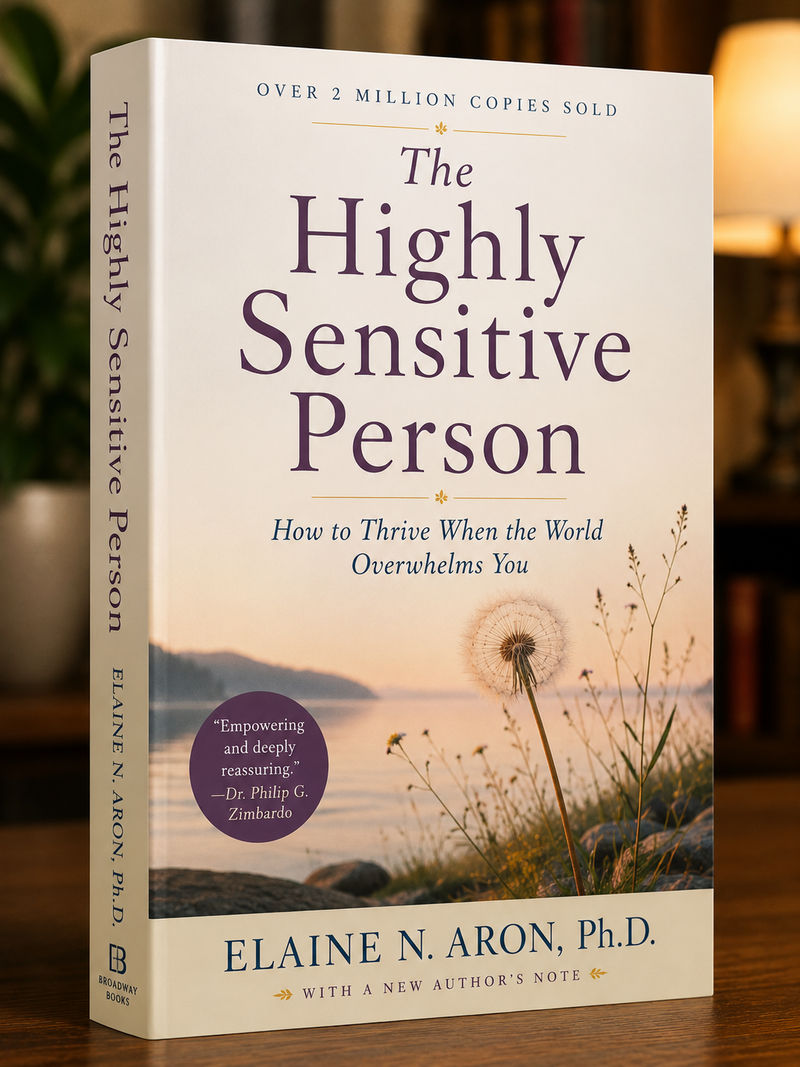
Our take in one line: this is less a self-help book and more a permission slip, one that turns a lifetime of being told "you're too much" into a coherent, workable explanation.
Try this before you read another word. Think of the last time a bright light, a loud room, someone else's bad mood, or a looming deadline left you feeling far more drained than it seemed to affect the people around you. Now consider that Elaine Aron's entire book is built on the idea that this isn't a personal failing. It's a measurable, inherited trait shared by roughly one in five people, and it comes with real advantages most people never hear about.
- Core concept: High sensitivity, or sensory processing sensitivity, is a normal, innate trait present in about 15 to 20 percent of people, not a disorder.
- The framework: DOES — Depth of processing, Overstimulation, Emotional responsiveness, and Sensing subtleties — defines the trait.
- The mechanism: A more responsive nervous system that processes stimulation more thoroughly, reaching overstimulation sooner than average.
- The misconception: High sensitivity is not the same as introversion; roughly 30 percent of HSPs are extroverts.
- The reframe: Sensitivity carries real strengths, empathy, creativity, conscientiousness, when managed with the right environment and self-care.
What The Book Actually Argues
Published in 1996, The Highly Sensitive Person was one of the first mainstream books to argue that a trait long dismissed as shyness, weakness, or "being too emotional" is actually a well-documented temperament dimension: sensory processing sensitivity (SPS). Elaine Aron, a research psychologist, built the book on her own studies into this trait, which she found in roughly 15 to 20 percent of people, and even across many other species in the animal kingdom.
The central argument is that high sensitivity is not a disorder to be fixed or a personality quirk to apologize for. It's an innate way of processing the world more deeply, and once a person understands the trait, they can stop fighting their own nervous system and start working with it.
The DOES Framework, Explained
Aron summarizes the trait using the acronym DOES, and argues all four elements need to be present for someone to be considered highly sensitive:
- D — Depth of processing. HSPs tend to think more thoroughly about information and experiences before acting, often below the level of conscious awareness.
- O — Overstimulation. Because more is being processed, HSPs reach a state of overwhelm sooner in loud, busy, or emotionally intense environments.
- E — Emotional responsiveness and empathy. HSPs tend to feel emotions, their own and other people's, more intensely.
- S — Sensing subtleties. HSPs often notice small details, in a room, a conversation, or someone's tone, that others miss entirely.
Overstimulation and the Nervous System
Aron connects overstimulation to a well-established idea in psychology called the Yerkes-Dodson law: performance and wellbeing peak at a moderate level of arousal, then decline once stimulation becomes excessive. Her argument is that HSPs simply hit that excessive point sooner than the average person, not that they're incapable of handling stimulation at all.
This reframes a familiar experience, needing to leave a party early, feeling frazzled after a full day of meetings, dreading a chaotic environment, not as a lack of resilience, but as a nervous system doing exactly what it's built to do, just on a shorter runway than most.
Why Sensitivity Isn't a Flaw
A major thread of the book addresses the shame many HSPs carry from childhood, often shaped by parents, teachers, or peers who labeled their sensitivity as overreacting, being dramatic, or simply "too much." Aron argues this messaging can cause HSPs to internalize a false belief that something is wrong with them, layering unnecessary self-doubt on top of an already intense inner experience.
The Practical Reframe
When you notice yourself feeling ashamed of needing quiet time, a break from a crowded room, or space after an emotional conversation, Aron's suggestion isn't to push through and ignore it. It's to recognize the need as a legitimate feature of a highly sensitive nervous system, not evidence of weakness.
Sensitive Does Not Mean Fragile
A common misreading of the book is that high sensitivity means being unable to cope with a demanding life. Aron is explicit that this isn't the case: with the right understanding, environment, and self-care, HSPs can and do thrive in demanding careers, relationships, and creative pursuits.
Sensitivity vs. Introversion
One of the book's most useful clarifications is that high sensitivity and introversion are not the same trait, even though they're often confused. Aron found that roughly 30 percent of highly sensitive people are actually extroverts, meaning they still draw energy from social interaction while also processing stimulation more deeply and reaching overstimulation sooner.
- Introversion/extroversion: Describes where a person gets their energy, from solitude or from social interaction.
- High sensitivity: Describes how deeply the nervous system processes stimulation, regardless of where someone gets their energy.
Core Practices the Book Teaches
1. Building in Recovery Time
Aron repeatedly emphasizes scheduling deliberate downtime, quiet, low-stimulation periods, rather than waiting until overstimulation forces a shutdown. Treating recovery as a regular need, not an emergency measure, is one of her most practical recommendations.
2. Managing Environment Deliberately
Because HSPs are more affected by their surroundings, Aron encourages actively shaping environments, lighting, noise levels, pacing, rather than simply enduring whatever conditions are presented by default.
- Reactive approach: Pushing through a loud, overstimulating workspace until burnout hits.
- Deliberate approach: Requesting a quieter desk, using noise-canceling headphones, or scheduling focused work during low-traffic hours.
HSP Nervous System vs. Average Nervous System, at a Glance
| Dimension | Highly Sensitive Person | Average Nervous System |
|---|---|---|
| Processing depth | Processes information and experience more thoroughly. | Processes at a more standard, faster pace. |
| Overstimulation threshold | Reached sooner, in louder or busier environments. | Reached later, with more tolerance for stimulation. |
| Emotional response | Feels emotions, own and others', more intensely. | Feels emotions with typically less intensity. |
| Noticing detail | Picks up on subtle cues others often miss. | Tends to notice fewer subtle details by default. |
| Recovery need | Needs regular quiet time to reset. | Can typically go longer without dedicated downtime. |
HSPs in Relationships and Work
Aron applies the trait directly to relationships and careers, arguing that HSPs often bring valuable qualities, deep empathy, conscientiousness, careful decision-making, to both, but can struggle in environments that don't account for their need for lower stimulation or recovery time. A relationship or workplace that misunderstands sensitivity as weakness can quietly erode an HSP's confidence over time.
Where the Book Strains
A useful summary tells you the limits too, not just the highlights. Three fair criticisms worth knowing before you dive in:
- Self-report assessment has limits. The HSP scale Aron developed relies on self-reported answers, and some researchers argue this leaves room for overlap with other traits like neuroticism or general anxiety.
- The construct is still debated. While sensory processing sensitivity has gained more research support since the book's release, some psychologists continue to debate exactly where its boundaries lie compared to existing personality traits.
- Can be over-applied as a label. As the term has become more popular, it's sometimes stretched to explain almost any emotional intensity, which risks diluting a specific psychological framework into a catch-all identity label.
Your 30-Day Sensitivity Plan
- Week 1 — Notice your DOES. Each day, jot down one moment where depth of processing, overstimulation, emotional response, or noticing subtlety showed up clearly.
- Week 2 — Schedule recovery time. Build at least one deliberate quiet block into each day, rather than waiting until you're already overstimulated.
- Week 3 — Adjust one environment. Change one recurring source of overstimulation, lighting, noise, a chaotic schedule, in a space you control regularly.
- Week 4 — Practice naming it out loud. The next time you need to set a boundary around stimulation, state the need plainly to someone else instead of silently pushing through or apologizing for it.
Core Takeaways
Sensitivity is a trait, not a flaw
Roughly 1 in 5 people share this innate, well-documented temperament dimension.
DOES defines the whole trait
Depth of processing, overstimulation, emotional responsiveness, and sensing subtleties all need to be present.
Overstimulation isn't weakness
A shorter runway to overwhelm reflects a more responsive nervous system, not a lack of resilience.
Sensitive and introverted aren't the same
About 30 percent of HSPs are extroverts, so the two traits describe different things entirely.
Frequently Asked Questions
What is the main message of The Highly Sensitive Person?
That high sensitivity is a normal, innate temperament trait found in roughly 15 to 20 percent of people, not a flaw or a disorder, and that understanding it as sensory processing sensitivity allows highly sensitive people to work with their nervous system instead of fighting or hiding it.
What is the DOES framework in The Highly Sensitive Person?
DOES is Elaine Aron's acronym summarizing the four core features of the trait: Depth of processing, being easily Overstimulated, Emotional responsiveness and empathy, and Sensing subtleties that others tend to miss. Aron argues all four need to be present for someone to be considered highly sensitive.
Is being a highly sensitive person the same as being an introvert?
No. Aron found that around 30 percent of highly sensitive people are extroverts. Sensitivity is about how deeply the nervous system processes stimulation, while introversion and extroversion describe where a person gets their energy from, and the two traits can combine in different ways.
What does overstimulation mean for a highly sensitive person?
Because highly sensitive people process sensory and emotional input more deeply, their nervous system reaches a state of overstimulation sooner than average, which can show up as feeling overwhelmed, needing to withdraw, or performing worse under noise, crowds, or time pressure.
Is The Highly Sensitive Person backed by science?
Elaine Aron is a research psychologist, and the book is built on her own studies into sensory processing sensitivity, a trait that has since been studied further in personality psychology and, more recently, neuroscience. That said, some aspects of the self-report HSP scale and the boundaries of the trait remain subjects of ongoing academic debate.
Final Verdict
Whether The Highly Sensitive Person lands for a given reader often depends on whether they, or someone close to them, have spent years wondering why ordinary situations felt more intense than they seemed to for everyone else. Aron's framework doesn't promise to make sensitivity disappear, and it isn't a substitute for addressing anxiety or other mental health concerns that may coexist with it, but it offers something rarer: a clear, research-grounded explanation that turns a source of lifelong shame into a trait that can be understood, managed, and even leveraged. For readers who've felt "too much" their whole lives, it can be genuinely validating. For readers wanting a rigorous clinical diagnosis, it's better read as a temperament framework than a medical one. Either way, its central invitation, work with your nervous system instead of against it, remains just as practical now as it was in 1996.