The Compound Effect by Darren Hardy: The Complete, Easy-to-Understand Summary
Why nobody's life changes in one dramatic moment — it changes in thousands of small, boring choices that quietly compound while nobody's watching.
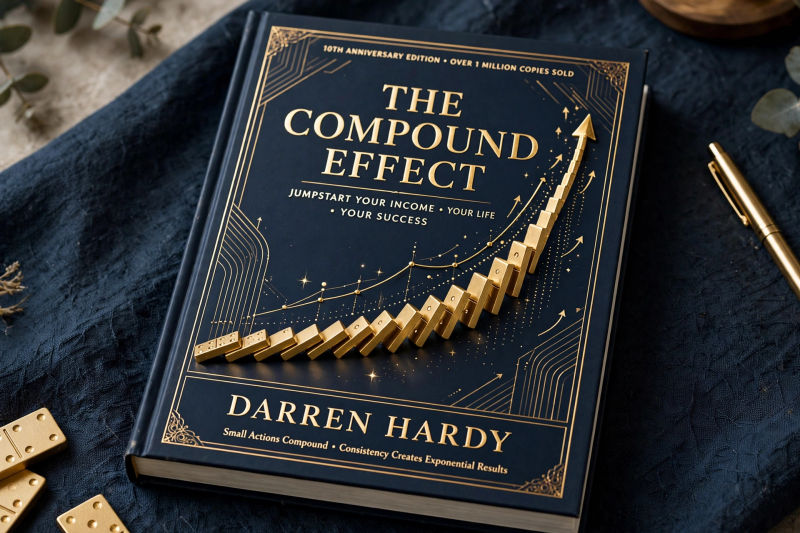
Quick thought experiment: would you rather have $3 million handed to you today, or a single penny that doubles in value every day for 31 days? Almost everyone's gut says take the $3 million. But run the math, and the doubling penny quietly overtakes it, ending the month worth more than $10 million — with almost all of that growth happening in the final handful of days. Darren Hardy opens his book with exactly this trap, because it's also the trap most people fall into with their own habits: they underestimate how much small, consistent choices are worth, simply because the early returns look too small to matter.
- Core concept: Small, smart choices, repeated consistently over time, produce massive results — the same math works in reverse for small bad choices.
- The trap: Early progress from good habits looks so small it feels pointless, which is exactly why most people quit right before the results accelerate.
- Own your choices: Every outcome in your life traces back to a choice you made — and every choice sets off a chain of consequences.
- Momentum matters: Once a good habit gets moving, it takes far less effort to keep it going than it did to start it.
- Influences shape you: What you consume, who you associate with, and the environment you're in quietly steer your choices more than willpower does.
The Core Idea
Darren Hardy's The Compound Effect makes a simple, almost mathematical argument: success isn't the result of luck, a single big break, or one heroic decision. It's the result of a handful of small, ordinary choices, repeated with consistency for long enough that they compound into something dramatic. The same principle explains failure — a handful of small, ordinary bad choices, repeated the same way, quietly compound into decline.
What makes the compound effect easy to ignore, Hardy argues, is that it's invisible in the short term. Skipping dessert once doesn't change your body. Reading ten pages once doesn't change your career. Saving twenty dollars once doesn't change your finances. None of these choices feel significant in the moment — which is precisely why most people never stick with them long enough to see the curve bend upward.
Reactive Mindset vs. Compound Mindset
| Feature | Reactive Mindset | Compound Mindset |
|---|---|---|
| Belief about results | Big results need a big, dramatic action. | Big results come from small actions repeated consistently. |
| View of small choices | Too minor to matter; easy to dismiss. | The real levers; every choice sets off a chain reaction. |
| Response to slow progress | Quits when early results feel invisible. | Trusts the curve and keeps going through the flat part. |
| Relationship to tracking | Rarely tracks; relies on memory and motivation. | Tracks choices and habits to stay accountable. |
| View of influences | Assumes surroundings and associations don't matter much. | Deliberately curates inputs, people, and environment. |
The Compound Effect in Action: Real-World Domains
1. The Compound Effect in Health and Fitness
Hardy illustrates the principle with three friends who each want to lose the same amount of weight. One changes nothing. One makes an obvious, immediate change — cutting calories hard for a short burst — then quits when it feels too restrictive. The third makes small, sustainable shifts, like cutting 125 calories a day and walking a bit more, and simply keeps doing it. Months later, the third friend has transformed their health while the other two are back where they started — proof that consistency beats intensity when intensity can't be sustained.
2. The Compound Effect in Money and Wealth
Hardy contrasts two financial approaches drawn straight from the compound effect:
- Reactive spenders: treat small purchases as insignificant, avoid tracking expenses, and wait for a big windfall — a raise, a bonus, a lucky break — to fix their finances.
- Compound savers: automate small, consistent saving and investing habits, track spending closely, and let time and compounding interest do the heavy lifting instead of waiting for a single big financial event.
3. The Compound Effect in Relationships
Hardy applies the same logic to relationships: it's rarely one dramatic betrayal that ends a marriage or friendship, and rarely one grand gesture that builds a strong one. Small, repeated deposits — a daily check-in, a kept promise, a moment of real attention — compound into deep trust over years. Small, repeated withdrawals — a dismissed comment, a broken small promise, chronic distraction — compound into distance, long before anyone names it as a problem.
The Penny That Doubles
Hardy's clearest illustration of exponential compounding is the choice he poses at the very start of the book.
$3 Million vs. a Doubling Penny
Offered a straight $3 million today, or a single penny that doubles in value every single day for 31 days, most people instinctively grab the cash. But the doubling penny finishes the month worth over $10 million — and more than half of that total value appears only in the final few days. Early on, the penny looks like a joke: after two weeks it's still worth less than $164. The lesson isn't about money — it's that consistent small choices look worthless right up until the moment they suddenly aren't.
Why This Matters
- It explains why most people give up on good habits right before the results become visible.
- It shows that consistency, not intensity, is what unlocks exponential rather than linear growth.
- It reframes patience with a "boring" habit as a rational trade, not a lack of ambition.
The Choices-Habits-Momentum Framework
- Own your choices. Stop blaming circumstances and start tracking the small decisions that are actually within your control, day to day.
- Turn a choice into a habit. Repeat the same small action consistently until it requires less willpower to do it than to skip it.
- Build momentum. Once a habit is rolling, protect it — momentum is far easier to maintain than it was to create in the first place.
- Curate your influences. Deliberately choose what you read and watch, who you spend time with, and the environment you operate in, since all three quietly shape your choices.
- Accelerate. Once a habit is stable, raise the bar slightly rather than staying comfortable — small increases compound just as much as the original habit did.
Where the Book Falls Short
A useful summary tells you the limits too, not just the highlights. Three fair criticisms worth knowing:
- Light on research, heavy on anecdote. Hardy writes from experience as a publisher and motivational speaker rather than from rigorous academic study, so the book reads more like practical philosophy than a scientifically validated framework.
- Can understate outside factors. The "100 percent responsible" framing is motivating, but taken too literally it can minimize real structural barriers — health conditions, financial hardship, unequal opportunity — that small daily choices alone can't fully offset.
- Risk of obsessive tracking. The book's heavy emphasis on tracking every choice and habit can tip into a rigid, anxious relationship with self-monitoring for readers who are already prone to perfectionism.
Your 30-Day Starter Plan
- Week 1: Track one area of your life daily — spending, food, or time — without changing anything yet. Just build awareness of your current choices.
- Week 2: Pick one small, sustainable change in that area, and repeat it daily, even when the results feel invisible.
- Week 3: Audit your influences — what you're reading, watching, and who you spend the most time with — and swap one input for something that supports your goal.
- Week 4: Once the habit feels automatic, raise the bar slightly and use the momentum you've built to take on a bit more.
Core Takeaways
Small choices compound
Consistency turns tiny, unremarkable actions into dramatic long-term results.
The flat part is normal
Early progress looks invisible by design — that's not a sign to quit, it's the setup for the curve.
Track to stay honest
Writing choices down makes patterns visible that memory and intention alone will miss.
Influences aren't neutral
What you consume and who you spend time with quietly compounds too — choose deliberately.
Frequently Asked Questions
What is the main idea of The Compound Effect by Darren Hardy?
That massive success or failure is rarely the result of one big event — it's the accumulated result of small, ordinary choices repeated consistently over a long period of time.
What is the penny-doubling story about?
It's a thought experiment comparing $3 million handed over today against a single penny that doubles in value every day for 31 days. The doubling penny ends up worth more, but nearly all of its growth happens in the final few days, illustrating how compounding results stay hidden until late in the process.
What is the Choices-Habits-Momentum framework?
Hardy's core structure for applying the compound effect: consciously own your choices, repeat them until they become habits, then protect and build the momentum those habits create, while curating the influences that shape your decisions.
Why do people give up on good habits too early?
Because early results from small, consistent actions are often too small to notice, so people mistake a lack of visible progress for a lack of real progress and quit right before the compounding effect accelerates.
What role do "influences" play in the book?
Hardy identifies three: what you feed your mind (input), who you spend time with (associations), and your physical surroundings (environment) — all of which shape your choices more than willpower alone does.
Has The Compound Effect faced any criticism?
Yes. Critics note it leans on anecdote rather than academic research, that its "100 percent responsibility" framing can understate real structural barriers, and that its emphasis on constant tracking can tip into obsessive self-monitoring for some readers.
Conclusion
Strip away the case studies, and The Compound Effect makes one grounded claim: you don't need a dramatic reinvention to change your life — you need a small, smart choice, repeated long enough for the math to start working in your favor. By owning your choices, turning them into habits, protecting the momentum they create, and curating what influences you, anyone can bend their own curve upward. You don't need to overhaul everything today. Just pick one small choice you're willing to repeat tomorrow, and let time do the rest.