Sapiens by Yuval Noah Harari: The Complete, Easy-to-Understand Summary
One hundred thousand years ago, at least six human species shared the planet. Today there's just one — us. Yuval Noah Harari's global phenomenon asks how an unremarkable ape ended up running the whole show, and argues the answer has less to do with muscle or tools than with our unmatched ability to believe in things that don't physically exist. Here's every core idea, explained in plain English, with a practice plan you can start today.
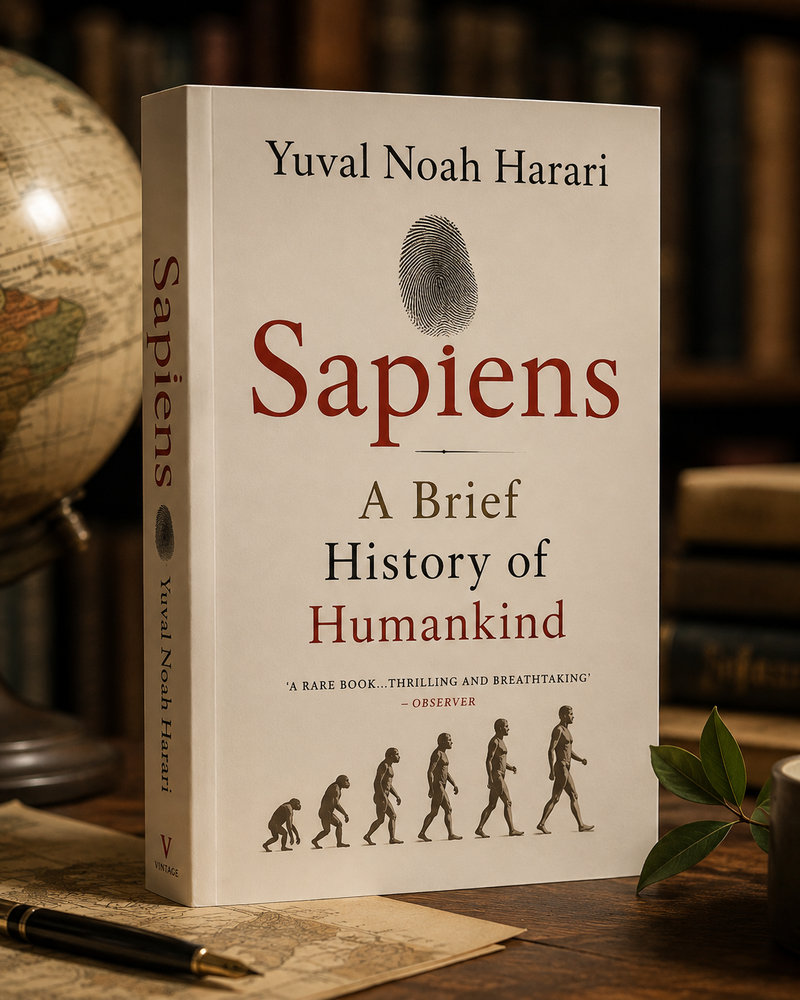
Our take in one line: this isn't really a book about the past, it's a book about noticing that most of the rules you live inside — money, borders, companies, even human rights — are stories humanity agreed to believe, which means they can be rewritten.
Try this before you read another word. Pick up a banknote, or picture your bank balance on a screen. It has no nutritional value, no shelter value, no survival value on its own. Yet people will trade real food, real labor, and real years of their lives for it, entirely on trust. Yuval Noah Harari's 2011 book (published in English in 2014) argues that this small act of collective make-believe is the same trick behind nations, religions, corporations, and legal systems — and that learning to see the trick is the key to understanding how a mid-sized savanna ape ended up building cities, empires, and spacecraft.
- Core concept: Published in Hebrew in 2011 and in English in 2014, the book traces how Homo sapiens went from one of several human species to the sole ruler of Earth, blending biology, anthropology, and economics into a single narrative.
- The framework: Three revolutions structure the story — Cognitive (roughly 70,000 years ago), Agricultural (roughly 10,000 years ago), and Scientific (roughly 500 years ago) — alongside a fourth theme, the gradual unification of humankind through money, empire, and religion.
- The mechanism: What separates sapiens from every other species, living or extinct, is the capacity to invent and collectively believe in fictions — stories with no physical existence that let total strangers cooperate in the millions.
- The misconception: Many readers expect a triumphant march of progress. Harari repeatedly complicates that picture, arguing the Agricultural Revolution may have made individual life harder even as it made the species collectively more powerful.
- The reframe: History was never inevitable. It was shaped by contingent, invented stories — which means those stories, examined honestly, can still be questioned and rewritten today.
What The Book Actually Argues
Yuval Noah Harari's book, subtitled A Brief History of Humankind, began as lecture notes for an undergraduate course at the Hebrew University of Jerusalem before its 2011 Hebrew publication and 2014 English release. It went on to sell more than 25 million copies in over 65 languages, spend upward of 220 weeks on the New York Times bestseller list, and earn a place on the paper's own readers' list of the top 100 books of the 21st century. It has drawn public praise from figures ranging from Barack Obama to Bill Gates.
The book's central question is deceptively simple: around 100,000 years ago, at least six species of humans coexisted on Earth, including Neanderthals in Europe and Homo erectus in Asia. Today, only Homo sapiens remains. What let this one species out-compete, out-cooperate, and in some cases likely eradicate its closest relatives, then go on to build cities, empires, corporations, and eventually reshape the planet's climate and its own genetic code?
Harari's answer unfolds across three revolutions that reorganized how humans think, live, and cooperate — the Cognitive Revolution, the Agricultural Revolution, and the Scientific Revolution — with a fourth connective thread, the slow unification of humankind through the spread of money, empires, and religions, running underneath all three.
The Four Pillars of the Book
Beneath the sweep of the narrative, four recurring ideas carry the argument.
- The Cognitive Revolution. Around 70,000 years ago, a shift in sapiens' mental abilities allowed for a new kind of language, one that could describe not just real things but pure fictions, unlocking cooperation at a scale no other species has matched.
- The Agricultural Revolution. Around 10,000 years ago, humans began domesticating wheat and other crops. Harari controversially frames this as a trade that expanded the species' collective power while, for centuries, making individual daily life harder.
- The Unification of Humankind. Money, empires, and religions each spread their own version of a universal order, gradually stitching thousands of once-separate human cultures into a single interconnected system.
- The Scientific Revolution. Starting roughly 500 years ago, an unusual admission — "we do not know" — combined with capitalism and imperial ambition to produce an explosion of knowledge, power, and, eventually, the tools to remake life itself.
Imagined Orders: The Fictions That Run the World
Harari's most influential idea is a three-way split in how anything can be said to exist. Objective reality exists independently of what anyone believes, a mountain's elevation stays the same whether or not a single person is thinking about it. Subjective reality exists only inside one person's private mind, a headache is real, but only to the person feeling it. Between these sits a third category Harari calls intersubjective reality: things that exist only because a critical mass of people collectively believe in them and act accordingly. Money, nations, corporations, laws, and human rights all belong here.
None of these intersubjective entities has any physical form of its own. A dollar bill is paper; a corporation is a filing cabinet of documents; a nation is a story told across generations. Yet Harari argues these fictions are not lesser or fake in any meaningful sense, they are, in fact, the single most powerful force in human history, more decisive than tools, weapons, or even genetics, because they are what allow strangers who will never meet to trust each other enough to trade, build, fight wars, or form governments together.
Foragers vs. Farmers: Two Ways of Living Compared
Harari illustrates the stakes of the Agricultural Revolution through a direct comparison. Foraging bands, he argues, typically worked fewer hours, ate a more varied and often healthier diet, and lived with less hierarchy, since a family that fell on hard times could usually just walk toward better foraging grounds. Early farming communities, by contrast, worked longer and more repetitive hours tending a narrow set of crops, faced worse nutrition from a less varied diet, suffered more from crowd diseases and famine when a single harvest failed, and found themselves newly tied to one plot of land they could no longer easily leave.
Neither lifestyle wins outright in Harari's telling. Foraging left populations small and technologically limited, vulnerable to any environmental disaster large enough to wipe out a band with no reserves. Farming, whatever it cost individuals, allowed populations to grow explosively, supported the first cities, writing systems, and specialized professions, and set the species on a trajectory toward the scale of cooperation everything since has depended on.
The Luxury Trap: How Progress Quietly Backfires
Harari uses the phrase "luxury trap" for a pattern he sees recurring throughout history: a convenience is adopted because it makes one part of life easier, people adjust their expectations and habits around it, and within a generation or two the luxury has quietly become a necessity, often demanding more total effort to maintain than the harder life it replaced. He splits the pressures that drive this pattern into two broad categories.
- Biological drives (internal pressure): instincts shaped over millions of years of foraging, craving calorie-dense food, seeking status, avoiding short-term discomfort, that evolution never updated for a world of surplus and abundance.
- Cultural fictions (external pressure): the intersubjective systems, markets, employers, social expectations, that quietly convert yesterday's convenience into today's baseline requirement.
Harari's broader point is that most "progress" is judged by whether it increases a society's collective power and output, not whether it increases any individual's actual day-to-day wellbeing, and those two measures can move in completely opposite directions for centuries at a stretch.
Why the Stories We Tell Determine the World We Build
The book's most practical claim is easy to state and uncomfortable to sit with: since intersubjective fictions like money, nations, and corporations only exist because enough people keep imagining them into being, they are not fixed laws of nature, they are collective decisions, made and remade every day by the people who participate in them. Recognizing a system as a shared fiction rather than an immovable fact is, in Harari's account, the first step toward being able to question or reshape it.
The Practical Reframe
If a rule, hierarchy, or system in your life feels like an unchangeable fact of nature, Harari's suggestion is to check whether it's actually an intersubjective fiction, something that persists only because enough people keep treating it as real.
Core Practices the Book Teaches
1. Question What Feels "Natural"
Harari treats the word "natural" as a red flag worth investigating rather than a conversation-ending fact, since so much of what feels inevitable in daily life, from gender roles to property rights to national identity, has a specific, traceable historical starting point.
2. Notice the Myth Behind the Money
Because intersubjective fictions are easiest to see once you're looking for them, Harari's method involves practicing on the most familiar one of all: currency.
- Unexamined view: money has value because it's money.
- Examined view: money has value because a large enough group of strangers has agreed, without ever meeting, to keep trusting it.
3. Ask the Happiness Question Before Calling Something Progress
Because collective power and individual wellbeing can diverge sharply, Harari's method involves pausing before labeling any technological or social shift as an improvement, and asking directly whether it made daily life for actual people better, not just more productive or more efficient.
Three Levels of Reality, at a Glance
| Dimension | Objective Reality | Subjective Reality | Intersubjective Reality |
|---|---|---|---|
| Definition | Exists independent of anyone's belief or awareness. | Exists only within one individual's private mind. | Exists through shared belief across a large network of people. |
| Example | A mountain's elevation; radioactive decay. | A personal feeling of fear or love. | Money, national borders, corporations, laws. |
| Disappears if belief stops? | No, it persists regardless. | Yes, the moment that one person's belief or feeling stops. | Only if enough people simultaneously stop believing at once. |
| Harari's synthesis | Most of recorded history is driven not by objective facts alone, but by shared fictions. | These fictions can be rewritten if enough people choose to imagine differently. | |
The Story Behind the Book
Harari, born in Israel in 1976, earned his PhD in history from the University of Oxford in 2002 and teaches at the Hebrew University of Jerusalem. Sapiens grew directly out of an undergraduate world history course he taught there, reworked into a single accessible narrative for a general audience rather than a specialist one, an unusual move for an academic historian at the time. The book's blend of biology, economics, and anthropology into one sweeping story was initially a hard sell to publishers used to narrower, more conventional history titles, but it went on to become one of the defining nonfiction books of its decade.
Its success also launched Harari into an unusual role as a public intellectual, giving keynote talks at the World Economic Forum, engaging with heads of state, and writing further books, including Homo Deus and Nexus, that extend the same intersubjective-reality framework forward into questions about artificial intelligence, biotechnology, and information networks.
Where the Book Strains
A useful summary tells you the limits too, not just the highlights. Three fair criticisms worth knowing before you dive in:
- Specialists have pushed back on the sweeping claims. Archaeologists and anthropologists have challenged some of the book's broader generalizations about foraging life and the Agricultural Revolution, arguing the historical and archaeological record is messier and more regionally varied than a single global narrative can capture.
- Breadth sometimes comes at the cost of precision. Covering biology, economics, and anthropology in one continuous story means some claims that feel definitive on the page are, in specialist literature, still actively debated or only partially supported.
- The later chapters lean more speculative. The sections on the Scientific Revolution, capitalism, and the future of the species blend established historical claims with Harari's own predictions and opinions more freely than the earlier, more evidence-grounded chapters.
Your 30-Day Practice Plan
- Week 1 — Notice the fictions. Each day, catch three intersubjective fictions you interacted with, money, brands, job titles, laws, national identity, and name them explicitly as fictions.
- Week 2 — Trace one assumption to its origin. Pick something that feels "natural" in your daily life and research when and why humans actually invented that arrangement.
- Week 3 — Track a luxury trap. Notice one convenience in your life, a phone, an inbox, a subscription, that has quietly become an obligation demanding more effort than it saves.
- Week 4 — Ask the happiness question. Pick one recent change in your life or in the world and ask honestly whether it increased actual wellbeing, or only capability, output, or convenience.
Core Takeaways
History has no single destination
Nothing about how we live today was inevitable, it could have gone differently at almost every turn.
Fictions built civilization
Shared stories, not just tools, are what let strangers cooperate at massive scale.
Progress and wellbeing aren't the same
A society can grow more powerful while individuals inside it grow less happy.
The stories can be rewritten
Because these systems are collectively imagined, examining them is the first step toward changing them.
Frequently Asked Questions
What is the main message of Sapiens?
That Homo sapiens rose to dominate the planet primarily through the unique ability to invent and collectively believe in fictions, shared stories like money, nations, and religions, that let total strangers cooperate at a scale no other species has ever managed.
What are the three revolutions in Sapiens?
The Cognitive Revolution (around 70,000 years ago, the rise of complex, fiction-capable language), the Agricultural Revolution (around 10,000 years ago, the shift to farming), and the Scientific Revolution (around 500 years ago, the systematic pursuit of knowledge combined with capitalism and empire).
What does Harari mean by an "imagined order" or fiction?
Something that exists only because a large enough group of people collectively believes in it and behaves accordingly, with no independent physical existence of its own, examples include money, corporations, nations, and legal systems.
Has Sapiens been criticized by historians and scientists?
Yes. Specialists in archaeology and anthropology have challenged some of its broader generalizations, particularly around foraging societies and the Agricultural Revolution, arguing the actual historical record is more regionally varied than a single sweeping narrative allows.
Is Sapiens still worth reading in 2026?
Yes, largely because its central framework, that most of the systems running modern life are collective fictions rather than fixed facts, remains a genuinely useful lens for questioning institutions, technology, and social norms, even where individual historical claims are debated.
Final Verdict
Whether Sapiens lands for a given reader often depends on their appetite for a book that moves at enormous speed across a hundred thousand years of history without pausing long to defend every individual claim. Harari never fully resolves whether the story he tells is one of triumph or cautionary tale, and by his own logic, that ambiguity may be the point. What the book offers instead is a genuinely useful habit of mind: the instinct to ask, of any system that feels permanent and natural, who actually invented it, and whether it still deserves to be believed in. More than a decade after its publication, that habit of mind is still the book's most enduring argument.