Thinking, Fast and Slow by Daniel Kahneman: The Complete, Easy-to-Understand Summary
A Nobel Prize–winning psychologist's uncomfortable discovery: most of your "decisions" were never really decisions at all — they were snap judgments your brain dressed up as reasoning after the fact.
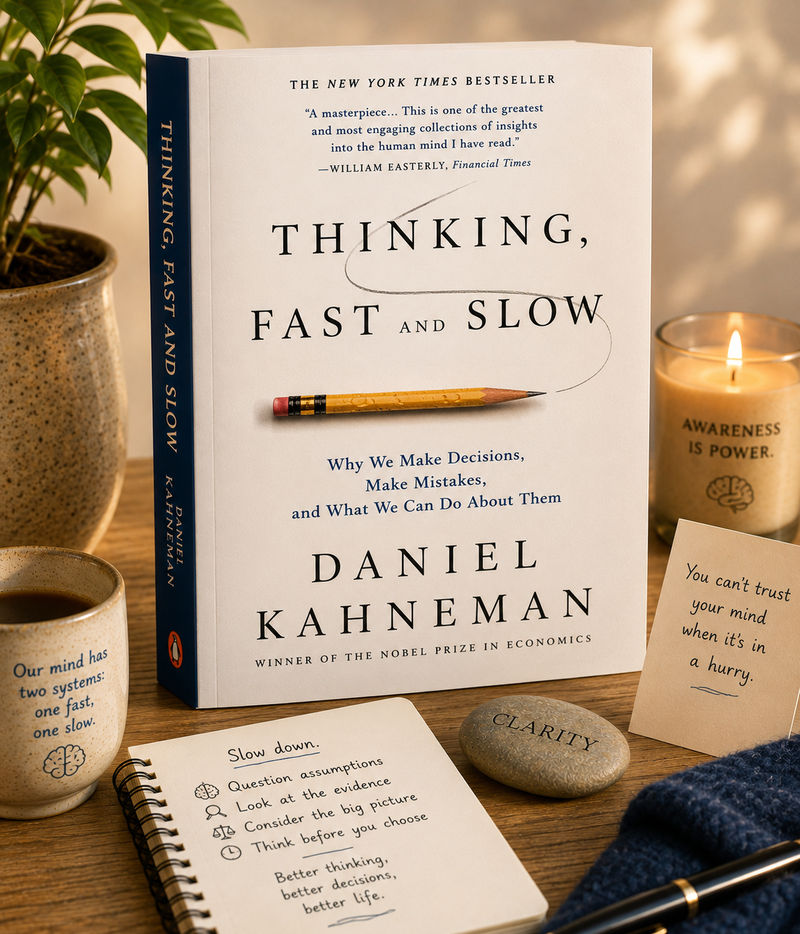
Quick test: a bat and a ball cost $1.10 together. The bat costs $1 more than the ball. How much is the ball? If "10 cents" jumped into your head first, you're not alone — and you're also wrong. (It's 5 cents.) Daniel Kahneman opens with puzzles exactly like this one because they prove something unsettling about the mind: it doesn't wait to be right, it waits to feel confident. Thinking, Fast and Slow spends over 400 pages mapping the gap between those two things, drawing on decades of research Kahneman conducted largely with his late collaborator Amos Tversky — work that eventually won Kahneman the Nobel Prize in Economics, despite being, at heart, a psychologist.
- Core concept: Two mental "systems" run your thinking — System 1 is fast, automatic, and intuitive; System 2 is slow, effortful, and deliberate. Most errors happen when System 1 handles something it shouldn't.
- WYSIATI: "What You See Is All There Is" — the mind builds a confident story from whatever information is on hand, rarely pausing to ask what's missing.
- Prospect theory: People don't evaluate outcomes in absolute terms; they evaluate gains and losses relative to a reference point, and losses hurt roughly twice as much as equivalent gains feel good.
- Overconfidence is structural: Experts, forecasters, and ordinary people are all reliably more certain than the evidence justifies — a pattern Kahneman calls the "illusion of validity."
- You have two selves: The "experiencing self" lives each moment; the "remembering self" writes the story afterward — and it's the remembering self that makes most future decisions.
The Core Idea
Kahneman's central claim is architectural: the mind isn't one unified reasoning engine, it's two systems working in an uneasy partnership. System 1 operates automatically and instantly — recognizing a face, reacting to a loud noise, finishing the phrase "war and ___." System 2 is the effortful, conscious thinking used for a task like multiplying 17 by 24, or checking a legal contract line by line. System 2 is slower, more accurate, and lazier than most people assume — it tends to accept whatever confident answer System 1 hands it, rather than double-checking.
The book's real subject is where this partnership breaks down. System 1 is brilliant at pattern recognition and terrible at statistics; it substitutes easy questions for hard ones without telling you, and it's happiest when it can generate a coherent story — even from incomplete or misleading evidence. Most of the biases the book catalogs aren't random mistakes. They're System 1 doing exactly what it's built to do, just in situations where that shortcut quietly produces the wrong answer.
System 1 vs. System 2 at a Glance
| Feature | System 1 (Fast) | System 2 (Slow) |
|---|---|---|
| Speed | Instant, automatic, involuntary. | Deliberate; requires conscious effort. |
| Energy cost | Effortless — runs constantly in the background. | Mentally taxing; depletes with use. |
| Good at | Pattern recognition, snap judgments, emotion. | Logic, statistics, rule-following, checking. |
| Weak spot | Jumps to conclusions from incomplete data. | Lazy — often just approves System 1's answer. |
| Typical example | Detecting anger in a voice; reading a billboard. | Filling out a tax form; parking in a tight space. |
Fast and Slow Thinking in Action: Real-World Domains
1. Money & Choices: Prospect Theory
Kahneman and Tversky's prospect theory overturned a core assumption of classical economics: that people evaluate outcomes based on final wealth. Instead, people evaluate gains and losses relative to a reference point — usually the status quo — and losses are felt roughly twice as intensely as equivalent gains, a pattern called loss aversion. This explains why people will take a bigger gamble to avoid a certain loss than they will to secure an equivalent certain gain, and why the pain of losing $100 outweighs the pleasure of finding $100.
2. Predictions & Confidence: The Illusion of Validity
The book is unsparing about expert forecasting. Kahneman describes studying stock pickers, political analysts, and clinical psychologists and finding that confidence in a prediction was reliably unrelated to its accuracy — professionals felt certain about outcomes that were, statistically, close to coin flips. He calls this the "illusion of validity": the more coherent a story feels, the more confident we become in it, regardless of how much real predictive power the underlying data actually has.
- Illusion-prone approach: trusting a confident, coherent narrative about the future without checking it against a track record or base rate.
- Evidence-based approach: deliberately asking "what does the historical base rate say?" before trusting a specific, story-driven prediction.
3. Memory & Well-Being: The Two Selves
Kahneman distinguishes between the "experiencing self," which lives each moment as it happens, and the "remembering self," which constructs a story afterward and is disproportionately shaped by the peak moment and the ending — a pattern known as the peak-end rule. Crucially, the duration of an experience barely registers in memory at all, a phenomenon called duration neglect. Because it's the remembering self that makes future decisions — booking the next vacation, choosing whether to repeat an experience — people often optimize their lives for a good story rather than a good set of moments.
WYSIATI: The Machine That Doesn't Know What It's Missing
One of Kahneman's most quietly unsettling ideas is WYSIATI — "What You See Is All There Is." It describes System 1's tendency to construct the most coherent possible story from whatever evidence happens to be in front of it, without pausing to ask what evidence might be missing.
WYSIATI in Practice
Hear one persuasive side of an argument, and it can feel completely convincing — not because it's correct, but because your mind isn't automatically prompted to imagine the missing counter-evidence. This is also why first impressions carry outsized weight: System 1 builds a confident, coherent picture of a person from minimal information and then defends that picture, a close cousin of what's known as the halo effect.
How to Counteract It
- Before finalizing a judgment, explicitly ask: "What information am I not seeing?"
- Deliberately seek out the strongest opposing case before settling on a confident conclusion.
- Remember that a coherent story and a true story are not the same thing — coherence is easy to manufacture from partial data.
10 Biases Worth Knowing by Name
- Anchoring effect. An arbitrary first number — even one you know is random — pulls your later estimates toward it.
- Availability heuristic. Events that are easy to recall (vivid, recent, emotional) feel more probable than they actually are.
- Representativeness heuristic. Judging likelihood by how much something resembles a stereotype, while ignoring actual base rates.
- Loss aversion. Losses are felt roughly twice as strongly as equivalent gains.
- Planning fallacy. Systematically underestimating how long a task will take, even when past projects have run over.
- Hindsight bias. Once an outcome is known, it retroactively feels like it was predictable all along.
- Regression to the mean. Extreme results tend to be followed by more average ones — often mistaken for the effect of some intervention.
- Halo effect. One positive trait (looks, charm) unconsciously colors judgments of unrelated traits (competence, honesty).
- Base rate neglect. Ignoring general statistical information in favor of specific, vivid details about an individual case.
- Sunk cost thinking. Continuing a losing course of action because of resources already invested, rather than future value.
Where the Book Falls Short
A useful summary tells you the limits too, not just the highlights. Four fair criticisms worth knowing:
- The replication crisis hit some chapters hard. Kahneman himself later acknowledged that several priming studies discussed in the book — particularly around subtle behavioral priming — did not replicate reliably in later research, a point he addressed candidly in public statements after publication.
- "Two systems" is a metaphor, not a map of the brain. Kahneman is explicit that System 1 and System 2 aren't literal brain regions; some readers still walk away treating the metaphor as more neurologically literal than intended.
- Heavy reliance on lab experiments. Many findings come from controlled studies, often with narrow participant pools, raising fair questions about how consistently they generalize to messy real-world decisions.
- Long and dense for casual readers. With over 400 pages covering decades of research, the book is thorough but demanding — some readers find the middle sections repetitive or overly technical.
Your 30-Day Starter Plan
- Week 1: Notice one snap judgment a day and ask afterward: "Was that System 1 or System 2 talking?" Just building the awareness is the goal.
- Week 2: Before a moderately important decision, deliberately look up a relevant base rate before trusting your gut estimate.
- Week 3: Practice steelmanning: for one belief you hold confidently, write out the strongest possible case against it.
- Week 4: Reflect on one experience using both selves — how it felt moment-to-moment (experiencing self) versus how you'd describe it looking back (remembering self). Notice the gap.
Core Takeaways
Two systems, one brain
Fast, automatic System 1 and slow, effortful System 2 divide the mental labor — and mistakes happen when the wrong one is in charge.
Confidence isn't accuracy
A coherent, confident-feeling story is easy to build from partial evidence — and easy to mistake for the truth.
Losses loom larger
Prospect theory shows people fear losses roughly twice as much as they value equivalent gains.
Two selves, one life
The self that lives your life and the self that remembers it aren't the same — and the remembering self usually wins.
Frequently Asked Questions
What is the main idea of Thinking, Fast and Slow?
That the mind runs on two systems — a fast, automatic System 1 and a slow, effortful System 2 — and most everyday errors in judgment happen when System 1 quietly handles a decision that actually needed System 2's scrutiny.
What is WYSIATI in Thinking, Fast and Slow?
"What You See Is All There Is" — Kahneman's term for the mind's habit of building a confident, coherent story from only the information immediately available, without pausing to consider what evidence might be missing.
What is prospect theory?
The Kahneman-Tversky model showing that people judge outcomes as gains or losses relative to a reference point, not in absolute terms, and that losses are felt roughly twice as intensely as equivalent gains — a pattern called loss aversion.
What are the "two selves" in the book?
The "experiencing self," which lives each moment as it happens, and the "remembering self," which constructs a story afterward based heavily on the peak moment and the ending, largely ignoring duration.
Has any of the research in Thinking, Fast and Slow been questioned?
Yes. Kahneman later acknowledged that some priming studies cited in the book, especially in the chapter on priming effects, did not hold up during psychology's replication crisis, though the core System 1/System 2 framework remains widely referenced.
Is Thinking, Fast and Slow hard to read?
It's more demanding than a typical pop-psychology book — dense, research-heavy, and long — but it's written for a general audience and doesn't require a background in statistics or psychology to follow.
Conclusion
Strip away the academic weight and the Nobel Prize, and Thinking, Fast and Slow makes one humbling claim: the feeling of being right and the fact of being right are produced by completely different processes, and your mind will rarely tell you which one it's currently running on. Learning to notice that gap — to ask "is this System 1 talking, or have I actually checked?" — is the book's real, lasting gift. You don't need to overhaul how you think. Just start noticing the next time a confident answer arrives suspiciously fast.