The Happiness Hypothesis by Jonathan Haidt: The Complete, Easy-to-Understand Summary
One question quietly runs through this entire book: was old wisdom actually right about happiness, or did we just get lucky guessing? Here's every core idea, explained in plain English, with a practice plan you can start today.
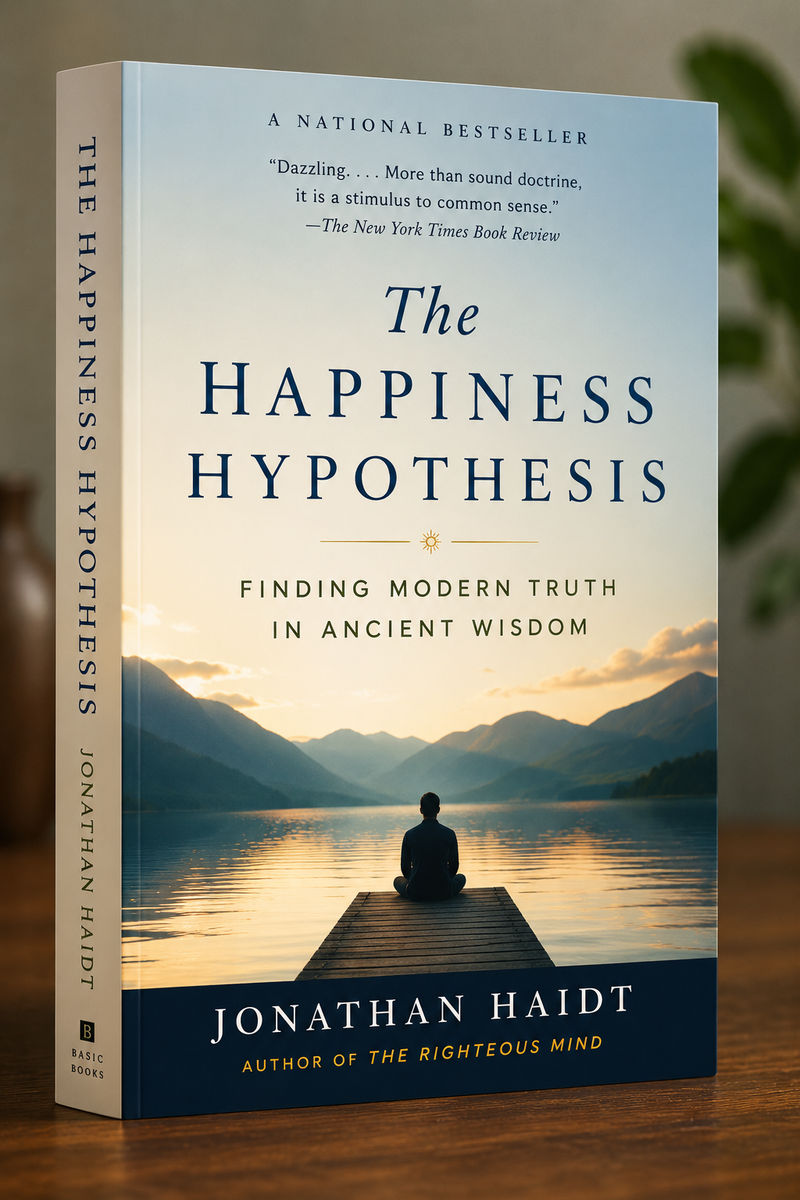
Our take in one line: this is the rare self-help-adjacent book written by someone whose actual job is to test whether the advice is true — and that discipline is exactly what makes it worth your time.
Try this before you read another word. Think of a moment you knew, logically, was the "right" thing to do — eat better, forgive someone, stop procrastinating — and did the opposite anyway. That gap between what you know and what you do is the exact starting point of the entire book. Jonathan Haidt's central claim is that the gap isn't a character flaw. It's the structure of your own mind.
- Core concept: Ten pieces of ancient wisdom, tested one by one against modern psychological research.
- The split: The mind is divided into an automatic "Elephant" and a controlled "Rider" — and the Elephant is far more powerful.
- The hidden trap: Predictable distortions in thinking that quietly warp how situations, people, and setbacks get judged.
- The formula: Happiness = Set point + Conditions + Voluntary activities — and Conditions matter far less than people assume.
- The goal: Not chasing pleasure, but building coherence between the Rider and Elephant, between yourself and others, and between yourself and something larger.
What The Book Actually Argues
Published in 2006, The Happiness Hypothesis takes an unusual approach for a book about happiness. Rather than inventing new advice, Jonathan Haidt, a social psychologist, gathers ten "great ideas" that show up again and again across Buddhism, Stoicism, Confucianism, Hinduism, and the Bible, and then puts each one on trial using modern experiments and data. Some old wisdom holds up. Some doesn't. The book is honest about both.
The throughline is that happiness is not a destination you arrive at once your circumstances are fixed. It's closer to a byproduct of the relationship between different parts of your own mind, your relationships with other people, and your connection to something beyond yourself. Haidt calls this final idea "the final version of the happiness hypothesis": happiness comes from between, not within.
The Rider and the Elephant
The book's most famous idea is a metaphor for how the mind is divided against itself. Haidt describes the conscious, reasoning part of the self as a small Rider perched on top of a much larger Elephant, which represents automatic processes: emotions, intuitions, and habits.
The Rider can see further ahead and plan, but has only limited control over the Elephant. When willpower fails, it's rarely because the Rider didn't understand what to do. It's because the Elephant simply didn't want to go along, which is why Haidt argues that lasting change has to work with the Elephant's instincts and habits, not just the Rider's logic.
The Automatic Mind's Distortions
Because the Elephant reacts faster than the Rider can reason, it introduces predictable distortions into how people judge situations. Haidt points to the mind's built-in negativity bias, its tendency to see confirming evidence for beliefs it already holds, and its habit of reacting to events long before conscious reasoning catches up.
This is why simply "knowing better" rarely changes behavior on its own. The Rider can win an argument about what should happen, while the Elephant keeps steering things in the old direction regardless, exactly the gap most people experience between intention and action.
The Adversity Hypothesis
One of the book's most carefully argued sections examines the old idea that suffering builds character. Haidt calls this the "adversity hypothesis" and treats it with real nuance rather than either endorsing or dismissing it outright.
The Practical Reframe
The evidence Haidt reviews is mixed: moderate, manageable adversity does tend to build resilience and even post-traumatic growth in many people. But severe, prolonged, or overwhelming adversity often causes lasting harm rather than strength. The old proverb is only half true, and knowing which half applies matters.
Growth Is Not Guaranteed
A common misreading of the "adversity builds character" idea is that any hardship is secretly good for you. Haidt is explicit that this isn't automatic: growth after adversity tends to depend on support, meaning-making, and manageable scale, not on suffering itself doing the work.
The Happiness Formula: H = S + C + V
Haidt presents a compact formula that summarizes decades of happiness research: H = S + C + V. H is your overall happiness, S is your biological set point, C is the conditions of your life, and V is the voluntary activities you choose to engage in.
- Set point (S) in action: Two people can win the same amount of money and settle back near their own baseline mood within months.
- Conditions (C) in action: A bigger house or a longer commute changes daily life, but research shows its effect on lasting happiness is smaller than most people expect.
- Voluntary activities (V) in action: Choosing to exercise, pursue a meaningful hobby, or practice gratitude tends to move happiness more than most changes in circumstance do.
Core Practices the Book Teaches
1. Meditation and Cognitive Therapy
Haidt discusses meditation and cognitive behavioral therapy as two of the most evidence-backed ways to actually retrain the Elephant, rather than just arguing with it. Both work by repeatedly interrupting automatic patterns until new ones take hold.
2. Cultivating "Vital Engagement"
A recurring theme is that flow, deep absorption in work or activity that matches your skills to a challenge, is one of the more reliable paths to genuine wellbeing. Haidt argues this kind of engagement matters more for lasting happiness than most passive pleasures do.
- Passive pleasure: scrolling, snacking, watching TV — pleasant but fades fast.
- Vital engagement: a hobby, project, or skill that fully absorbs your attention — builds happiness that lingers.
The Rider vs. The Elephant, at a Glance
| Dimension | The Elephant (Automatic Mind) | The Rider (Controlled Mind) |
|---|---|---|
| Speed | Instant, reflexive reactions. | Slow, deliberate reasoning. |
| Power | Supplies the energy and motivation. | Supplies planning and foresight, but little raw power. |
| Role in change | Must be retrained through habit and practice. | Can set direction and intentions. |
| Driven by | Emotion, intuition, habit. | Logic, language, self-narrative. |
| Common failure | Reacts to old patterns and biases. | Mistakes its own justifications for the real reason behind a choice. |
Happiness in Love and Work
Haidt argues that two of the strongest, most consistently supported predictors of happiness are strong relationships and meaningful work. He describes happiness as arising from "between" rather than "within," meaning it grows in the connective tissue between a person and their partner, friends, and larger sense of purpose, not in isolation.
Where the Book Strains
A useful summary tells you the limits too, not just the highlights. Three fair criticisms worth knowing before you dive in:
- Some evolutionary explanations are speculative. Haidt leans on evolutionary psychology to explain why certain mental patterns exist, and while intriguing, some of these explanations are harder to test than the happiness research itself.
- Written before positive psychology matured further. Published in 2006, the book predates almost two decades of follow-up research, some of which has refined or challenged specific studies it cites.
- Dense in places. Because each chapter is built around testing a specific proverb against research, some sections read more like a literature review than a flowing narrative, which can slow down readers expecting a lighter self-help pace.
Your 30-Day Happiness Plan
- Week 1 — Notice the Elephant. Three times a day, pause and ask "was that reaction the Rider deciding, or the Elephant reacting?" Just observe it; don't judge it.
- Week 2 — Adjust the V, not the C. Pick one voluntary activity, a walk, a hobby, a call to a friend, and do it daily instead of waiting for your circumstances to change.
- Week 3 — Catch a cognitive distortion. When a negative thought spikes, name the distortion at play, catastrophizing, mind-reading, or overgeneralizing, before deciding whether to believe it.
- Week 4 — Invest in one relationship or one piece of work. Give real, undistracted attention to a single relationship or project, and notice how it compares to a typical passive-pleasure day.
Core Takeaways
You are the Rider, not the Elephant
Recognizing the split between automatic and controlled processing is the starting point for everything else the book teaches.
Conditions matter less than you think
The happiness formula shows voluntary activity moves the needle further than most changes in circumstance.
Adversity helps, but only sometimes
Moderate, manageable hardship can build resilience; overwhelming hardship usually just causes harm.
Happiness comes from between
Relationships, meaningful work, and connection to something larger matter more than internal willpower alone.
Frequently Asked Questions
What is the main message of The Happiness Hypothesis?
That ten pieces of ancient wisdom, from sources like Buddha, the Stoics, and the Bible, hold up remarkably well against modern psychological research, and that happiness comes not from getting everything you want but from the right relationship between the emotional and rational parts of the mind.
What is the Rider and the Elephant metaphor?
Haidt compares the mind to a Rider, the small conscious, reasoning part of the self, sitting atop an Elephant, the much larger automatic, emotional part. The Rider can plan and advise, but the Elephant provides the power, meaning lasting change requires training the Elephant, not just convincing the Rider.
What is the happiness formula in the book?
Haidt presents happiness as H = S + C + V, where S is a person's biological set point, C is the conditions of their life, and V is the voluntary activities they choose to do. The formula's key insight is that C matters far less than most people assume, while V can matter a great deal.
What is the adversity hypothesis?
The adversity hypothesis is the idea that suffering and setbacks can lead to psychological growth and strength, but Haidt is careful to show the evidence is mixed: moderate adversity often builds resilience, while overwhelming or prolonged adversity can cause lasting harm rather than growth.
Is The Happiness Hypothesis backed by science?
Yes, more so than most popular psychology books. Haidt is a social psychologist and structures the book around testing ancient proverbs and wisdom against peer-reviewed research, though some of the evolutionary psychology explanations remain more speculative than proven.
Final Verdict
Whether The Happiness Hypothesis lands for a given reader often depends on how much patience they have for a book that treats happiness as a hypothesis to be tested rather than a promise to be sold. Haidt's willingness to say "this old idea turned out to be wrong" is rare in the genre, and it's exactly what gives the ideas that do hold up their weight. For readers who want a rigorous, honest tour through what psychology actually knows about a good life, it delivers. For readers who want a quick emotional pick-me-up, it may feel more like a course syllabus than a hug. Either way, its central invitation, that lasting happiness comes from the space between the Rider and the Elephant, and between yourself and others, remains just as useful now as it was in 2006.