The Gifts of Imperfection by Brené Brown: The Complete, Easy-to-Understand Summary
A practical field guide to letting go of who you think you're supposed to be, and becoming who you actually are — built from ten specific, learnable practices, not one big idea.
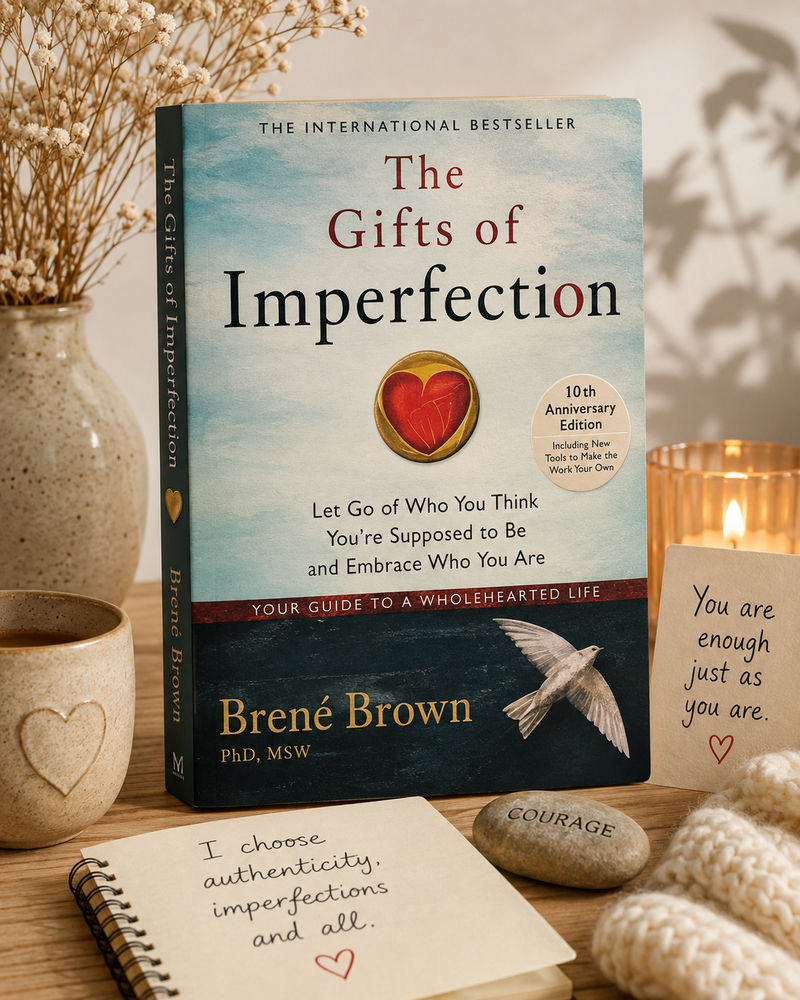
Quick thought experiment: you get invited to a beginner's painting class. Your first, instant thought isn't "that sounds fun" — it's "I'm not creative," and you decline before you've even considered it. Nobody tested that claim. You just believe it, the same automatic way you might believe you're "not a runner" or "not a public speaker" or "not someone people really choose to be close to." Brené Brown's argument in The Gifts of Imperfection is that most of these quiet, lifelong verdicts aren't facts about you — they're old coping strategies, dressed up as self-knowledge, that once kept you safe from judgment and now just keep you small. This is the book that goes furthest in showing exactly how to take them off, one specific practice at a time.
- Core concept: Wholehearted living means engaging with your life from a place of worthiness you already have — not one you earn through achievement or approval.
- Ten Guideposts, not one idea: Brown turns a decade of research into ten specific, learnable practices, each pairing something to cultivate with something to consciously let go of.
- Perfectionism is armor, not ambition: it's a shield against shame and judgment, dressed up as high standards — and it blocks the very connection it's trying to protect.
- Scarcity culture: the constant background hum of "never enough" — not thin enough, not successful enough, not certain enough — is the engine behind most of the letting-go work in this book.
- Belonging beats fitting in: belonging means you don't have to change who you are to be accepted; fitting in means constantly editing yourself in hopes of being accepted.
The Core Idea
Brown built the book from the same large body of interviews behind her broader shame and vulnerability research, but this time she went looking specifically for what the most Wholehearted people in her data — the ones who described a strong, steady sense of love and belonging — actually did differently in daily life. She found it wasn't a personality type, an income bracket, or a lack of hardship. It was a set of repeated, ordinary practices. That distinction matters: it means Wholeheartedness isn't a trait you either have or don't, it's a skill you build the same way you'd build any other habit.
Brown also makes a point of reclaiming the word "courage" back to its original root — from the Latin word for heart — meaning something closer to telling the story of who you are with your whole self, not just the polished version. That reframing runs through the entire book: the goal isn't to become fearless or flawless, it's to keep showing up honestly even while afraid or flawed, because that's what courage actually meant before it got confused with confidence.
The Ten Guideposts to Wholehearted Living
This is the actual backbone of the book — ten chapters, each built the same way: something worth deliberately cultivating, paired with an old coping habit worth consciously letting go of. Skimming this list alone will give you a genuinely accurate map of the entire book.
| # | Cultivate | Let Go Of |
|---|---|---|
| 1 | Authenticity | What people think of you |
| 2 | Self-Compassion | Perfectionism |
| 3 | A Resilient Spirit | Numbing and powerlessness |
| 4 | Gratitude and Joy | Scarcity and fear of the dark |
| 5 | Intuition and Trust | The need for certainty |
| 6 | Creativity | Comparison |
| 7 | Play and Rest | Exhaustion as a status symbol |
| 8 | Calm and Stillness | Anxiety as a lifestyle |
| 9 | Meaningful Work | Self-doubt and "supposed to" |
| 10 | Laughter, Song, and Dance | Being cool and always in control |
Two things are easy to miss on a first read. First, every guidepost is a pair — you're not just adding a virtue, you're actively releasing the specific coping strategy that's been standing in its way. Second, the order isn't random: authenticity and self-compassion come first because Brown treats them as the foundation the other eight are built on. Try practicing gratitude or creativity while still hiding your real self out of fear of judgment, and it tends not to stick.
Perfectionism vs. Self-Compassion at a Glance
| Feature | Perfectionism | Self-Compassion (Wholehearted) |
|---|---|---|
| Core question | "What will they think of me?" | "How can I grow, for myself?" |
| What a mistake means | Proof that you're not enough. | Evidence that you're human. |
| The standard | Impossible, and it keeps moving. | Realistic, and allowed to flex with reality. |
| Response to shame | Hide it, perform past it, overcompensate. | Name it out loud, reach out, stay connected. |
| "Good enough" | Doesn't really exist as a category. | Is the actual, achievable goal. |
The Guideposts in Action: Real-World Domains
1. The Guideposts in Relationships & Belonging
Brown draws a sharp line between fitting in and belonging, and it's one of the most quoted ideas in the book for a reason. Fitting in means scanning a room, figuring out who you're "supposed" to be to be accepted, and performing that version of yourself. Belonging means showing up as you already are and being accepted anyway — which means it's only available to people willing to risk being their actual, unedited selves. This directly powers Guidepost 1 (Authenticity): you cannot belong anywhere using a self you invented for the occasion, because the people around you end up connected to a performance, not to you.
2. The Guideposts at Work and in Creativity
Guidepost 6 — cultivating creativity by letting go of comparison — gets a lot of real-world traction here. Brown argues creativity isn't a talent some people have and others don't; it's a practice that comparison quietly shuts down, because the moment you're measuring your work against someone else's, you've stopped making something honest and started managing an image. Paired with Guidepost 9 (meaningful work over self-doubt and "supposed to"), the chapter pushes readers to separate work that's genuinely theirs from work chosen because it looked impressive or safe to other people.
- Comparison-driven approach: measures your work against someone else's highlight reel before it's even finished, and quietly kills the attempt.
- Guidepost-driven approach: makes the thing first, privately, purely because making it means something to you.
3. The Guideposts in Rest, Play, and Everyday Life
Guideposts 7 and 8 take direct aim at a habit Brown found almost everywhere in her data: treating exhaustion as proof of worth, and constant anxious busyness as simply how life is. She argues rest and play aren't rewards you earn after enough productivity — they're basic needs, and skipping them regularly is itself a form of numbing, not a sign of discipline. This connects back to Guidepost 3 (resilient spirit over numbing): scrolling, overworking, and staying perpetually busy all function the same way emotionally, keeping you too occupied to feel whatever you're actually avoiding.
The Scarcity Spiral: "Never Enough"
Running underneath most of the ten guideposts is a pattern Brown calls scarcity culture — and once you see it, it's hard to unsee in your own self-talk.
The Scarcity Spiral
First, a quiet background belief runs: never thin enough, never successful enough, never certain enough, never good enough. That belief triggers a rush to prove worth through perfect performance, achievement, or control. When the impossible bar inevitably isn't met — because it was never meetable — the failure gets read as further proof of "not enough," which deepens the original belief and demands even harder striving next time. Brown's point: the spiral isn't solved by finally achieving enough. It's only interrupted by refusing to accept scarcity's terms in the first place.
How to Interrupt the Spiral
- Notice when "not enough" shows up as the reason behind a decision, and name it as scarcity talking, not fact.
- Practice gratitude deliberately — Brown pairs joy and gratitude in Guidepost 4 because she found joy without gratitude tends to curdle into fear of losing it.
- Decide "enough" on purpose, in advance, instead of letting it be measured after the fact by outcome.
How to Start Practicing Wholeheartedness
- Pick one guidepost, not all ten. Brown's own research subjects built this over years — start with Authenticity or Self-Compassion, since the other eight tend to rest on those two.
- Catch one moment of self-editing. Notice a specific instance this week where you shaped yourself to be accepted, and ask what the unedited version would have said instead.
- Swap one perfectionist thought for a self-compassionate one. Replace "I should have done this better" with "I did this with what I had today."
- Protect one hour of real rest or play. No productivity purpose allowed — the point is that it doesn't need to justify itself.
- Name scarcity out loud when it shows up. Simply saying "that's scarcity talking, not truth" starts to loosen its grip.
Where the Book Falls Short
A useful summary tells you the limits too, not just the highlights. Four fair criticisms worth knowing:
- Ten guideposts can feel like a lot to hold at once. Compared to a single, sharp thesis, the ten-part structure is comprehensive but can feel diffuse — readers sometimes finish the book unsure which practice to actually start with.
- Some guideposts are thinner than others. Chapters like Authenticity and Perfectionism draw on deep research and stories; later ones, like Calm & Stillness or Laughter, Song & Dance, are shorter and more impressionistic by comparison.
- The "letting go" language can quietly backfire. Readers prone to self-criticism can turn "let go of comparison" into a new thing to fail at — noticing you're still comparing yourself to others and then feeling ashamed of that, too.
- Built mainly on qualitative interviews. As with Brown's other work, the evidence base leans on grounded-theory interviews rather than large randomized studies, so readers wanting harder quantitative backing may want to pair it with other research.
Your 30-Day Starter Plan
- Week 1 — Authenticity & Self-Compassion: Notice one moment daily where you edit yourself for others' approval. Replace one self-critical thought each day with a self-compassionate one.
- Week 2 — Resilient Spirit & Gratitude: Track your go-to numbing habit (scrolling, snacking, overworking) without judging it. Write down three specific things you're grateful for each night.
- Week 3 — Creativity & Meaningful Work: Make one small thing purely for yourself, with no audience. Notice one "I'm supposed to" thought about your work and question where it actually came from.
- Week 4 — Play, Rest & Calm: Schedule one real block of rest or play with zero productivity purpose. Practice saying no once this week to protect your calm.
Core Takeaways
Worthiness isn't earned
It's the starting point for Wholehearted living, not a prize you win after enough achievement.
Perfectionism is armor
Not ambition — a shield against judgment that ends up blocking the connection it was meant to protect.
Belonging beats fitting in
Belonging never requires you to change who you are to be accepted — fitting in always does.
Comparison steals creativity
The moment you measure your work against someone else's, you've stopped making something honest.
Frequently Asked Questions
What is the main idea of The Gifts of Imperfection?
That Wholehearted living — engaging with life from a place of worthiness you already have — is built from ten specific, learnable practices, not a personality trait or a single mindset shift. Each practice pairs something to cultivate with an old coping habit to let go of.
What are the Ten Guideposts to Wholehearted Living?
Authenticity, Self-Compassion, a Resilient Spirit, Gratitude and Joy, Intuition and Trust, Creativity, Play and Rest, Calm and Stillness, Meaningful Work, and Laughter, Song, and Dance — each paired with a specific thing to let go of, such as perfectionism, comparison, or the need for certainty.
What's the difference between perfectionism and healthy striving?
Healthy striving is self-focused and asks "how can I improve?" Perfectionism is other-focused and asks "what will people think?" — it treats mistakes as proof of unworthiness rather than as part of being human.
What's the difference between fitting in and belonging?
Fitting in means changing who you are to be accepted by a group. Belonging means being accepted as you already are, without having to edit yourself — which is why Brown treats authenticity as a requirement for real belonging, not just a nice bonus.
What is scarcity culture, or "never enough"?
The constant cultural background belief that you're never thin, successful, certain, or accomplished enough. Brown argues it drives perfectionism, comparison, and numbing, and that it's interrupted by gratitude and by consciously deciding what's "enough" rather than letting outcomes decide it for you.
How does this book relate to Daring Greatly?
Both come from the same body of shame and vulnerability research. Daring Greatly focuses more narrowly on vulnerability and courage in relationships, parenting, and leadership; The Gifts of Imperfection widens the lens into ten concrete daily practices for building worthiness overall.
Has the book faced any criticism?
Yes. Common critiques include the ten-guidepost structure feeling like a lot to hold at once, some chapters being thinner than others, the risk of "letting go" language becoming a new source of self-criticism, and a reliance on qualitative interviews over large-scale quantitative research.
Conclusion
Strip away the ten labels, and The Gifts of Imperfection makes one grounded claim: the parts of yourself you've spent years editing out — the uncertainty, the unfinished creative attempts, the need for rest, the moments you didn't have it all together — were never actually the problem. They're the raw material Wholehearted living is built from. You don't need to master all ten guideposts at once. Just pick the one guidepost that stung a little reading this article, and let go of one small piece of armor this week.