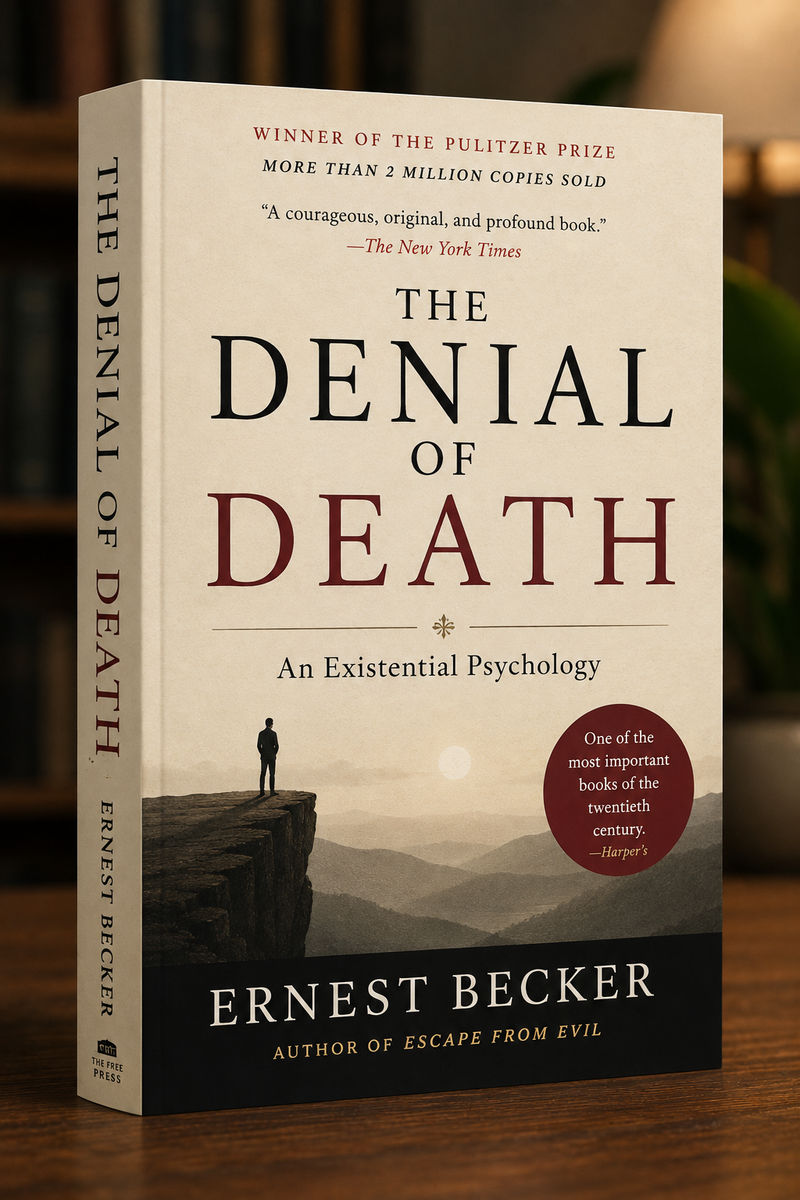
The Denial of Death by Ernest Becker: The Complete, Easy-to-Understand Summary
One question quietly runs through this entire book: what if almost everything you chase, status, love, legacy, achievement, is secretly an attempt to feel like you won't really die? Here's every core idea, explained in plain English, with a reflection plan you can start today.
Our take in one line: this is one of the few books that can make you re-read your own life's choices, career, relationships, even hobbies, and suddenly see the same fear running underneath all of them.
Try this before you read another word. Think about the last time you felt a genuine flash of panic about not mattering, about being forgotten, about your work amounting to nothing. Now consider that Ernest Becker's entire book is built on the idea that this exact flash of panic, usually buried, is running quietly under almost every ambition, relationship, and belief system you have. That's the starting point of his Pulitzer Prize-winning argument.
- Core concept: The fear of death is the single deepest driver of human motivation, mostly operating outside conscious awareness.
- The paradox: Humans are part physical animal, doomed to decay, and part symbolic self, capable of imagining limitless meaning.
- The coping mechanism: "Hero systems," beliefs, careers, relationships, or causes that let a person feel their life transcends physical death.
- The trade-off: A "vital lie," a necessary illusion, keeps people functional; too little or too much of this illusion causes different kinds of breakdown.
- The legacy: The book directly inspired terror management theory, a major and still-active area of experimental social psychology.
What The Book Actually Argues
Published in 1973 and awarded the Pulitzer Prize shortly after Becker's death, The Denial of Death weaves together psychoanalysis, anthropology, and existential philosophy into a single, ambitious claim: the awareness of mortality is not just one psychological issue among many, it is the central organizing fact of human life, and most of culture and personality can be understood as an elaborate, largely unconscious response to it.
Becker draws heavily on Freud, but reinterprets much of psychoanalysis through a different lens, arguing that what Freud attributed mainly to sexual repression is, underneath, more often a response to death anxiety. He also leans on the psychoanalyst Otto Rank's ideas about the fear of both life and death to build his central framework.
The Human Paradox: Part Animal, Part Symbol
At the center of the book is what Becker calls the essential paradox of being human: a person is simultaneously a physical animal, a body that eats, ages, and will decay, and a symbolic self, a mind capable of language, imagination, and a felt sense of limitless meaning and possibility.
Becker argues this creates a strange internal contradiction, memorably describing human beings as creatures who can imagine gods and eternity while still needing to attend to the most ordinary bodily functions. The symbolic self reaches for immortality; the physical body is a constant, undeniable reminder that it will end.
Hero Systems and Immortality Projects
Because directly facing this paradox is, in Becker's view, too much for most people to tolerate constantly, cultures and individuals build what he calls hero systems or immortality projects: belief systems, careers, causes, or roles that let a person feel their life has significance that outlasts physical death.
A hero system doesn't have to involve literal belief in an afterlife. Building a company, raising children, creating art, devoting oneself to a nation or a cause, all can function as symbolic ways of mattering beyond one's own lifespan. Becker argues that nearly every culture, in this sense, is a collective hero system for managing death anxiety.
The Vital Lie and Repression
Becker calls the necessary illusions that let a person function day to day, rather than being paralyzed by constant awareness of death, the vital lie. He argues a healthy amount of this repression and self-deception is not a flaw but a requirement for ordinary functioning; total, unfiltered awareness of mortality at all times would be unbearable.
The Practical Reframe
Becker's view of mental health is more nuanced than "face reality at all costs." He suggests that too little illusion can lead to a kind of paralyzing depression or breakdown, while too much rigid illusion can lead to a brittle, fragile character that shatters when life inevitably challenges it.
This Is Not a Call to Despair
A common misreading of Becker is that he's arguing life is meaningless because it's built on illusion. He's careful to frame the vital lie as necessary and even valuable, not something to be angrily torn away, since he sees total unfiltered confrontation with mortality as psychologically dangerous rather than heroic.
Romantic Love as a Substitute Religion
One of the book's most striking arguments concerns modern romantic love. Becker suggests that as traditional religion lost its grip on Western culture, many people quietly transferred their need for a god-like source of meaning onto a romantic partner, expecting a single relationship to provide the sense of ultimate significance once supplied by faith.
- Healthy hero system: A relationship as one meaningful part of a fuller life, alongside work, community, and belief.
- Overloaded hero system: A relationship expected to single-handedly resolve someone's entire fear of insignificance and death, an expectation Becker argues no partner can realistically meet.
What The Book Suggests Instead of Denial
1. Conscious Awareness Over Blind Repression
Becker doesn't offer a step-by-step self-help program, but he does point toward a middle path: neither total denial of death nor total unshielded confrontation with it, but a more conscious relationship with one's own mortality and the illusions that make life livable.
2. Holding Illusions Loosely
Drawing on Kierkegaard, Becker suggests that the healthiest orientation is one that can hold meaning-making beliefs with humility, aware that they are constructions that serve a real psychological need, rather than treating them as absolute, unquestionable truths.
- Rigid illusion: "My worth is entirely defined by this one achievement or relationship."
- Held loosely: "This gives my life meaning, and I also know it's one of several sources I could draw on."
Healthy Illusion vs. Neurotic Denial, at a Glance
| Dimension | Healthy Hero System | Neurotic Denial |
|---|---|---|
| Awareness of mortality | Acknowledged, if not constantly dwelt upon. | Fully repressed or frantically avoided. |
| Source of meaning | Spread across multiple roles and relationships. | Concentrated entirely in one person, cause, or role. |
| Flexibility | Beliefs held with some humility. | Beliefs treated as absolute and unquestionable. |
| Response to failure | Painful, but survivable and adaptable. | Can trigger breakdown or collapse of identity. |
| Underlying function | Provides workable meaning for daily life. | Serves as a fragile shield against unbearable anxiety. |
Death Denial in Everyday Life
Becker argues the fear of death shows up far beyond obvious moments like funerals or illness. He suggests it quietly shapes career ambition, nationalism, consumerism, and even everyday arguments, since defending one's worldview, political, religious, or personal, is often, underneath, a way of defending one's entire sense of meaning against the threat of insignificance.
Where the Book Strains
A useful summary tells you the limits too, not just the highlights. Three fair criticisms worth knowing before you dive in:
- Theoretical rather than experimental. Becker synthesizes existing psychoanalytic and philosophical ideas rather than running original studies, so the book itself offers argument and case illustration, not controlled data.
- Dense and academic in places. The prose assumes familiarity with Freud, Kierkegaard, and Otto Rank, which can make some chapters heavy going for readers new to psychoanalytic or existential theory.
- A totalizing framework. Explaining nearly all human behavior through death anxiety is a bold claim, and critics have argued it risks overreach, reducing complex motivations to a single underlying cause.
Your 30-Day Reflection Plan
- Week 1 — Notice your hero systems. Each day, name one activity, role, or belief that gives your life a sense of significance, and ask where that sense of significance actually comes from.
- Week 2 — Spot the vital lie at work. Notice moments where a comforting assumption, "I have plenty of time," "this will last," quietly shapes a decision, without judging it as good or bad.
- Week 3 — Diversify your meaning. Identify whether any single relationship, achievement, or role is carrying an outsized share of your sense of worth, and consciously invest a little attention elsewhere.
- Week 4 — Sit with the paradox. Spend a few quiet minutes acknowledging both your physical mortality and your capacity for meaning-making, without rushing to resolve the discomfort.
Core Takeaways
You are animal and symbol at once
Recognizing this paradox is the starting point for understanding why death anxiety runs so deep.
Ambition often hides a hero system
Careers, causes, and achievements frequently function as symbolic bids for lasting significance.
Illusion in moderation is healthy
The vital lie isn't weakness, it's what makes ordinary functioning possible, in the right amount.
Don't overload one relationship
No single partner or achievement can realistically carry an entire fear of insignificance.
Frequently Asked Questions
What is the main message of The Denial of Death?
That the awareness of our own mortality is the deepest driver of human behavior, and that most people manage this terror not by confronting it, but by unconsciously building "hero systems," cultural and personal illusions that make life feel significant, permanent, and meaningful.
What does Ernest Becker mean by the human paradox?
Becker describes humans as uniquely caught between being a physical animal, bound to a decaying body, and a symbolic self, capable of imagination, meaning, and a sense of limitless possibility. This tension between the physical and the symbolic self is, for Becker, the root of existential anxiety.
What is a hero system or immortality project?
A hero system, or immortality project, is any belief system, career, relationship, or cultural role that lets a person feel their life has lasting significance beyond physical death, such as raising a family, building a legacy, or devoting oneself to a cause, nation, or religion.
What is the "vital lie" in The Denial of Death?
The vital lie is Becker's term for the necessary illusions and repression that allow a person to function day to day without being paralyzed by the constant awareness of death. He argues a healthy degree of this illusion is required for ordinary life, while too little or too much can both cause psychological distress.
Is The Denial of Death backed by science?
Becker synthesized psychoanalysis, anthropology, and existential philosophy rather than conducting original experiments, so the book itself is theoretical. However, it directly inspired terror management theory, a body of experimental social psychology research that has tested many of its core claims about mortality awareness and behavior.
Final Verdict
Whether The Denial of Death lands for a given reader often depends on their appetite for confronting uncomfortable questions rather than resolving them neatly. Becker doesn't offer a five-step plan or a reassuring conclusion; he offers a lens, one that, once picked up, is hard to set back down when watching people, including yourself, chase status, security, or meaning. For readers drawn to existential and psychoanalytic thought, it's a landmark work whose influence, especially through terror management theory, still shapes psychology today. For readers wanting practical techniques, it demands more philosophical patience than that. Either way, its central invitation, notice the fear underneath the ambition, remains as searching and relevant now as it was in 1973.