Stumbling on Happiness by Daniel Gilbert: The Complete, Easy-to-Understand Summary
Why the person worst equipped to predict what will make you happy is, most of the time, you.
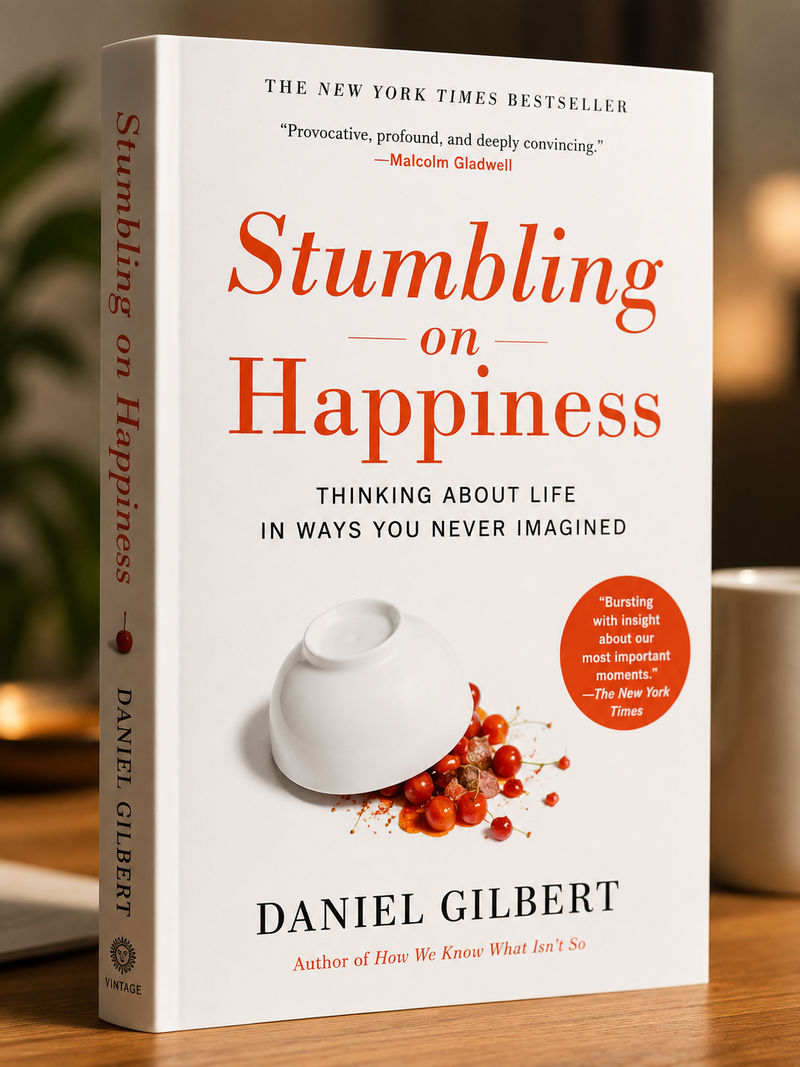
Researchers once tracked two groups of people a year after the most extreme events of their lives: lottery winners who'd suddenly become wealthy, and people who'd been paralyzed in accidents. Ask anyone beforehand to predict how happy each group would feel twelve months later, and almost everyone guesses the same thing — the winners thriving, the paraplegics devastated. A year out, the two groups reported strikingly similar levels of everyday happiness. Daniel Gilbert opens Stumbling on Happiness with findings like this to make an unsettling case: not only do we struggle to predict what will make us happy, we're often wrong about the direction of the effect entirely — and the reasons why turn out to be built into the basic machinery of imagination itself.
- Core concept: People are surprisingly bad at predicting how future events will make them feel, and how long that feeling will last.
- The trap: Imagination quietly fills in missing details and borrows from our current mood, so the "future" we picture is more fiction than forecast.
- Impact bias: we overestimate both the intensity and the duration of our emotional reactions to good news and bad news alike.
- The psychological immune system: we're far better at coping with hardship than we predict, but we consistently fail to factor in our own resilience.
- A better predictor exists: asking someone currently living an experience beats imagining it ourselves — but most people avoid doing it.
The Core Idea
Daniel Gilbert's Stumbling on Happiness argues that the mental act of imagining the future — deciding what job to take, whether to get married, how a vacation will feel — is far less reliable than we assume. We treat our imagination as a kind of internal simulator, running the future forward so we can preview how we'll feel and choose accordingly. Gilbert's research shows this simulator has systematic, predictable flaws: it quietly fills in missing details, it borrows too heavily from how we feel right now, and it consistently underestimates our own capacity to adapt.
The result isn't just occasional error — it's a consistent pattern Gilbert calls the impact bias: we expect both triumphs and disasters to affect us more intensely, and for far longer, than they actually do. Good news rarely elates us as long as we expect. Bad news rarely crushes us for as long as we fear. And because we rarely go back and check our own track record of predictions against what actually happened, we keep making the same kind of mistake, over and over, without noticing the pattern.
Imagined Future vs. Actual Experience
| Feature | Imagined Future (Prediction) | Actual Experience (Reality) |
|---|---|---|
| Emotional intensity | Predicted to be extreme and overwhelming. | Usually milder than expected, in both directions. |
| Duration of the feeling | Assumed to last a long time, good or bad. | Fades faster than predicted, thanks to adaptation. |
| Influence of the present | Colored by how we happen to feel right now. | Shaped by a future context we can't fully picture yet. |
| Level of detail | Generic, gap-filled, missing key specifics. | Specific, textured, full of details imagination skipped. |
| Best information source | Our own simulation of how we'll feel. | Someone currently living the experience. |
Why Our Predictions Go Wrong
Gilbert identifies a handful of specific mental habits that quietly sabotage our ability to predict our own future feelings.
1. Realism
Imagination doesn't show us a blank slate — it fills missing details in automatically, the same way our eyes fill in the blind spot in our vision, without ever flagging that it's doing so. We end up mistaking a rough, gap-filled sketch for a complete and accurate picture.
2. Presentism
When we imagine how we'll feel in the future, we can't fully escape how we feel right now — our current mood, hunger, or stress quietly leaks into the simulation, distorting the prediction without our awareness.
3. Rationalization (The Psychological Immune System)
After something difficult happens, the mind has a built-in set of coping tools — reframing, finding silver linings, generating explanations — that kick in and help us adapt faster than expected. We routinely forget to factor this resilience into our predictions, so we overestimate how devastated we'll feel.
4. The Surrogation Solution
Gilbert's proposed fix: instead of trying to imagine the future yourself, ask someone who's currently living through the experience you're considering. It's a more accurate predictor than your own simulation — but most people resist it, convinced their own situation and reactions are too unique for someone else's experience to apply.
Stumbling on Happiness in Action: Real-World Domains
1. Stumbling on Happiness in Major Life Decisions
Gilbert applies the book's core findings to big, irreversible choices — changing careers, having children, getting married, relocating — arguing that people routinely overestimate how much these milestones will improve their day-to-day happiness, and underestimate how quickly they'll adapt to the new normal, whatever it turns out to be.
2. Stumbling on Happiness in Everyday Choices
The same impact bias shows up in smaller decisions too — the meal we're sure we'll love, the purchase we're sure we'll regret, the minor inconvenience we're sure will ruin the day. Gilbert argues the size of the decision doesn't remove the bias; it just changes the stakes of getting the prediction wrong.
3. Stumbling on Happiness in Adversity and Loss
Gilbert devotes particular attention to hardship, arguing that people are far more resilient in the face of loss, illness, or setback than they predict in advance — not because the events themselves are less painful than expected, but because the psychological immune system works harder, and faster, than we give it credit for.
Lottery Winners and Paraplegics
Gilbert's clearest illustration of how badly we predict our own future happiness is a comparison he returns to throughout the book.
Two Groups, One Year Later, Nearly the Same Happiness
Ask people to predict how happy a lottery winner will be a year after their win, and how happy someone who's just become paraplegic will be a year after their accident, and almost everyone predicts a huge gap between the two. In the actual research Gilbert cites, that gap largely disappeared: a year out, both groups reported similar levels of everyday happiness. The lottery windfall hadn't delivered the lasting boost people expected, and the paraplegia hadn't delivered the lasting devastation people feared — because in both cases, the psychological immune system had done more work than anyone predicted it would.
Why This Matters
- It shows that our intuitions about what will make us happy or miserable are often wrong not just in degree, but in direction.
- It demonstrates the psychological immune system in action — proof that we adapt to circumstances more completely than we ever predict.
- It reframes big life decisions with a humbling question: is this choice really about lasting happiness, or about a future feeling we're simply imagining wrong?
Where the Book Falls Short
A useful summary tells you the limits too, not just the highlights. Three fair criticisms worth knowing:
- The fix is harder than the diagnosis. Gilbert's own research shows people strongly resist asking others about their experiences instead of imagining it themselves, so the book is more convincing about the problem than about how to actually apply the solution in daily life.
- Relies on studies with the same limits as the field. Some of the psychological experiments the book draws on are decades old and share the replication concerns that have affected social psychology more broadly.
- Can feel more unsettling than empowering. The book's central message — that we can't trust our own imagined predictions about happiness — is intellectually compelling but can leave some readers without a clear, comforting sense of what to actually do differently.
Your 30-Day Starter Plan
- Week 1: Track one prediction you make about how an upcoming event will make you feel, then compare it to how you actually felt afterward — start building evidence of your own impact bias.
- Week 2: Before your next non-trivial decision, find a "surrogate" — someone who's already lived through it — and ask them directly how it felt, instead of relying only on your own imagination.
- Week 3: Watch for presentism: catch one moment where your current mood is coloring how you're picturing a future outcome, and pause before deciding.
- Week 4: After a setback this week, journal about how you're actually coping — notice your own psychological immune system doing more work than you expected.
Core Takeaways
We mispredict our own feelings
Both the intensity and duration of future emotions are consistently overestimated.
Imagination fills in gaps silently
The mind completes missing details without ever flagging that it did so.
We're more resilient than we think
The psychological immune system helps us adapt faster than we ever predict.
Ask a surrogate, not your imagination
Someone living the experience predicts your future feelings better than you can.
Frequently Asked Questions
What is the main idea of Stumbling on Happiness?
That human beings are consistently bad at predicting what will make them happy or how long a feeling will last, largely because the imagination quietly fills in gaps, borrows from our current mood, and underestimates our own ability to cope and adapt.
What is affective forecasting?
The mental process of predicting how a future event will make us feel. Gilbert's research shows these predictions are systematically inaccurate, both in how intense the feeling will be and how long it will last.
What is impact bias?
The tendency to overestimate both the intensity and the duration of our emotional reactions to future events, whether positive or negative — we expect good and bad news alike to affect us more, and for longer, than it usually does.
What is the psychological immune system?
Gilbert's term for the mind's built-in set of coping mechanisms — reframing, rationalizing, finding silver linings — that kick in after difficult events and help people recover and adapt faster than they expect, even though people rarely factor this resilience into their predictions.
Why does Gilbert say we should ask other people about happiness instead of imagining it ourselves?
Because research shows that asking someone currently living through an experience how they feel predicts our own future feelings more accurately than imagining it ourselves — though most people resist this because they believe their own situation and reactions are unique.
Has Stumbling on Happiness faced any criticism?
Yes. Critics note that its proposed fix, relying on other people's experiences, runs against strong psychological resistance and is harder to apply than to state, that some cited studies are subject to the same replication concerns common across social psychology, and that its overall message can read as unsettling rather than empowering to some readers.
Conclusion
Strip away the case studies, and Stumbling on Happiness makes one grounded, humbling claim: the future you're picturing so confidently in your mind is a rough sketch, not a preview — filled with gaps your imagination quietly patched over, and colored by a mood that won't even exist by the time you get there. The good news buried in that humility is real: you're also far more resilient than you predict, and better information is often just one honest conversation away. You don't need to stop imagining the future. Just hold your predictions a little more loosely, and ask someone who's already there.