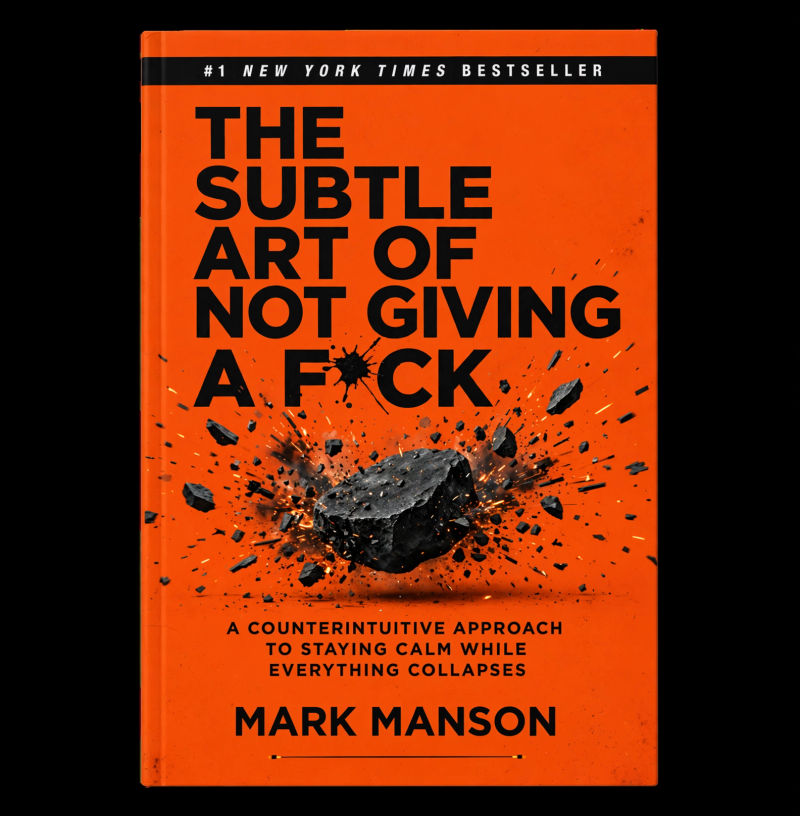
The Subtle Art of Not Giving a F*ck by Mark Manson: The Complete, Easy-to-Understand Summary
A counterintuitive self-help book that says the path to a better life isn't about caring more — it's about caring less, but about the right things.
Quick thought experiment: picture two people who both get passed over for a promotion. One spirals for weeks — replaying the meeting, obsessing over what the boss thinks, posting a humble-brag on LinkedIn to compensate. The other feels the sting for a day, asks what it actually says about their priorities, and moves on. Same event, same sting, wildly different aftermath. Mark Manson's argument is that the difference isn't confidence or luck — it's what each person has decided is actually worth caring about. Everything else, he says, is just noise you've agreed to suffer over.
- Core concept: You only have a limited number of f*cks to give — the goal is to spend them on what actually matters, not on everything.
- The Backwards Law: Chasing positive experience is itself a negative experience; accepting negative experience is itself a positive one.
- Good vs. bad values: Bad values chase feelings and image (pleasure, always being right); good values are grounded in honesty, responsibility, and reality.
- Pain has a purpose: Suffering is universal — the real question is never "how do I avoid pain" but "what pain am I willing to endure?"
- Responsibility isn't blame: You may not be at fault for a problem, but you're always responsible for how you respond to it.
The Core Idea
Mark Manson's The Subtle Art of Not Giving a F*ck opens with a deliberately jarring move: it argues against most of what modern self-help preaches. Instead of "you can achieve anything," Manson's message is closer to "you can't care about everything, so choose carefully." Not giving a f*ck, in his framing, doesn't mean apathy or indifference to life. It means being selective — refusing to burn your limited emotional energy on other people's opinions, on things outside your control, or on chasing a feeling instead of a life.
The book's real subject is values. Manson argues that most unhappiness comes not from a lack of willpower or a lack of positivity, but from caring about the wrong things — or caring about too many things at once. Once you strip away the noise, what's left is a small set of values worth actually building a life around.
Bad Values vs. Good Values at a Glance
| Feature | Bad (Fragile) Values | Good (Reliable) Values |
|---|---|---|
| Source of self-worth | External validation, pleasure, being liked. | Internal honesty, contribution, self-respect. |
| Response to being wrong | Denial, defensiveness, doubling down. | Curiosity; updates beliefs when shown new evidence. |
| View of pain | Something to avoid or numb at all costs. | Necessary feedback that reveals what matters. |
| Relationship to certainty | Needs to be right, craves fixed answers. | Comfortable saying "maybe I'm wrong." |
| View of freedom | Keeping every option open indefinitely. | Freedom through commitment to fewer things. |
Not Giving a F*ck in Action: Real-World Domains
1. Not Giving a F*ck in Relationships
Manson applies his values framework directly to love and friendship. Fragile relationships, he argues, are built on "entitlement" — one or both people believing they deserve happiness, attention, or loyalty without having to give anything difficult in return. Healthy relationships, by contrast, are built on two people who are willing to disappoint each other occasionally in service of something honest. He's blunt that the strongest relationships aren't the ones with zero friction — they're the ones where both people can say "no" to each other and still trust the relationship will hold.
2. Not Giving a F*ck in Career and Ambition
Manson pushes back hard on the "find your passion, do what you love" advice common in career self-help. He argues passion is usually a byproduct of skill and effort, not a prerequisite for starting. Waiting to feel inspired before doing the work, he says, has the causality backwards — action typically comes first, motivation follows.
- Entitled approach: expects success and recognition without tolerating the boring, repetitive grind that skill actually requires.
- Values-driven approach: picks a form of struggle worth enduring — not the fantasy of the outcome, but the actual unglamorous process — and commits to it long enough to get good.
3. Not Giving a F*ck in Personal Growth
Manson describes two competing mental models people use for self-improvement: the "Do Something" model (you're flawed, so change everything about yourself immediately) and a subtler "Don't Just Sit There" model, where growth comes from small, repeated, unglamorous action rather than a dramatic personal reinvention. He's skeptical of the self-help industry's tendency to sell people on a total transformation, arguing that lasting change is closer to a quiet accumulation of better choices than a single lightning-bolt moment.
The Feedback Loop from Hell
One of Manson's most memorable ideas is what he calls the Feedback Loop from Hell — the process of feeling bad about feeling bad, which is where most chronic anxiety actually lives.
The Feedback Loop from Hell
First you feel anxious about an upcoming event. Then you feel ashamed that you're anxious at all — "why can't I just relax?" That shame produces more anxiety, which produces more shame, spiraling until the original event is almost irrelevant compared to the anxiety about the anxiety itself. Manson's point: the emotion isn't the real problem — your judgment of the emotion is.
How to Break the Loop
- Let the initial emotion exist without immediately layering a second emotion on top of it.
- Ask what the emotion is actually pointing to, rather than trying to argue yourself out of feeling it.
- Remember that wanting a stress-free, friction-free life is itself a kind of stress — this is Manson's "Backwards Law" in miniature.
How to Start Giving Fewer F*cks
- Audit what you're currently spending your f*cks on. List the things that eat your attention — many will turn out to be other people's opinions or outcomes you can't control.
- Ask "is this problem actually mine to solve?" You're always responsible for your response to a situation, even in the cases where you didn't cause it.
- Choose values you can act on directly. Trade vague, outcome-based values ("be successful") for process-based ones you control ("show up and do honest work").
- Get comfortable being wrong. Manson's "uncertainty principle" says the more certain you are that you're right, the less open you become to actually improving.
- Say no more often. Every commitment you accept is a f*ck you've already spent — protect the ones that matter by declining the ones that don't.
Where the Book Falls Short
A useful summary tells you the limits too, not just the highlights. Four fair criticisms worth knowing:
- Tone can overshadow substance. The heavy use of profanity and casual, blog-style voice is a deliberate hook, but it puts off some readers before they reach the more thoughtful arguments underneath.
- Light on rigorous evidence. The book leans heavily on anecdotes, personal stories, and Manson's own past as a dating-advice blogger rather than dense citation of academic research, so it reads more like reasoned personal philosophy than a clinical or scientific text.
- Risk of being misread as apathy. "Not giving a f*ck" is easy to flatten into an excuse for disengagement or avoiding responsibility, which is close to the opposite of what Manson actually argues for.
- Not a substitute for mental health support. The book touches on anxiety and grief in places, but it's a general-audience philosophy book, not a treatment plan — readers dealing with clinical depression, anxiety, or grief are better served pairing it with a licensed professional's guidance.
Your 30-Day Starter Plan
- Week 1: Track every time you feel annoyed, anxious, or offended. At the end of the week, sort the list into "things I control" and "things I don't."
- Week 2: Pick one value you've been chasing that depends on other people's approval, and replace it with a process-based version you fully control.
- Week 3: Practice saying "maybe I'm wrong" once a day in a real disagreement, and notice how the conversation changes.
- Week 4: Say no to one obligation that doesn't serve your chosen values, and notice what opens up in its place.
Core Takeaways
Care selectively, not less
The goal isn't to feel nothing — it's to spend your limited attention on the few things that truly deserve it.
Pain is information
Struggle isn't a sign something's wrong with you — it's the tax you pay for caring about something real.
Values over feelings
Chasing a feeling is a trap; building a life around honest, actionable values is durable.
Responsibility isn't fault
You don't have to have caused a problem to be the one responsible for how you respond to it.
Frequently Asked Questions
What is the main idea of The Subtle Art of Not Giving a F*ck?
That you have a limited amount of emotional energy to "give," and a good life comes from being deliberate about what you spend it on — grounded in honest, actionable values rather than chasing pleasure, approval, or constant positivity.
What does "not giving a f*ck" actually mean in the book?
It doesn't mean indifference to everything. It means refusing to let things outside your control, or other people's opinions, dictate your emotional state — while still caring deeply about a small number of things you've chosen.
What is the Feedback Loop from Hell?
It's the spiral of feeling ashamed or anxious about an emotion you're already feeling, which produces more of that emotion — for example, feeling anxious, then feeling ashamed of the anxiety, which makes the anxiety worse.
What is the Backwards Law?
The idea that directly chasing positive feelings — happiness, certainty, comfort — tends to produce more anxiety and dissatisfaction, while accepting negative experience as part of life tends to produce more genuine peace.
What are "good values" according to Manson?
Values that are reality-based, socially constructive, and within your control — like honesty, curiosity, and taking responsibility — as opposed to "bad values" like pleasure-seeking, needing to always be right, or relying on constant external approval.
Has the book faced any criticism?
Yes. Common critiques include its casual, profanity-heavy tone, a reliance on anecdote over rigorous research, and the risk that its central message gets misread as an excuse for apathy rather than a call for selective, deliberate caring.
Conclusion
Strip away the profanity and the provocative title, and The Subtle Art of Not Giving a F*ck makes one grounded claim: you can't care about everything, so stop trying. By auditing where your attention actually goes, trading fragile values for reliable ones, and treating pain as useful information instead of a problem to eliminate, anyone can build a calmer, more honest relationship with their own life — at work, in relationships, or just in the privacy of their own head. You don't need a total reinvention. Just pick one thing you've been needlessly stressing over this week, and consciously decide to stop giving a f*ck about it.