Man and His Symbols by Carl Jung: The Complete, Easy-to-Understand Summary
One question quietly runs through this entire book: what if the strangest dream you had last week wasn't nonsense, but a message you dismissed too quickly? Here's every core idea, explained in plain English, with a practice plan you can start today.
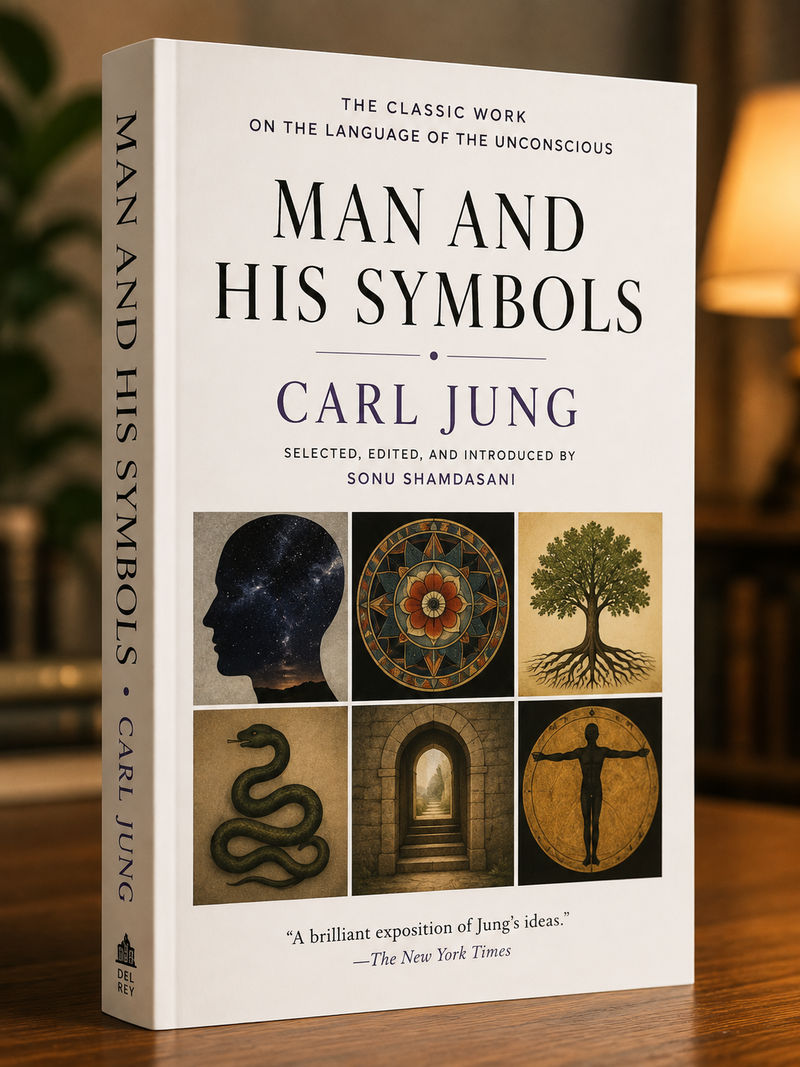
Our take in one line: this isn't one author walking you through his theory — it's five specialists taking turns opening different doors in the same house, and by the last chapter, your own dreams stop looking so random.
Try this before you read another word. Think back to the last dream you actually remembered — the strange, illogical one you almost dismissed the second you woke up. Carl Jung's radical proposal in this, his final work, is that you dismissed it too soon: that dream wasn't static or nonsense, it was a message from a part of your mind that already knows things your waking mind hasn't caught up to yet.
- Core concept: The unconscious mind is constantly communicating — most clearly through dreams — using symbols instead of plain language.
- The map: Archetypes — universal patterns like the Shadow, the Anima/Animus, and the Self — inherited structures shared across all humans through the "collective unconscious."
- The hidden self: The Shadow, the repressed or unlived parts of your personality, which resurface in dreams and get projected onto other people.
- The tool: Learning to treat symbols as symbols, not signs — and using dreams as an ongoing dialogue with your own unconscious.
- The goal: Individuation — the lifelong process of integrating conscious and unconscious into a more complete, whole self.
What The Book Actually Argues
First published in 1964, three years after Jung's death, Man and His Symbols was Jung's final undertaking — the one book in his long career written explicitly for general readers rather than fellow analysts. The project came about after BBC broadcaster John Freeman persuaded a reluctant Jung to explain his ideas in plain language; Jung agreed, according to his own account, after a dream convinced him the public was finally ready to hear him directly.
The book has an unusual structure for this reason: Jung personally wrote only the opening section, "Approaching the Unconscious," in English, finishing it just ten days before the illness that led to his death. The remaining four sections were completed by four of his closest associates — Joseph L. Henderson, Marie-Louise von Franz, Aniela Jaffé, and Jolande Jacobi — each covering a different facet of his theory, with von Franz coordinating the project and drafting the conclusion after he died.
Why Your Dreams Are Not Nonsense
Jung opens by asking readers to take dreams seriously again. Modern life, he argues, trains people to dismiss dreams as random static — leftover noise from a busy brain — when in fact they are the clearest channel the unconscious has for reaching the conscious mind. A dream is not decoration; it is information, arriving in a language of images instead of words.
Crucially, Jung insists a dream image cannot be reliably interpreted from a generic symbol dictionary. A snake in one person's dream and a snake in another's can mean almost opposite things, because the meaning depends on the dreamer's own life, associations, and current psychological situation — not on some universal lookup table.
Archetypes and the Collective Unconscious
Beneath the personal unconscious — the forgotten memories and repressed material unique to one person's life — Jung proposed a deeper layer shared by everyone: the collective unconscious. This layer doesn't contain specific memories but inherited patterns of imagery and behavior he called archetypes, which surface differently in every individual's dreams, myths, art, and religion across every culture and era.
- The Shadow: the disowned, repressed, or undeveloped parts of the personality.
- The Persona: the social mask a person presents to the outside world.
- The Anima / Animus: an inner figure representing qualities a person has not consciously developed.
- The Wise Old Man / Great Mother: figures representing inherited wisdom or nurturing and devouring aspects of care.
- The Self: the archetype of psychological wholeness — the goal, not the starting point, of the whole process.
The Shadow: Your Unlived Life
Of all the archetypes, the shadow gets the most practical attention, because it's the one people bump into constantly without recognizing it. The shadow holds everything about ourselves we've rejected, repressed, or never allowed to develop — and because it stays unconscious, it doesn't disappear. It tends to show up in dreams as a threatening or unpleasant figure, and in daily life as intense, disproportionate reactions to traits we notice in other people.
The Practical Reframe
When someone's trait irritates you far more than the situation seems to warrant, Jung's suggestion isn't to simply write them off. It's to consider — carefully and without self-punishment — whether that trait is a disowned piece of your own personality, showing up on the outside because you haven't yet met it on the inside.
Signs vs. Symbols
Jung draws a precise distinction that runs through the whole book: a sign stands for something already known and fully expressible, while a symbol points toward something that can't yet be captured any more clearly or completely than the image itself. This is why he warns against treating dream images like a code to be cracked once and filed away.
- Sign in action: A red octagon means "stop." Once you know the code, there's nothing more to discover.
- Symbol in action: A recurring dream of climbing an unreachable mountain resists a single tidy meaning — it may be gesturing at ambition, mortality, an unresolved life situation, and something wordless, all at once.
Core Practices the Book Teaches
1. Keep a Dream Journal
The book repeatedly returns to one practical foundation: record dreams immediately upon waking, before the conscious mind has a chance to edit or rationalize them away.
2. Look for Patterns, Not One-Off Answers
Rather than decoding a single dream in isolation, the book's contributors repeatedly compare a dreamer's images across many nights, watching for recurring figures, settings, or themes that shift subtly over time as a way of tracking the individuation process in progress.
- Does the same figure or setting keep reappearing in different forms?
- Does an unpleasant dream figure become less threatening as you consciously engage with what it represents?
- Are opposites — light/dark, known/unknown, control/chaos — showing up together in the same dream?
Conscious Mind vs. Unconscious Mind at a Glance
| Dimension | Conscious Mind | Unconscious Mind |
|---|---|---|
| Source of content | Deliberate thought, choice, waking perception. | Inherited archetypes, repressed material, instinct. |
| Relationship to time | Linear, sequential, goal-directed. | Timeless, symbolic, non-linear. |
| How it communicates | Direct language, logic, argument. | Dreams, myths, art, slips, projections. |
| Response when ignored | Grows narrow, rigid, one-sided. | Compensates — intrudes via dreams, mood, or projection. |
| Ultimate goal | Mastery of outer, practical life. | Integration into a complete, whole Self. |
Symbols in Everyday Life and Art
The book extends the same lens beyond dreams into culture at large. Modern life, several contributors argue, has grown so committed to rational explanation that symbolic and mythic thinking has been pushed to the margins — and art, in response, has increasingly turned obscure, abstract, and hard to decode, as a kind of cultural counterbalance to a world that's tried to explain everything away.
Where the Book Strains
A useful summary tells you the limits too, not just the highlights. Three fair criticisms worth knowing before you dive in:
- Dated, gendered framing. The anima/animus concept, as originally framed, leans heavily on mid-20th-century assumptions about masculine and feminine traits that many contemporary readers and clinicians now read more flexibly or critically.
- Light on empirical testing. Archetypes and the collective unconscious are drawn from decades of clinical case material and comparative mythology rather than controlled studies, making the framework more of an interpretive lens than a scientifically validated model.
- Uneven across its five voices. Because five different specialists wrote the book's five parts, tone and depth shift noticeably from section to section — some readers find Jung's own opening chapter far more accessible than the denser essays that follow.
Your 30-Day Dream & Symbol Practice
- Week 1 — Start the journal. Record every dream you can recall immediately on waking. No interpreting yet — just capture the images before they fade.
- Week 2 — Look for patterns. Reread the week's entries together and note any recurring figures, places, or themes, rather than analyzing any single dream in isolation.
- Week 3 — Notice the shadow in daily life. Track moments of unusually strong irritation, contempt, or judgment toward someone else, and ask what it might be reflecting back at you.
- Week 4 — Sit with one symbol. Choose the single most persistent image from your month of dreams or daily life and simply hold it in attention for several days, without forcing a tidy meaning onto it.
Core Takeaways
Dreams are communication, not noise
The unconscious constantly relays messages; dismissing dreams cuts off a real channel of self-knowledge.
Archetypes are inherited, symbols are personal
Universal patterns get filled with individual meaning — no dream dictionary can replace your own context.
What irritates you may live in you
The shadow often reveals itself through disproportionate reactions projected onto other people.
Wholeness beats perfection
Individuation aims at integrating the unconscious, not eliminating or perfecting it away.
Frequently Asked Questions
What is the main message of Man and His Symbols?
That the unconscious mind is constantly communicating with us, most clearly through dreams, using symbols rather than plain language, and that ignoring this communication cuts us off from a vital part of our own psychological wholeness.
What are archetypes according to Carl Jung?
Archetypes are universal, inherited patterns of the human psyche, shared across all people through what Jung called the collective unconscious, such as the Shadow, the Anima or Animus, the Wise Old Man, the Great Mother, and the Self — each expressed differently through an individual's personal dreams and symbols.
What is the shadow in Jungian psychology?
The shadow is the archetype representing the parts of a person's personality that have been repressed, denied, or left undeveloped, often surfacing in dreams as a disturbing figure or in daily life through strong, disproportionate reactions to traits noticed in other people.
What is individuation in Man and His Symbols?
Individuation is the lifelong psychological process of becoming a complete, integrated self by consciously recognizing and incorporating unconscious material, including the shadow and the anima or animus, rather than remaining unaware of them or projecting them onto others.
Is Jungian psychology backed by science?
Jung's work is grounded in decades of clinical case material rather than controlled experiments, and concepts like archetypes and the collective unconscious are difficult to test empirically, so most of the book's framework is best understood as an influential interpretive model rather than an experimentally validated theory.
Final Verdict
Whether Man and His Symbols lands for a given reader often depends on how comfortable they are sitting with an idea that resists a single, final explanation — which is, fittingly, exactly what Jung means by a real symbol. For readers curious about dreams, myth, and the parts of themselves that don't fully make rational sense, the book offers a genuinely different vocabulary for self-understanding, illustrated throughout with striking artwork and a real analysis case study that grounds the theory in an actual life. For readers wanting tidy, testable claims, its five-author structure and interpretive style may feel more suggestive than proven. Either way, its influence on how people talk about archetypes, the shadow, and dream symbolism today is hard to overstate — and its central invitation, take your own dreams seriously, remains exactly as available on the first page as it is on the last.