Grit by Angela Duckworth: The Complete, Easy-to-Understand Summary
Why talent is overrated — and why the people who go furthest are usually the ones who simply refuse to quit on a goal they've decided matters.
Quick thought experiment: two new cadets arrive at West Point on the same day. One aced every entrance exam and scored near-perfect on the physical fitness test. The other was solid but unremarkable on paper. Seven weeks later, during the brutal training period cadets call "Beast Barracks," one of them has quit. It's not always the one you'd guess. Angela Duckworth spent her career studying exactly why — and her answer has less to do with talent than almost anyone expects.
- Core concept: Grit is passion and sustained perseverance applied to a single long-term goal, not a short burst of intensity.
- The grit formula: Talent × effort = skill. Skill × effort = achievement. Effort counts twice.
- Four psychological assets: gritty people consistently show interest, deliberate practice, purpose, and hope.
- Talent isn't destiny: across studies, grit predicted success as well as or better than talent measures alone.
- Grit can be built: from the inside out (through practice and mindset) and the outside in (through culture and parenting).
What Grit Actually Is
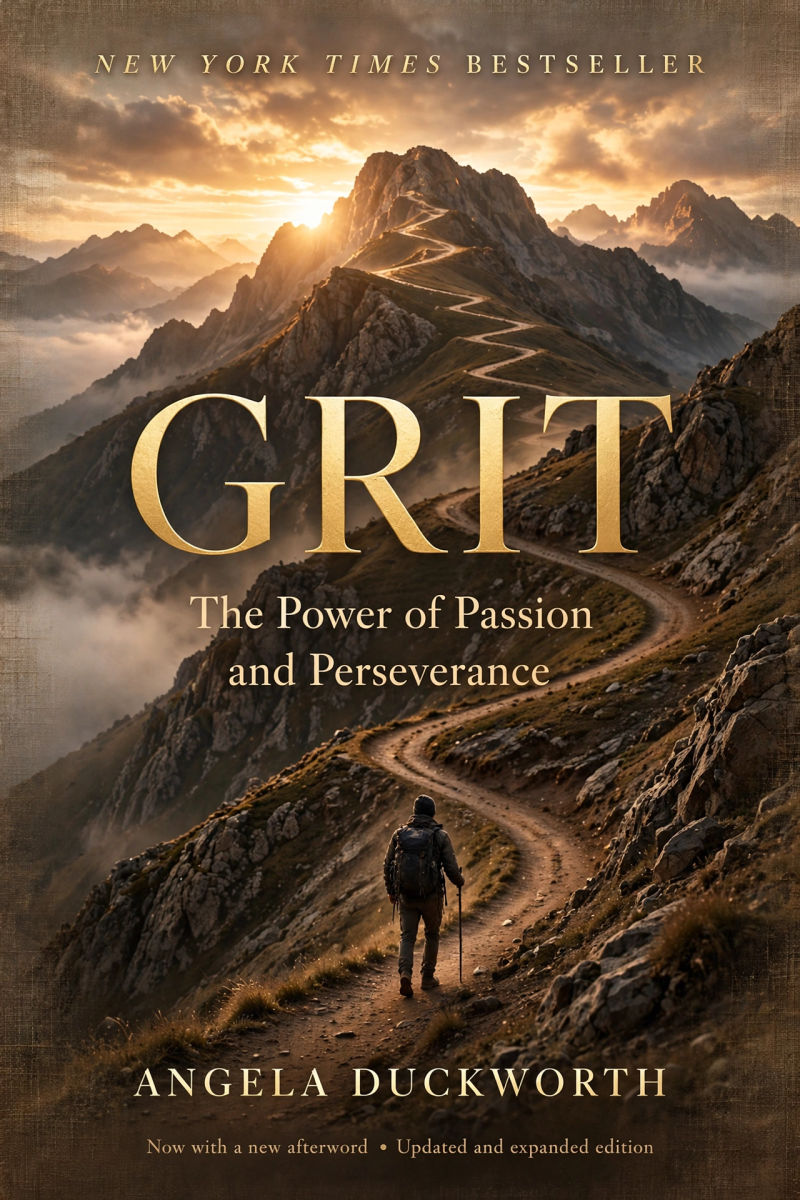
Based on years of research by psychologist Dr. Angela Duckworth, Grit: The Power of Passion and Perseverance argues that one trait predicts long-term achievement better than IQ, talent, or good looks: the combination of sustained passion and sustained perseverance toward a single, meaningful, long-term goal. Duckworth defines grit not as short-term intensity — pulling an all-nighter, training hard for a month — but as showing up for the same goal, year after year, even when it stops being fun.
Her research began with a simple but pointed question: why do some highly talented people quit, while other less naturally gifted people go on to become the best in their field? Her answer is that talent tells you how fast you improve with effort — but grit tells you whether you keep applying that effort long enough for it to matter.
Talent Mindset vs. Grit Mindset
| Feature | Talent-Focused Mindset | Grit Mindset |
|---|---|---|
| Belief about achievement | Natural ability alone determines success. | Effort turns talent into skill, and skill into achievement. |
| View of effort | A nice bonus, not strictly necessary. | A multiplier that counts twice in the outcome. |
| Response to plateaus | Assumes a natural ceiling has been reached. | Treats a plateau as a normal cost of a long-term goal. |
| Consistency of interest | Jumps between new pursuits when novelty fades. | Commits to one top-level goal across years. |
| Source of motivation | Chasing quick wins and being seen as gifted. | A sense of purpose connected to something beyond the self. |
Grit in Action: Real-World Domains
1. Grit in Sports & High-Stakes Training
Duckworth studied cadets surviving West Point's grueling summer training, competitors in the Scripps National Spelling Bee, and elite performers across sports and the arts. A consistent pattern emerged: raw aptitude predicted who started strong, but grit scores predicted who was still standing at the end. In the National Spelling Bee, for example, the number of hours spent on focused, deliberate practice — not casual quizzing with a parent — was what separated finalists from early dropouts.
2. Grit in Business and Leadership
Duckworth contrasts talent-obsessed hiring and leadership cultures with grit-oriented ones:
- Talent-obsessed cultures: chase "10x" hires, treat early struggle as a red flag, and reward flashy short-term wins over years of unglamorous consistency.
- Grit-oriented cultures: value staying power, tie individual work to a larger purpose, and treat a rough first year as a normal part of anyone's growth curve.
3. Grit in Parenting
Duckworth devotes a major section of the book to how grit gets built — or undermined — at home. She introduces her own family's "Hard Thing Rule": every person in the household, parents included, must be doing one hard thing that requires daily deliberate practice. Nobody is allowed to quit mid-commitment out of boredom or a bad day — but everyone is free to quit at a natural stopping point, like the end of a semester or a season, and choose a different hard thing. The rule isn't about forcing a single passion for life; it's about practicing the act of following through.
The West Point Study
Perhaps the most striking finding in the book comes from West Point Military Academy, which uses an extensive "Whole Candidate Score" — combining academics, physical fitness, and leadership potential — to select an already highly filtered pool of applicants.
The Beast Barracks Finding
Despite West Point's rigorous, multi-factor admissions score, it was Duckworth's short Grit Scale — not the Whole Candidate Score — that best predicted which cadets would make it through the first grueling summer of training without dropping out. A trait measurable with a dozen simple questions outperformed a far more elaborate selection process.
Why This Matters
- It suggests institutions often over-index on measurable talent and under-index on staying power.
- It implies grit can be assessed — and potentially developed — independent of raw ability.
- It reframes "who will succeed" as less about who's most gifted and more about who won't quit.
How to Build Grit
Duckworth identifies four psychological assets that gritty people tend to develop, roughly in this order over the course of a pursuit:
- Interest. Grit usually starts with genuine enjoyment of an activity — not a five-year plan, just curiosity that's allowed to develop naturally over time.
- Practice. Interest alone isn't enough; it has to be paired with deliberate practice — setting a stretch goal just past your current ability, focusing fully, getting immediate feedback, and repeating with refinement.
- Purpose. At some point, the pursuit needs to connect to something beyond personal enjoyment — a sense that the work matters to other people, not just yourself.
- Hope. A resilient belief that effort can improve your future, especially in the face of setbacks — closely tied to a growth mindset about your own ability to improve.
Where the Book Falls Short
A useful summary tells you the limits too, not just the highlights. Three fair criticisms worth knowing:
- Modest effect sizes. Some independent researchers and meta-analyses have found that grit's statistical link to success, while real, is smaller than the book's narrative sometimes implies, and overlaps heavily with the personality trait "conscientiousness."
- Risk of overlooking structural barriers. Critics point out that framing success mainly around individual grit can understate the role of poverty, unequal access to resources, and systemic barriers that no amount of perseverance fully offsets on its own.
- "Grit culture" can be misapplied. Praising perseverance without checking whether a goal or environment is actually worth persevering in can pressure people to stay too long in harmful jobs, relationships, or situations rather than making a reasoned exit.
Your 30-Day Starter Plan
- Week 1: Take stock of your current goals. Write down which ones you've pursued consistently for over a year, and which you've already abandoned more than once.
- Week 2: Pick one goal and design a deliberate practice session for it this week — a specific stretch challenge, full focus, and a way to get quick feedback.
- Week 3: Write one paragraph connecting that goal to a purpose beyond yourself — who else benefits if you get better at this?
- Week 4: Pick one recent setback and treat it as expected, not exceptional. Write down what you'll adjust, then keep going.
Core Takeaways
Effort counts twice
Effort builds skill, and effort turns that skill into real achievement — talent alone does neither.
Depth beats breadth
A single long-term goal, pursued for years, tends to outperform constantly chasing new interests.
Purpose sustains passion
Connecting your work to other people's wellbeing makes it easier to keep going when motivation dips.
Grit is learnable
Interest, practice, purpose, and hope can all be deliberately cultivated — grit isn't fixed at birth.
Frequently Asked Questions
What is the main idea of Grit by Angela Duckworth?
That sustained passion and perseverance toward a single long-term goal — not talent alone — is what predicts high achievement, and that this trait can be deliberately built rather than being a fixed, inborn quality.
What is the grit formula?
Talent multiplied by effort produces skill, and skill multiplied by effort produces achievement. Because effort appears in both steps, Duckworth argues it counts twice toward the outcome.
What did the West Point study find?
Duckworth's short Grit Scale predicted which cadets would complete the demanding summer training period better than West Point's own detailed Whole Candidate admissions score did.
What is the Hard Thing Rule?
A family practice from Duckworth's own household where every member must commit to one activity requiring daily deliberate practice, can't quit mid-commitment, but can choose a new hard thing at a natural stopping point.
What are the four psychological assets of gritty people?
Interest, deliberate practice, purpose, and hope — developed roughly in that order as a long-term pursuit matures.
Has the grit concept faced any criticism?
Yes. Some researchers found smaller effect sizes than the book's narrative suggests, and critics caution that an individual focus on grit can understate structural barriers and risks pressuring people to persist in situations not worth persisting in.
Conclusion
Strip away the case studies, and Grit makes one grounded claim: showing up for the same meaningful goal, year after year, matters more than being the most naturally gifted person in the room. By building genuine interest, pairing it with deliberate practice, connecting it to a purpose beyond yourself, and holding onto hope through setbacks, anyone can strengthen the trait that outlasts talent. You don't need to overhaul your entire life overnight. Just pick one hard thing worth sticking with, and choose to show up for it again tomorrow.