Emotional Intelligence by Daniel Goleman: The Complete, Easy-to-Understand Summary
Why the smartest person in the room isn't always the one who wins in life — and why the skill that actually predicts success can be learned at any age.
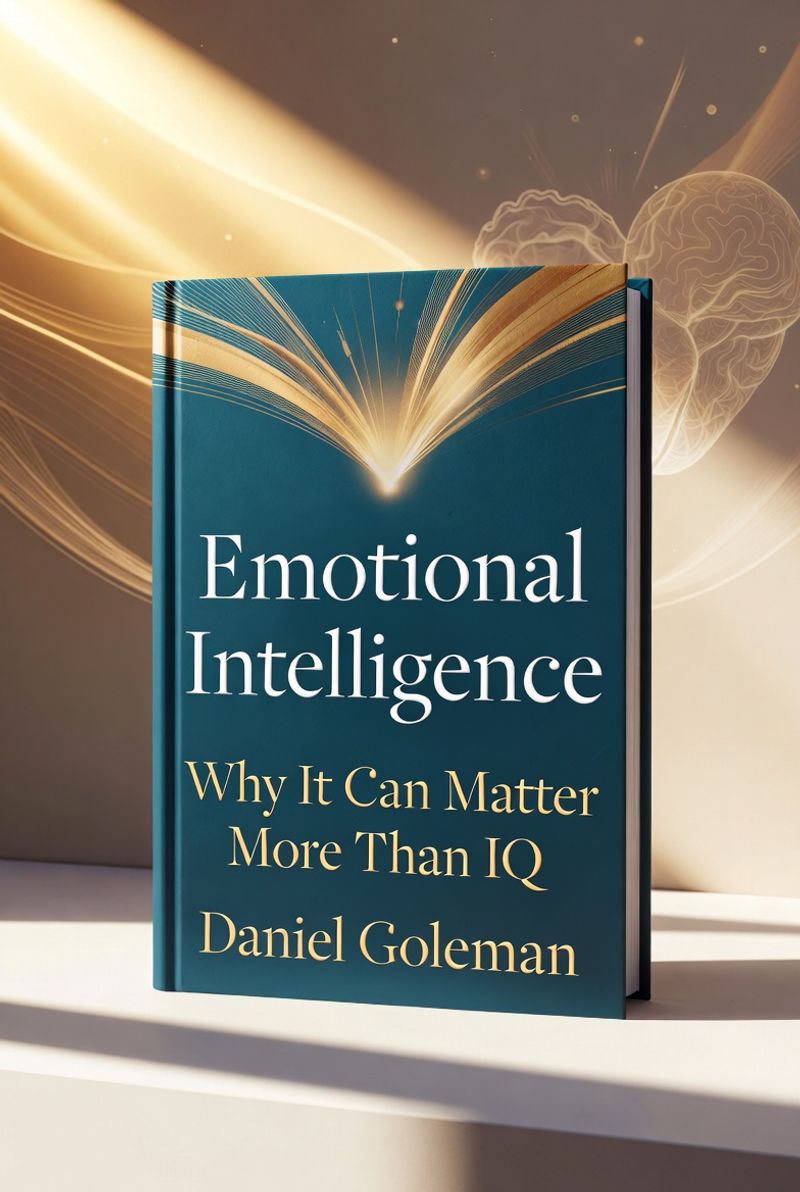
Picture two employees up for the same promotion. One has the highest test scores in the company, a sharp analytical mind, and answers that are almost always technically correct. The other is merely average on paper — but reads a tense room instantly, stays calm when a project falls apart, and makes everyone around them want to work harder. Nine times out of ten, Daniel Goleman argues, it's the second person who ends up leading the team. His book set out to explain why raw intellect is such a poor predictor of who actually thrives — and why the missing variable, emotional intelligence, can be measured, trained, and improved at any age.
- Core concept: How well you manage your own emotions and read other people's shapes your success in life at least as much as raw intellect does.
- The trap: Schools and workplaces optimize for IQ, while the emotional skills that actually predict resilience, leadership, and lasting relationships go largely untaught.
- Five components: self-awareness, self-regulation, motivation, empathy, and social skill — together, these make up what Goleman calls EQ.
- The amygdala hijack: under threat or stress, the brain's emotional center can seize control before the rational mind has a chance to weigh in.
- EQ can be learned: unlike IQ, which stays fairly fixed, emotional intelligence can be strengthened deliberately throughout adulthood.
The Core Idea
Daniel Goleman's Emotional Intelligence makes a case that upended how we think about success: cognitive intelligence, the kind measured by IQ tests, is a surprisingly weak predictor of how well someone actually does in life. What separates people who thrive from people who stall out, Goleman argues, is a distinct set of abilities — noticing your own emotions as they arise, keeping disruptive feelings in check, staying motivated through setbacks, sensing what others are feeling, and handling relationships skillfully. Together, these make up what he popularized as emotional intelligence, or EQ.
What makes EQ easy to overlook, Goleman argues, is that our institutions were never built to teach it. Report cards track grades, not self-control. Résumés list qualifications, not the ability to read a room. So people can sail through school or land a job on pure intellect, only to watch their careers or relationships unravel because they never learned to manage a bad mood, sit with criticism, or notice when someone else was struggling.
IQ-Driven Mindset vs. EQ-Driven Mindset
| Feature | IQ-Driven Mindset | EQ-Driven Mindset |
|---|---|---|
| Belief about success | Raw intellect and technical skill are what matter most. | Self-awareness and relationship skill matter just as much. |
| View of emotions | Distractions to suppress or push through. | Signals worth noticing and working with. |
| Response to conflict or stress | Reacts impulsively, or shuts down entirely. | Pauses, regulates, then responds deliberately. |
| Relationship to feedback | Takes criticism personally; becomes defensive. | Treats feedback as information to act on. |
| View of other people's emotions | Overlooked, or seen as irrelevant to the task. | Read closely and factored into every decision. |
The Five Components of Emotional Intelligence
Goleman organizes EQ into five interlocking abilities. Each builds on the one before it.
1. Self-Awareness
The foundation of everything else: the ability to recognize an emotion the moment it arises, rather than being swept along by it unnoticed. Goleman argues that people who can name what they're feeling in real time — "I'm anxious," not just a vague unease — are far better positioned to manage that feeling before it drives their behavior.
2. Self-Regulation
The ability to manage disruptive emotions and impulses once you've noticed them — staying composed under pressure, resisting the urge to snap back in anger, and recovering quickly from setbacks instead of staying rattled by them.
3. Motivation
Goleman describes this as the capacity to channel emotion in service of a goal — the inner drive that keeps someone working toward something meaningful even when progress is slow, rather than needing external rewards to stay engaged.
4. Empathy
The ability to sense what someone else is feeling and to take their perspective, even when it isn't stated outright. Goleman treats empathy as a trainable skill of attention, not a fixed personality trait some people simply have and others lack.
5. Social Skill
The ability to put the other four components to work in relationships — building rapport, finding common ground, managing disagreements, and influencing or inspiring others, rather than merely tolerating them.
Emotional Intelligence in Action: Real-World Domains
1. Emotional Intelligence at Work and in Leadership
Goleman argues that technical skill and IQ get someone hired, but emotional intelligence is what determines how far they rise. He points to "star performers" across fields who are rarely the most technically brilliant person in the room — instead, they're the ones who stay composed in a crisis, read what a team needs before being told, and turn disagreement into collaboration rather than conflict. The higher up an organization someone climbs, Goleman notes, the more their success depends on EQ rather than raw expertise.
2. Emotional Intelligence in Relationships
In close relationships, Goleman argues, it's rarely a single dramatic fight that ends things — it's an accumulated pattern of small emotional misses: not noticing a partner's frustration, responding defensively instead of with curiosity, or failing to repair after a disagreement. Couples who last, by contrast, tend to share a common thread: they're able to self-soothe during conflict and stay attuned to what the other person is actually feeling, rather than only what they're saying.
3. Emotional Intelligence in Parenting
Goleman discusses how children whose emotions are acknowledged and named by caregivers — rather than dismissed or punished — tend to develop stronger self-regulation and empathy later in life. He contrasts parents who help a child label and work through a feeling with those who either ignore emotional outbursts entirely or become emotionally overwhelmed themselves, arguing that the first approach builds a foundation kids carry into adulthood.
The Amygdala Hijack
Goleman's clearest illustration of why emotions can overpower reason is a piece of brain science he brings to a general audience.
When the Emotional Brain Overrides the Thinking Brain
Goleman describes how the amygdala, the brain's emotional alarm system, can react to a perceived threat and trigger a fight-or-flight response before the prefrontal cortex — the part responsible for rational thought — has finished processing what's actually happening. In that split second, a person can say or do something they'd never choose if they'd had time to think. Goleman calls this an "amygdala hijack," and argues that a large share of destructive arguments, impulsive decisions, and regretted outbursts trace back to exactly this gap between feeling and thought.
Why This Matters
- It explains why intelligent, well-meaning people still say things in anger that they immediately regret.
- It shows that self-regulation isn't about suppressing emotion — it's about creating a pause before the hijack takes over.
- It reframes "staying calm" as a trainable skill rooted in brain function, not simply a matter of willpower or personality.
The Self-Awareness → Regulation → Empathy Pathway
- Notice the feeling. Build the habit of naming an emotion the moment it arises, instead of only recognizing it after you've already acted on it.
- Create a pause. Between the feeling and the reaction, insert a deliberate gap — a breath, a delay, a walk — so the thinking brain has time to catch up.
- Choose the response. Once the pause is in place, respond in a way that serves the actual goal, not just the immediate impulse.
- Read the other person. Extend the same attention outward — notice what someone else may be feeling before responding to only what they've said.
- Practice it under real stakes. Goleman argues EQ is built the same way any skill is: through repeated practice in situations that actually matter, not just in calm, low-pressure moments.
Where the Book Falls Short
A useful summary tells you the limits too, not just the highlights. Three fair criticisms worth knowing:
- The term can be overstretched. Critics have argued that "emotional intelligence" sometimes gets defined so broadly that it overlaps heavily with existing personality traits, making it harder to say precisely what it adds beyond established psychology.
- Predictive claims can be overstated. Some researchers argue that the book's early claims about EQ predicting success were stronger than the underlying evidence at the time could fully support, and that later research paints a more modest, mixed picture.
- Hard to measure objectively. Unlike IQ, which has standardized tests with decades of validation, emotional intelligence is harder to measure reliably, which makes it difficult to assess growth or compare people fairly.
Your 30-Day Starter Plan
- Week 1: Practice naming your emotions as they happen — a few times a day, pause and identify exactly what you're feeling, without judging or acting on it yet.
- Week 2: Build a pause before reacting. When a strong emotion hits, wait a few breaths before you speak or respond, especially in moments of frustration.
- Week 3: Practice empathy deliberately. In one conversation a day, focus entirely on understanding what the other person is feeling before you respond with your own view.
- Week 4: Put social skill into practice. Use what you've built to repair one strained relationship or navigate one disagreement with more composure than usual.
Core Takeaways
EQ predicts more than IQ
How you manage emotion and read people shapes outcomes intellect alone can't explain.
Emotions can hijack the brain
Under stress, the emotional brain can act before the rational brain catches up — the pause is the skill.
Empathy is a skill, not a trait
Reading other people accurately can be practiced and improved like any other ability.
EQ can be trained
Unlike IQ, emotional intelligence stays flexible — it can be built deliberately at any age.
Frequently Asked Questions
What is the main idea of Emotional Intelligence by Daniel Goleman?
That the ability to understand and manage your own emotions, and to read and relate to other people's, predicts real-world success at least as much as raw intellectual ability — and that this ability can be deliberately developed.
What are the five components of emotional intelligence?
Self-awareness, self-regulation, motivation, empathy, and social skill. Goleman presents them as building on one another, starting with noticing your own emotions and ending with managing relationships skillfully.
What is an amygdala hijack?
It's Goleman's term for the moment the brain's emotional alarm system reacts to a perceived threat and triggers an immediate response before the rational, thinking part of the brain has processed the situation — leading to reactions people often regret afterward.
Can emotional intelligence be learned, or is it fixed?
Goleman argues it can be learned and strengthened throughout life, unlike IQ, which tends to stay relatively stable — a central and hopeful claim of the book.
What's the difference between IQ and EQ?
IQ measures cognitive and analytical ability and tends to stay fairly fixed. EQ refers to the set of skills involved in recognizing, managing, and working with emotions — both your own and other people's — and Goleman argues it's far more flexible and trainable than IQ.
Has Emotional Intelligence faced any criticism?
Yes. Critics note that the term can overlap with existing personality concepts, that some early claims about EQ predicting success outran the evidence available at the time, and that EQ is harder to measure reliably than IQ.
Conclusion
Strip away the case studies, and Emotional Intelligence makes one grounded claim: the qualities that make someone genuinely capable in life — composure under pressure, real empathy, the ability to stay motivated through setbacks — are skills, not fixed traits, and skills can be built. By learning to notice your emotions, create a pause before reacting, and extend that same attention to the people around you, anyone can strengthen their EQ over time. You don't need to rewire your personality overnight. Just pick one moment today to pause before you react, and let the practice compound from there.