Awaken the Giant Within by Tony Robbins: The Complete, Easy-to-Understand Summary
Why the moment you truly decide something is the moment your life actually changes — and why most people never make it that far.
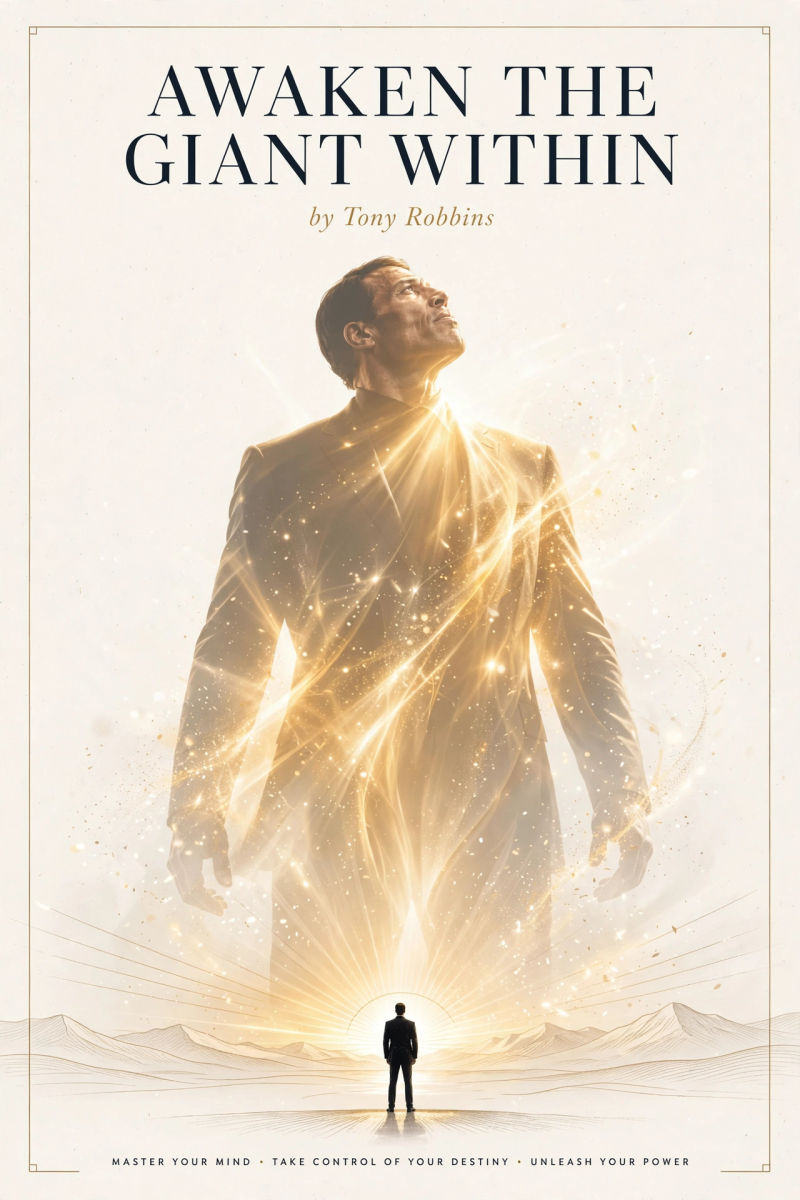
Picture someone who has read every productivity book, set a hundred New Year's resolutions, and still finds themselves stuck in the exact same patterns a decade later. Then picture someone who, after one gut-wrenching night, simply decides they will never live a certain way again — and never does. Tony Robbins built an entire philosophy around the gap between those two people. His argument is blunt: information alone rarely changes anyone. What changes people is a real decision, followed by rewiring the emotional associations that have quietly been steering their behavior all along.
- Core concept: Lasting change happens the instant you make a genuine decision, not through information or willpower alone.
- The hidden driver: Almost every human action is shaped by the pull to avoid pain and the pull toward pleasure — and those associations can be consciously rewired.
- Six human needs: certainty, variety, significance, love/connection, growth, and contribution — Robbins argues these drive behavior more than any goal on paper.
- Beliefs run the show: the stories you tell yourself about what's possible set the ceiling on what you'll ever attempt.
- Change is trainable: through deliberate practice — new questions, new associations, new standards — anyone can reshape their default patterns.
The Core Idea
Tony Robbins' Awaken the Giant Within makes a case that reframes how we think about willpower: knowledge and good intentions are not what create change. What actually shifts someone's life, Robbins argues, is the moment they stop merely "wanting" something different and cross into truly deciding it — cutting off any other possibility. From that single moment, he builds a broader system for taking deliberate control of the mental, emotional, physical, and financial patterns that otherwise run on autopilot.
What makes this easy to miss, Robbins argues, is that most people mistake a preference for a decision. Saying "I should really quit" or "I'd like to get in shape" costs nothing and rarely produces anything. A true decision, in his framing, closes the exits — it removes the option of going back to the old pattern, which is precisely why it works when a hundred half-hearted attempts didn't.
Drifting Mindset vs. Deciding Mindset
| Feature | Drifting Mindset | Deciding Mindset |
|---|---|---|
| Relationship to change | Waits for motivation or the "right moment" to arrive. | Manufactures a decision now and lets action generate motivation. |
| View of pain and pleasure | Reacts to whatever feels easiest in the moment. | Consciously links pain to the old pattern and pleasure to the new one. |
| Handling of setbacks | Treats a slip as proof the goal was unrealistic. | Treats a slip as feedback and adjusts the approach, not the outcome. |
| Source of beliefs | Accepts limiting beliefs as simply "the way things are." | Questions whether a belief is actually true or just familiar. |
| Standards | Sets goals that would be "nice to hit." | Sets standards that are simply non-negotiable. |
The Six Human Needs
Robbins argues that every sustained behavior — good or destructive — is an attempt to meet one or more of six universal needs. Understanding which needs are driving a habit, he says, is the real key to changing it.
1. Certainty
The need to feel safe and avoid pain — to have some assurance about what's coming next. Robbins notes that too much certainty breeds boredom, which is why the need pairs with its opposite.
2. Variety
The need for the unknown, for surprise and stimulation. Without it, even a comfortable life starts to feel flat — which is why people sometimes sabotage stability just to feel something different.
3. Significance
The need to feel unique, important, or needed. Robbins points out this need can be met constructively through mastery and contribution, or destructively through conflict and drama.
4. Love and Connection
The need to feel close to and connected with others. Robbins treats this as one of the most powerful of the six — strong enough that people will often settle for a weaker substitute, like attention, if genuine connection feels out of reach.
5. Growth
The need to keep expanding capacity, skill, and understanding. Robbins argues that without growth, nothing else feels satisfying for long, no matter how well the other needs are met.
6. Contribution
The need to give beyond oneself. Robbins calls this the need that brings the deepest fulfillment, distinguishing it from the first five, which are more about the self.
Robbins' Ideas in Action: Real-World Domains
1. Decision-Making and Personal Change
Robbins argues most failed New Year's resolutions fail for the same reason: they were never real decisions, just wishes dressed up as goals. He pushes readers to identify the precise moment they're willing to make something non-negotiable, arguing that a single firm decision, backed by an emotional reason strong enough to matter, does more than years of half-hearted effort.
2. Business and Leadership
Robbins argues that the people who lead effectively are the ones who've learned to manage their own state under pressure and consciously shape the state of the people around them. He frames leadership less as a title and more as the ability to consistently model the standards you want others to rise to, rather than simply asking for compliance.
3. Relationships
In relationships, Robbins argues that most conflict traces back to unmet core needs rather than the surface-level argument itself — a partner chasing significance through criticism, or certainty through control. He encourages identifying which of the six needs is actually driving a recurring fight, rather than re-litigating the same surface complaint every time.
4. Financial Destiny
Robbins extends the same decision-and-belief framework to money, arguing that people's financial ceilings are often set by inherited beliefs about wealth rather than by actual opportunity. He pushes readers to examine where a limiting money belief came from before assuming it reflects reality.
The Pain-Pleasure Principle
Robbins' clearest explanation for why people repeat habits they consciously want to quit is a mechanism he places at the center of the entire book.
Why Willpower Alone Keeps Losing
Robbins describes how every behavior a person repeats is, at some level, linked in their mind to more pleasure than pain — even habits they say they hate. A person who keeps smoking, procrastinating, or overeating hasn't failed at willpower; their brain has simply associated more immediate pleasure (or pain avoidance) with the habit than with quitting it. He calls the process of deliberately rewiring these links Neuro-Associative Conditioning, and argues that lasting change requires making the old pattern feel genuinely painful and the new one feel genuinely pleasurable — not just "better in theory."
Why This Matters
- It explains why logical arguments ("smoking will kill you") rarely stop a habit that's tied to immediate emotional relief.
- It shows that willpower isn't the missing ingredient — the missing ingredient is changing what the habit actually means to you emotionally.
- It reframes discipline as something you engineer through association, not something you simply grit your way through.
The Belief-Change Pathway
- Identify the belief. Get specific about the exact story you're telling yourself about why change isn't possible.
- Question it. Ask whether the belief is actually true, or simply a conclusion drawn from limited past evidence.
- Attach real pain to staying stuck. Make the cost of the old pattern feel immediate and personal, not abstract.
- Attach real pleasure to the new pattern. Vividly connect the new behavior to a reward that actually motivates you.
Robbins insists this only works with repetition — a single insight rarely rewires a lifetime of association on its own.
Where the Book Falls Short
A useful summary tells you the limits too, not just the highlights. Three fair criticisms worth knowing:
- The style can overwhelm the substance. Critics note the book is long and repetitive, with a high-energy, seminar-style voice that can make the underlying ideas feel more diluted than they need to be.
- Light on rigorous evidence. Some readers point out that many claims rest on anecdote and personal case studies rather than controlled research, so the "science" framing can oversell how settled some of the ideas are.
- Underestimates structural barriers. Critics argue the book's heavy emphasis on personal decision and belief can understate how much real external constraints — money, health, circumstance — shape what's actually achievable, regardless of mindset.
Your 30-Day Starter Plan
- Week 1: Pick one area of your life and make one real decision about it — not a preference, a decision. Write down exactly why it matters enough to be non-negotiable.
- Week 2: Identify the pain and pleasure currently keeping you stuck in the old pattern. Write both down honestly, including the short-term "pleasure" of staying the same.
- Week 3: Find one limiting belief behind that pattern and question where it actually came from. Replace it with a belief that's just as believable but more useful.
- Week 4: Set one new standard — not a goal, a standard — and practice living up to it daily, using small wins to reinforce the new association.
Core Takeaways
Decisions change lives, not intentions
A real decision closes off alternatives; a preference just sounds good and rarely moves anything.
Pain and pleasure run the show
Habits persist because of what they're linked to emotionally — change the link, and the habit loses its grip.
Needs drive behavior more than goals
Certainty, variety, significance, connection, growth, and contribution explain far more than willpower alone.
Beliefs set the ceiling
The stories you accept as true about yourself quietly limit what you'll ever attempt.
Frequently Asked Questions
What is the main idea of Awaken the Giant Within by Tony Robbins?
That lasting personal change happens the moment you make a genuine, non-negotiable decision — and that the emotional associations behind your habits (pain and pleasure) can be deliberately rewired to support that decision.
What are the six human needs Robbins describes?
Certainty, variety, significance, love/connection, growth, and contribution. Robbins argues every sustained behavior is, at some level, an attempt to meet one or more of these needs.
What is the pain-pleasure principle?
It's Robbins' explanation for why habits persist or change: people repeat whatever is linked to more pleasure (or less pain) in their mind, regardless of what they consciously say they want, and lasting change requires shifting those associations.
What is Neuro-Associative Conditioning (NAC)?
Robbins' term for the deliberate process of rewiring the pain-pleasure associations attached to a behavior, so that an old habit starts to feel genuinely unpleasant and a new one starts to feel genuinely rewarding.
How is this different from other self-help books on motivation?
Robbins puts less weight on motivation as a starting point and more on decision and association — he argues motivation is often a result of taking action after a real decision, not a prerequisite for it.
Has Awaken the Giant Within faced any criticism?
Yes. Critics note the book's length and high-energy style can dilute its message, that many claims lean on anecdote rather than rigorous research, and that its focus on mindset can understate real external constraints on people's lives.
Conclusion
Strip away the seminar energy, and Awaken the Giant Within makes one grounded claim: you have far more influence over your own patterns than you've been led to believe, but that influence only shows up once you stop drifting and actually decide. By getting honest about what's really driving a habit, questioning the beliefs that keep it in place, and deliberately reshaping what that habit means to you emotionally, you can change patterns that felt permanent for years. You don't need a seminar to start. Just pick one thing today you're willing to genuinely decide — not prefer, decide — and let that be the first domino.